Product Compatibility & Accessories
Gas spring compatibility: match specified force and travel
Keep force, travel and both end fittings with the specified gas-spring replacement for the vehicle.
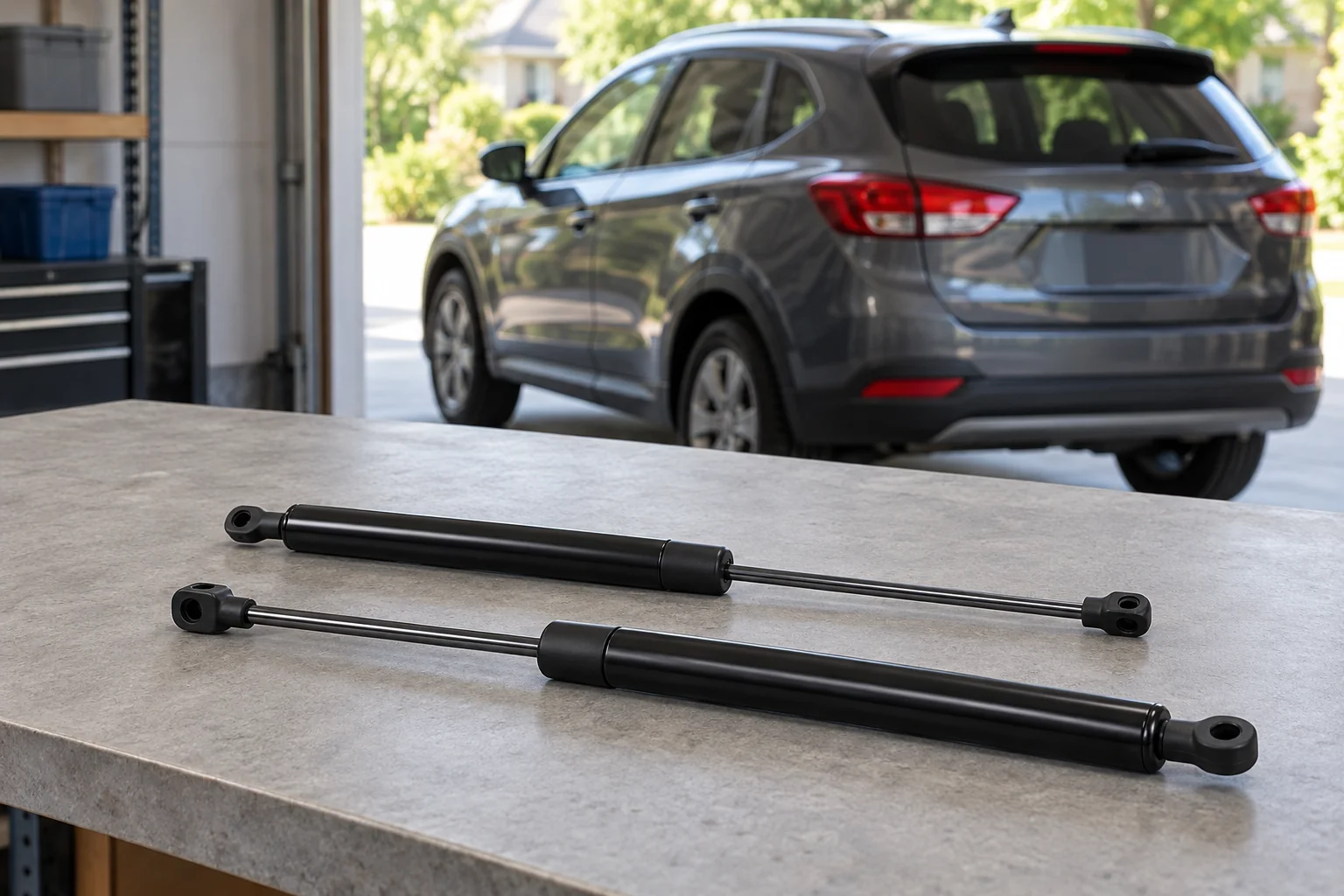
Gas spring compatibility requires the specification for the exact application. A replacement needs the appropriate force and travel as well as suitable connections. Stabilus describes the technical design as a match to application drawings and requirements. Use that approach when a listing gives a vehicle name and a length but leaves other properties unanswered. Obtain a documented replacement reference for the actual vehicle before treating the offer as a complete match.
Keep the Lexus offer’s two length states separate
The Unbranded Lexus trunk-lid support pair is listed for 2008–2014 Lexus IS F and 2006–2013 IS250 and IS350 sedans. Its actual catalog brand is Unbranded. The description gives an extended length of 21.85 inches and a compressed length of 12.99 inches. Keep the named state with each number when asking about the offered supports. A shortened note saying only twenty-two-inch struts would discard part of the actual description.
The offer also uses Tuff Support packaging wording and mentions a limited warranty. That wording does not independently establish the maker of the actual Unbranded item or supply a verified force value. The description gives no end-fitting dimensions or complete force characteristic. Retain those missing details in the purchase enquiry, along with the exact sedan application. Neither the package quantity of two nor the presence of both length states completes the mechanical specification for a particular car.
Read the Honda offer as a different application
The Unbranded Honda HR-V rear-hatch support pair is described for 2016, 2017 and 2018 vehicles. It lists two gas shocks and an extended length of 22.5 inches. The description uses Euplokeer brand wording, while the actual catalog brand remains Unbranded. Keep that distinction when asking who supplies the supports and which technical information belongs to them. A promotional name inside the description is insufficient to authenticate the offered parts.
Several interchange references appear in the offer, including 74820-T7J-H01 and 74870T7JH012M1. Ask which exact replacement specification applies to the actual vehicle and pair. The description supplies neither a compressed length nor an extension-force value or end-fitting dimensions. Its direction to use an Amazon fit tool is not a fit check supplied by this Republeq page. The easy-installation wording also provides no applicable service procedure here. Keep the unresolved specification separate from the seller’s assurances about replacement.
Read gas spring stroke with the length convention
Camloc’s terminology distinguishes the travel of the rod from the spring’s total length in an extended or closed state. Its definition measures those total lengths between the centres of specified end fittings. Where no end fittings are specified, it describes a different measurement reference that excludes the threads. The convention therefore belongs with a length value. A number without its endpoints can be incomplete even before the force requirement is considered.
For a gas spring stroke enquiry, ask for the specified travel and the drawing that identifies the two length states and their reference points. Keep supplied fittings in that account. A bare unit’s stated length and a finished support’s end-to-end description should not be silently treated as the same measurement. This is a request for applicable product information, without an instruction to remove a support, compress it by hand or raise a panel to obtain measurements. Resolve an unclear convention through the component information. Ask which drawing and measurement convention the supplier is using, and keep that answer with the exact replacement reference being discussed.
Understand what a gas spring force value describes
SUSPA explains that a gas spring’s force changes as the rod moves into the cylinder. The gas occupies less available volume and its pressure changes. That is why a gas spring force value needs its defined condition. A nominal extension figure cannot automatically describe every position across the travel. Use the specified force designation for the identified replacement, with the manufacturer’s definition attached, rather than treating an isolated number as a constant lifting capacity.
SUSPA’s FAQ also explains that friction affects the difference between compression and extension, and that temperature affects behaviour. Its nominal force measurement has specified test conditions. Those details matter when interpreting technical data, but they supply no force rating for either Unbranded offer. Ask for the applicable replacement specification instead of calculating an alternative or selecting a higher figure. The same FAQ treats choosing a spring for an application as an engineering task involving the whole arrangement, rather than a choice made from a load figure alone.
A force curve and damping describe different behaviour
Stabilus’s industrial brochure illustrates force over the spring’s travel and distinguishes extension and compression. It separately discusses damping, which concerns how movement is controlled. Reading the force and damping information together helps identify what a product specification actually describes. A description of smooth opening does not give the missing force curve, and a nominal force value does not fully describe the speed of movement in a particular application. These are separate technical questions for the identified support.
The brochure also identifies application information its engineers use, including the available space, connections and required movement. That account explains why a lid’s mass alone is insufficient for a replacement decision. Keep the actual application drawing and approved component reference together when seeking clarification. The diagrams are explanations of Stabilus systems, without establishing the dimensions, damping or force progression of either selected retail pair. This guide supplies no lever calculation, mounting-point change or method for deriving a substitute force from a panel’s weight.
Keep both end fittings in the specification
Camloc describes end fittings as the interface between a gas strut and its application. Its examples include ball joints, eyes and clevis forks, and it notes that the two ends can differ. An enquiry about a replacement therefore needs to identify both connections. Confirming one end leaves the other end to be confirmed. A general statement that a support has ball ends would still need the applicable dimensions and arrangement for the actual product.
The fitting selection also has a role in alignment and side loading, according to Camloc. Keep the connection requirement attached to the complete support specification, instead of treating the ends as decorative details around a tube of the right length. Camloc’s listed materials and sizes concern its own fittings. They establish no supplied adapter, interchangeable joint or approved modification for these Unbranded offers. Obtain the offered component’s actual fitting information when that part of its description is missing. A photograph alone cannot provide every required interface dimension.
Preserve the required function when choosing a replacement
Bansbach distinguishes ordinary compression gas springs, traction versions and lockable versions. Those names describe different functions, even though the products can share a rod-and-cylinder appearance. Identify the specified mechanism before comparing a candidate’s force or dimensions. A listing in a broad lift-support category does not establish that every item in that category performs the same movement or holds in the same way. The replacement enquiry should retain the function required by the actual application.
Bansbach also explains that a gas spring is a closed unit under pressure and cannot be opened for repair. Its guidance connects damage or contamination of the rod surface with the sealing system. Treat a damaged or altered component as a condition requiring the applicable professional advice, rather than a candidate for improvising a repair. These observations do not establish either retail pair’s internal design, service life or operating range. Retain the actual component information and its condition alongside the application requirement when the replacement is being identified. A replacement specification and a repair instruction are different documents; an incomplete specification supplies neither.
Use the manufacturer’s complete force designation
ACE’s GS-8 product account gives an extension-force range and a different compressed-force description. It also presents stroke as a separate field and asks for type, attachments and extension force when configuring its product. The useful reading habit is to retain those field names. A number copied without its force condition can lose the meaning that the technical page gave it.
Those ACE figures belong to its identified industrial product. They provide no rating or selection approval for the two vehicle offers. Use their relationship as an example of why the actual maker’s complete designation matters. This guide supplies no valve adjustment, pressure-setting procedure or calculation for a substitute spring. Seek the documented vehicle replacement when a seller’s short description leaves a force field empty.
Keep the application answer separate from the service task
Stabilus advises matching the application to technical drawings and specifications and warns against damaged or improperly altered products. An enquiry can therefore finish with a precise result: an identified support with applicable documentation, or an unresolved requirement that still needs an answer. Keep any missing property visible. Do not turn an unanswered specification into an installation instruction. Removal and fitting require the actual vehicle and component’s service information; this selection guide does not provide those operations.
A complete monitor arm is a different product decision
The MOUNT-IT and SIIG monitor-arm comparison concerns complete mounts for particular display layouts. Its display-weight limits sit beside VESA, desk-clamp and movement questions. The integrated gas-spring mechanism remains inside that complete-arm decision. A display-load rating from such a product cannot supply a loose vehicle support’s specified extension force, stroke or fittings. Use the monitor guide for its screen-and-desk task. The replacement here needs its own application documentation. Keep that distinction even when both product descriptions use gas-spring language. That comparison also treats a two-screen arm’s per-display rating separately from the single heavy-display mount. Combining the two screen ratings would lose their stated role. Likewise, the useful information for the vehicle replacement must retain its own role and conditions. The finished monitor assembly’s reach and movement ranges concern placing a display, rather than specifying the travel of a separately offered pressure support. Keep those measurements within the complete product they describe.
Plan the vehicle task around what has actually been checked
The winter car preparation guide separates vehicle-system checks from clearing equipment and trip conditions. Apply that practical separation when planning maintenance: buying an identified part is one task, while arranging the applicable service is another. Retain any unresolved vehicle issue with its exact reference. A purchase receipt does not report the condition of a hatch or trunk, and completed maintenance does not establish road conditions. If another person will use the vehicle, pass on what was actually completed and what still needs attention. The winter guide makes the same distinction between an observed check and a reassuring assumption. It identifies lights and wipers as vehicle systems to check, while snow removal remains a separate job. An issue found during that preparation needs its own applicable service answer. Keep the actual car in the maintenance record so a completed job on another vehicle is not mistaken for this one. Current weather and road information still belong to the decision about making the trip after the vehicle task is finished.