Garden Care & Watering
gas leaf blower leaves a scattered edge: narrow the pass
A broad, changing sweep can move some leaves forward while pushing others back onto cleared ground. Narrow the working strip and keep one destination in view.
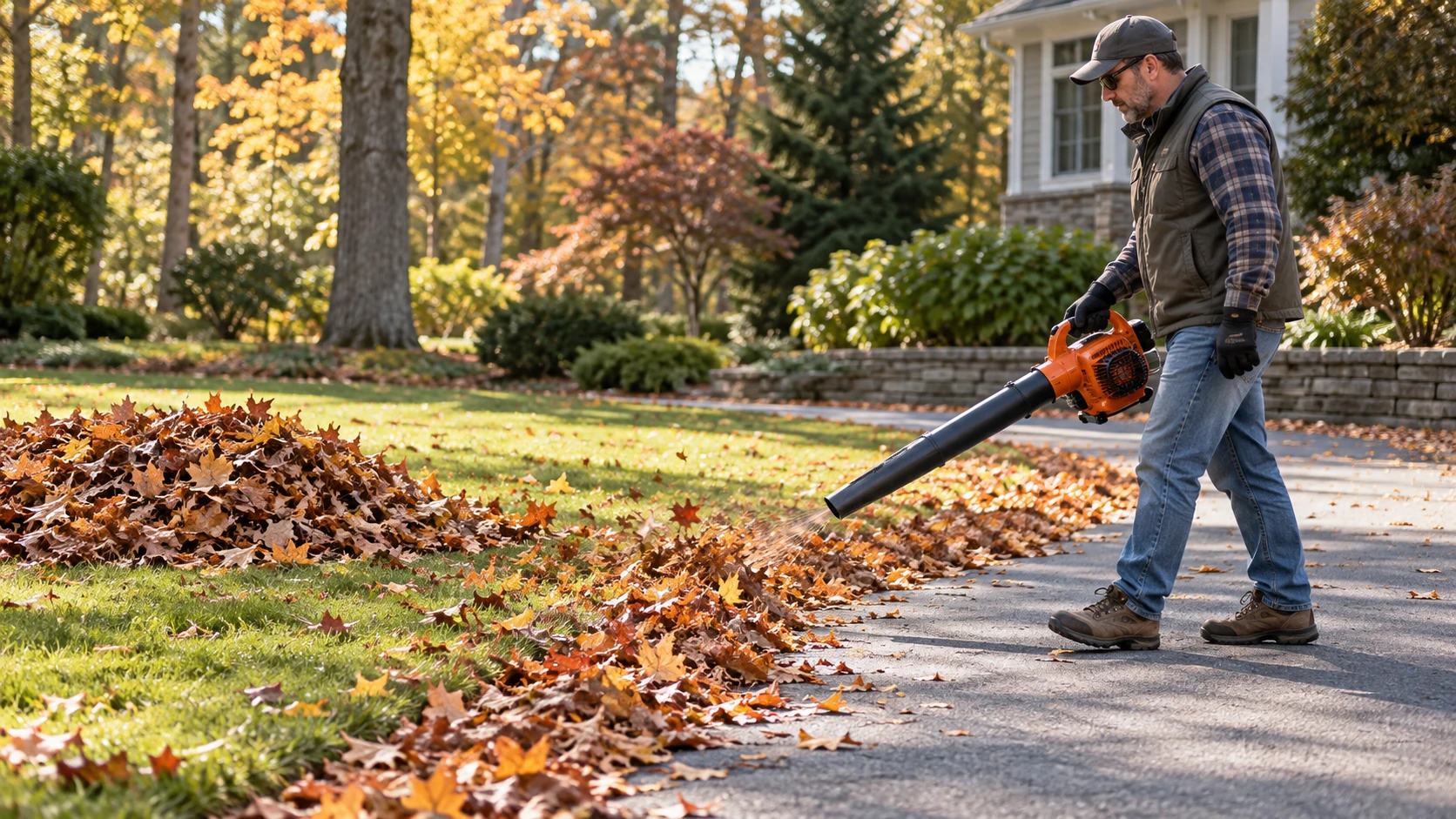
A leaf blower can move the center of a pile while leaving a loose border behind. The result looks like weak airflow, but the problem may be the shape of the pass. When a gas leaf blower leaves a scattered edge, begin with the route you are asking the leaves to follow. Pick one pile location, narrow the working strip, and keep the tube pointed along that route instead of sweeping across the whole yard.
This guide is about controlling the clearing line. It does not diagnose an engine or replace the instructions supplied with a machine. Stop if the blower runs abnormally, leaks, becomes damaged, or needs service. Read the manual for starting, fueling, cooling, maintenance, protective equipment, bystander distance, and permitted surfaces before use.
Choose the destination before starting
Decide where the leaves should end up. A tarp, collection area, or edge that can be reached without crossing people, vehicles, loose objects, or delicate planting gives the job a clear direction. Walk the route first. Remove objects that could be thrown and note places where the ground, wind, or a corner will make the path harder to hold.
Divide a wide lawn or path into narrow strips. Work one strip toward the destination, then begin the next strip beside it. This makes the boundary visible. If leaves cross back onto cleared ground, shorten the pass or change your position before increasing output. A larger sweep can feel productive while quietly widening the scattered edge.
Keep the nozzle far enough from the pile that the air stream moves the loose surface rather than digging into it. Distance depends on the machine, material, surface, and selected control setting, so follow the product instructions and adjust cautiously. Wet, matted, or embedded debris may need a different tool or a separate collection step.
Trace the edge after each pass. A clean boundary means the direction is working. A ragged boundary shows where the tube angle or walking path changed. Correct that small section before continuing across the yard. This is faster than reaching the end and chasing scattered leaves back through the entire area.
A narrow pass makes the boundary easier to control as leaves move toward the chosen pile.
Keep the tube aimed along the clearing line
Point the tube in the direction the leaves should travel. Repeated side-to-side swings can send the lightest pieces outside the route. Use a smaller arc when shaping the edge, and move your feet so the tube remains aligned with the next part of the strip. Pause when the pile begins to curl around your position.
The 25.4 cc handheld gas blower listing identifies a new handheld leaf blower. Its gallery shows an orange blower, long tube, fuel container, funnel, tools, and manual. Those images support the physical layout used in this guide. They do not establish how the blower should be fueled, started, serviced, or used on a particular property. Use the included instructions for those decisions.
The second handheld gas leaf blower listing describes adjustable output through pressure on the throttle trigger. Its gallery shows the handle controls, fuel opening, starter, intake housing, and assembled tube. That layout makes the control question concrete: the operator can choose a steady working level appropriate to the instructions and task instead of changing direction and control input at the same time.
Do not treat listing numbers as proof of performance in your yard. The two pages use seller-supplied descriptions, and one offers little descriptive text beyond the title and gallery. Surface conditions, leaf moisture, assembly, maintenance, and operator technique can change the result. Compare current package contents and manuals if either offer is under consideration.
Separate a clearing problem from a starting problem
A scattered edge is different from a blower that gives no response. If the tool will not start, stop treating the job as a tube-direction exercise. The published cordless leaf blower troubleshooting guide covers power inventory for a cordless tool. It does not provide gas-engine instructions, but it illustrates the useful boundary: confirm what kind of problem you have before changing the clearing technique.
For a gas machine, follow its manual and qualified service guidance when starting, fuel, ignition, damage, or abnormal operation is involved. Do not transfer battery troubleshooting steps to a gasoline blower. This article stays with the visible working pattern after a properly operating machine is ready for use.
If the blower operates normally but the edge remains loose, return to the route. Work a shorter strip. Keep the tube angle steady. Let one pass finish before starting the next. A small pile may need to be moved in stages rather than pushed the full distance in one attempt.
Match the pass to the surface
Leaves move differently on lawn, pavement, gravel, and planted areas. A direction that works on a smooth path may scatter material on uneven ground. Reduce the width of the pass near loose gravel, mulch, windows, vehicles, drains, people, pets, or anything that could be damaged or contaminated. Follow local rules and the machine instructions for permissible use.
Wind can also erase a neat boundary. Work with the actual direction of the breeze when practical, or postpone the job if the pile will not stay controlled. Do not compensate by aiming toward an unsafe area. The destination remains the constraint: if there is no safe route to it, choose a different collection plan.
End each strip where the next tool or collection step can take over. The blower does not have to finish every part of the cleanup. A rake, tarp, bag, or other appropriate method may handle the final edge more predictably. The garden rake storage guide addresses end-of-season care for leaf and soil tools. It owns that storage decision; this guide only uses the rake as a boundary tool when the blower pass is finished.
Make the collection point reachable
A pile location is useful only if you can finish the job there. Before starting another strip, picture the last step: will you rake the leaves onto a tarp, pick them up by hand, or move them into a container? Leave room to stand and collect without walking through the area you just cleared. A spot directly against a fence may look tidy from a distance yet leave no practical approach for the final cleanup. If the route ends at a drain, doorway, vehicle, or planting bed, move the collection point before trying to improve the blower pass.
For a larger area, one distant pile can make the working line harder to read. A temporary collection point halfway through the route may be easier to manage. Move leaves to that point in a controlled strip, stop, and decide whether the next move should use the blower, a rake, or a tarp. This is a planning choice, not a claim that either listed blower can push a particular load over a particular distance. Leaf depth, moisture, wind, and ground texture all change what a single pass can accomplish.
Keep the next strip separate from leaves already gathered. If a new stream of air crosses the finished pile, its loose outer pieces may spread again. Approach from a position that directs the next strip toward the pile without blowing through it. When that approach is not available, collect the first pile before opening the next strip. A short stop to remove leaves can be less work than repeatedly rebuilding the same border.
Read the pattern left on the ground
After one short test pass, look at the whole path rather than the size of the central pile. A thin trail beyond the chosen boundary suggests the stream continued past the destination. Leaves left in a broad band may show that the working strip was wider than you could control. A patch that remains fixed while nearby leaves move may be damp, caught in grass, or trapped against an object. Each pattern calls for a different response. Redirect the route for overshoot, narrow the strip for a wide band, and use a suitable hand tool for material that does not move safely.
Do not use a higher setting simply because one patch stays behind. The product pages identify handheld gas blowers, and the second describes output adjustment through the throttle trigger, but they do not establish the right setting for your surface. First check whether the remaining material is actually in the path of the air. If it is held by grass or pressed against a wall, a different angle or a rake may be more useful than another broad pass. Follow the individual machine's manual for all control use and shut it down as instructed before clearing any obstruction or handling the tube.
At a corner, there may be no straight route from the loose leaves to the main pile. Treat the corner as its own small area. Choose a safe intermediate point that does not send debris toward glass, people, pets, vehicles, or loose mulch. Move the leaves out of the corner first; then rejoin the main line. If the corner is too close to a fragile object to control the direction, collect it with an appropriate nonpowered tool. The aim is to avoid repeatedly crossing a finished edge while trying to empty an awkward pocket.
Use one change to diagnose the next pass
Consider a walkway with dry leaves along one side and a lawn on the other. If the first pass clears the center but pushes a few leaves onto the grass, mark the boundary where that happens. On the next short section, keep the destination fixed and reduce only the width of the sweep. If the border stays cleaner, continue at that width. If the leaves still cross, stop and reconsider the direction or collection location. That sequence tells you more than alternating between wider sweeps, a different throttle position, and a new pile location on every attempt.
Now consider leaves beside a planted bed. The direct path to the main pile may run across mulch or delicate stems. Start by deciding whether there is any safe blower route at all. If there is, isolate a narrow strip on the open side and keep the discharge away from the bed. If not, use a rake or hand collection for that section and resume the blower on open ground. The boundary of the job can change with the surface; a continuous blower pass is not required to make the overall cleanup orderly.
Once you find a pass that leaves a clear edge, remember where it worked and where it did not. The same yard can have a smooth path, a rough lawn edge, and a sheltered corner, so carry the route forward only while the surface and wind remain similar. If a later section scatters again, return to a short test rather than assuming the machine has changed. Stop and follow the manual whenever operation itself becomes abnormal. A visible clearing problem and a mechanical problem require different decisions.
Review the route before another pass
Shut down and handle the blower as its instructions require before inspecting, adjusting, refueling, storing, or leaving it unattended. Once the area is safe, look at where the edge broke apart. A repeated gap beside a corner points to the route. A wide halo around the pile suggests the final approach is too broad. Leaves returning from behind you suggest the destination or wind direction needs reconsideration.
Use the next pass to test one change. Shorten the strip, narrow the arc, or move the pile location. Changing several things at once makes it hard to know what improved the edge. Keep the successful route for the remaining sections and stop when conditions no longer allow safe, controlled work.
The two product pages show complete handheld gas blowers with long tubes and visible controls, but they do not promise a clean boundary for every yard. The useful decision is whether the actual machine, instructions, and package suit the job you need to do. For the clearing problem itself, a defined destination and a narrow, steady pass give scattered leaves fewer directions to escape.