Laundry
Reading garment steamer hanger parts by their roles
Identify garment support and nozzle-rest roles in the exact GS45-DJ and SF-520 documents, while retaining their accessory and handling limits.
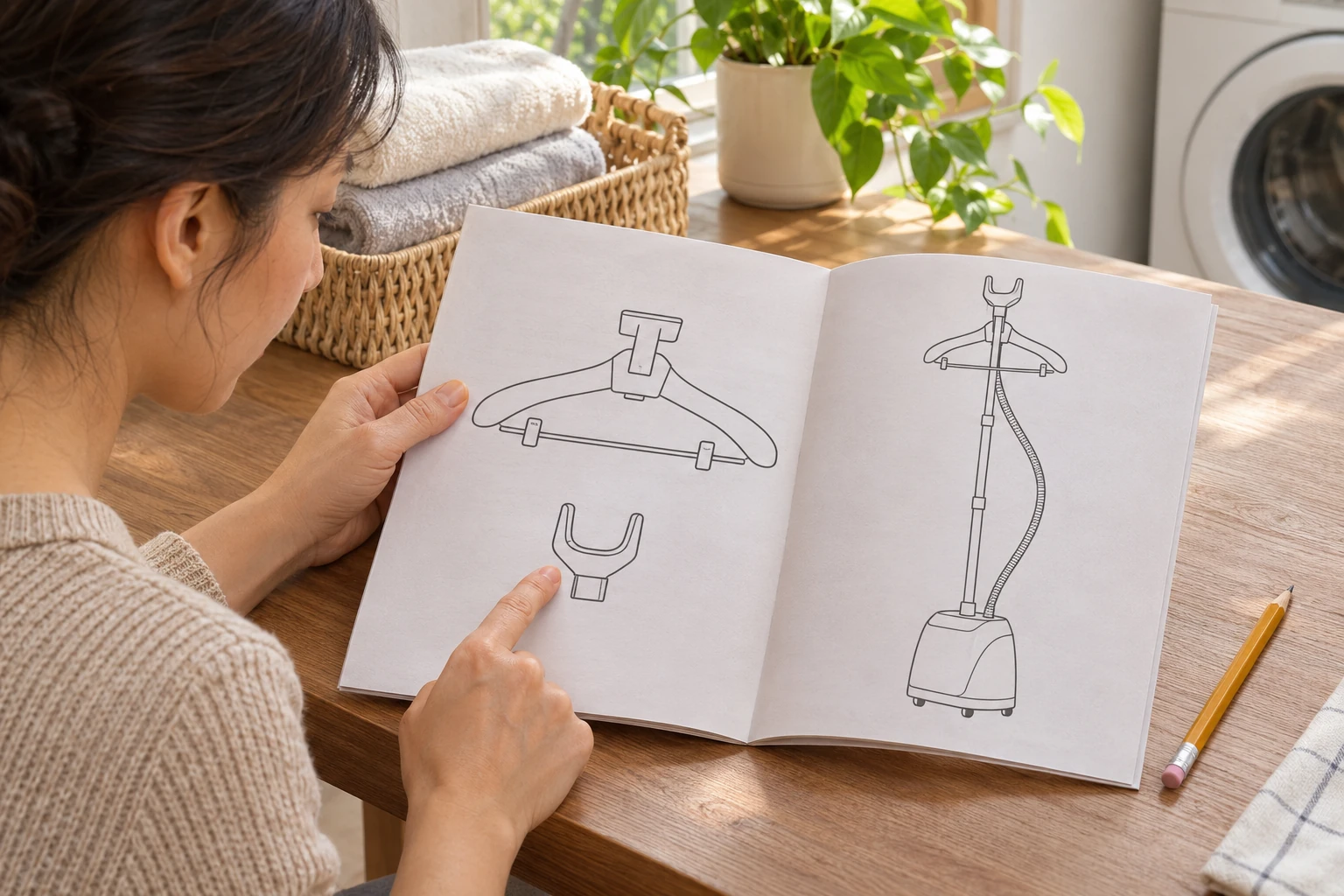
Reading garment steamer hanger parts starts with the names in the equipment document. A broad shoulder-shaped piece, a hook and a small fork can appear together near the top of an upright machine. Establish which documented part carries clothing and which receives the steam nozzle before interpreting that upper assembly. The two exact models below give different examples of how those jobs are described.
This is a reading exercise for an unused appliance and its matching paperwork. Keep the machine off while identifying the documents. Follow its own safety instructions before handling any equipment. A diagram can help you find a named component, while the applicable manual supplies its assembly and operating conditions. The discussion concerns component roles, with fault diagnosis, warm-up timing and garment treatment left to their respective instructions.
Locate garment supports in the SF-520 diagram
Steamfast's SF-520 owner's guide labels the pole top as item 2. Within that assembly, 2a identifies hanger anchor holes, 2b identifies clothes hanger hooks and 2c identifies the steam-nozzle cradle. The supplied folding hanger is separately numbered 13 and connects through the anchor holes. The hooks provide an alternative for a garment on a clean, rust-free hanger. These names distinguish the garment supports from the location for the nozzle. The manual also identifies a separate fabric brush, item 12, for lint, hairs and loose threads.
For this exact model, the manual directs the nozzle into its cradle when unused and during cooling. It warns against pulling hard on a hanging garment because the machine may tip. Its storage instructions begin with switching off, unplugging and allowing at least thirty minutes for complete cooling. Retain those conditions with the diagram.
The SF-520 document also separates the hose from the support pole. The hose carries steam to the nozzle; the pole carries its top assembly. That distinction helps you follow the diagram's connection lines without assigning the same purpose to every long part shown.
Read the native offer before borrowing a component name
The SALAV GS45-DJ offer currently identifies Silver, model GS45-DJ Silver and UPC 700115256360. Its URL retains orange wording. The description names dual telescopic bars and a multifunctional hanger, together with hanger clips, a pants press, fabric brush and mini ironing paddle. The one native variant is Silver. Its sole gallery shows one assembled upright machine with twin poles and a hanger-shaped upper support. That image supplies no complete laid-out accessory inventory or proof of the delivered contents. Preserve the written inclusions when checking the package.
The Steamfast SF-520 offer identifies UPC 047171520012 and lists a foldable hanger, fabric brush, insulated hose, telescoping pole and cord wrap. Its one variant is SF-520. The sole image shows one upright machine, with a separate hanger form below the upper nozzle position. The description limits its electrical and warranty account to U.S. use. The photograph establishes the pictured arrangement, while the exact manual identifies the numbered parts. A similar-looking upper fitting on another appliance needs its own documentation.
Find the nozzle rest in the SALAV account
The branded GS45-DJ Silver specification sheet matches UPC 700115256360. It describes a rounded hanger, dual hanger levels, a fold-down bar and side hooks, with hanging space for the steamer head and hangers. Its package list includes two hanger clips, a pants press, fabric brush and mini ironing paddle. These are positive inclusions to retain in a contents inquiry. The description of a multifunctional hanger provides several functions within the same upper assembly. It leaves the exact part and its applicable directions to be identified when you need a nozzle rest.
The sheet gives the Silver model name and the same UPC as the selected native offer. Keep that identity with the component description when comparing paperwork. A matching family name on an accessory page still leaves the particular supplied piece to be confirmed. The printed package account is useful evidence for that question, alongside the contents actually received and the instructions supplied with the appliance.
The SALAV GS45-DJ user manual shows the nozzle handle hanging from the multifunctional hanger hook in its setup drawing. Its component sheet separately shows the mini ironing board, and a later drawing uses that handheld backing behind a garment detail. The pants press and fabric brush are nozzle attachments; the two clips attach at the hanger. The safety page prohibits placing the nozzle directly on a surface or the power cord while hot or plugged in. It also requires turning off and unplugging when unused, and at least thirty minutes of cooling before draining and storage. Follow the matching document for any handling.
SALAV's safety page also says to keep the hose and nozzle elevated above the tank and to keep the hose off the ground. It prohibits extending the hose or power cord. These limits remain with the model even when a component drawing makes a proposed arrangement look convenient. Read the complete matching instructions before any practical use, including the restrictions concerning steam near people and garments being worn.
Keep the part name beside the picture you mean
Imagine Jules reviewing a borrowed machine's paperwork at a kitchen table before deciding whether to use it. She has a printed booklet and a photograph sent by its owner. Her first note says only "the top bit." When her friend asks which bit, she realizes that the note could refer to more than one shape on the page. She copies the document's own name beside the relevant illustration and sends that page reference with her question.
The imagined exchange concerns identifying what she is asking about. Jules can keep her original photograph intact and make a separate annotated copy for the conversation. That gives the owner a way to respond to the same pictured detail. If the answer refers to a different part of the page, she can compare the two references before changing her note. The original image remains available when they need to revisit the question.
Suppose the owner then sends a second document with a similar cover. Jules writes its model name at the top of a fresh sheet and puts the earlier note beside the earlier booklet. She can ask which document belongs with the borrowed unit. Until that is settled, a sentence copied from the second file stays attributed to that file. Her notes describe what each document says without treating their similar presentation as confirmation that they describe identical equipment.
A reply might answer only part of her question. For example, the owner could confirm that the photographed page came with the appliance while still needing to find a missing insert. Jules records the confirmed point and leaves space for that insert. She can pause the practical task at that point. The reading session has still produced a specific question that another person can investigate using the retained paperwork.
Carry the document reference into a handoff
For a household sharing equipment, a note can identify the document used and the page where the unresolved detail appears. Add the date you received a clarification and who supplied it. Someone returning to the task later can then see why the note was written. Keep private correspondence separate from the booklet itself, especially when the equipment belongs to somebody outside the household. Ask the owner before passing their contact details to another person.
In the same fictional household, Lee joins after Jules has put the papers away. He sees the short description on her note and opens the referenced page. If his question concerns a different illustration, he starts another note instead of editing her words to suit his question. They can show both pages to the owner together. Each person can then recognize the question they actually asked when a reply arrives.
A clear handoff can also preserve an unanswered request. Jules might write that she has asked for a clearer copy of one illustration and is waiting for it. Lee can avoid sending the same request again by reading that entry. If he receives a better copy through another route, he can keep its origin with it and tell Jules what arrived. That is a choice about organizing their conversation, without reporting an equipment test or a successful assembly.
When the owner sends the requested copy, Jules can place it beside the earlier one and record which file she will use for her question. She keeps the earlier correspondence because it explains why she asked. A later reader can follow that history without having to reconstruct the conversation from an isolated photograph.
Use the relevant guide for a separate clothing question
The published garment-steamer spitting-water guide owns model-specific hose and water questions for Jiffy J-2000 and SALAV X3. It retains damage and service limits and distinguishes the manufacturers' instructions. Consult that context for the symptom it addresses. Its hose and water guidance supplies no substitute part map for the GS45-DJ or SF-520.
The published clothes-slipping-off-hangers guide concerns ordinary wardrobe support and storage. It discusses garment loops, notches, fastening and the choice to fold some items. That is a separate decision from identifying a steamer's supplied components. A familiar wardrobe arrangement provides no independent confirmation of an appliance attachment or its approved use.
Retain an optional order with its own details
If identifying a component leads you to consider an order at republeq.com, retain the exact item and any selected variant with the question you have resolved. An order may concern a complete appliance or a separately offered accessory, so read the goods description supplied for that basket. If you are considering crypto, check the methods presented for that particular transaction. If USDT is offered, read its asset and network instructions before deciding whether to use it. Keep the merchant's order reference beside the payment reference supplied for the transaction you authorize. Review the displayed amount and any delivery charge, and retain the terms that apply to the actual goods and payment route. If an essential product detail remains open, obtain clarification through the seller's published support process before committing to the order. Should the basket change while you are asking, check the revised description and preserve the version you finally accept. If a payment result is uncertain, reconcile that result using the existing references before considering another payment for the same order. For a later delivery inquiry, keep the confirmation and any dispatch information together. Read the applicable return or cancellation conditions when those become relevant, including any directions specific to the payment method used. Keep wallet recovery phrases and private keys outside shared product notes and correspondence. A person helping identify an accessory needs the product reference and the relevant question. Decide whether the available order and payment instructions are clear enough to proceed, and retain any written clarification with that purchase record. Completing a transaction records a purchase, while the equipment's matching instructions continue to govern its handling.