Cameras & Video Gear
Fujifilm X half vs Canon G7 X Mark III: choose trip output
Check X half vertical still and paired-image claims against Canon G7 X Mark III video, audio and travel-kit details before confirming your trip output.
Decide what you want to bring home from a trip before comparing Fujifilm X half vs Canon G7 X Mark III. Fujifilm's selected X half offer describes a vertical still-image sensor and Film Camera and 2-in-1 modes. Canon's selected G7 X Mark III kit describes still photographs, 4K UHD video, a flip-up screen and an external microphone input. Check which documented recording output meets the project you have in mind. Write down whether the trip depends on individual photographs, paired-image work or video with a specific resolution and frame rate, then investigate that output on the exact camera.
The silver Fujifilm X half Bundle 1 offer is $1050. Its retail identity includes model 16954095, SKU sku-18734961271 and UPC 663992083965. The black Canon PowerShot G7 X Mark III travel kit is $2124.99, a current listed difference of $1074.99. Keep those selected offers with your questions. A similarly named Canon bundle can supply different accessories, and the words Bundle 1 do not identify every Fujifilm component. Neither price is a complete delivered quote or evidence that the cameras provide interchangeable recording arrangements.
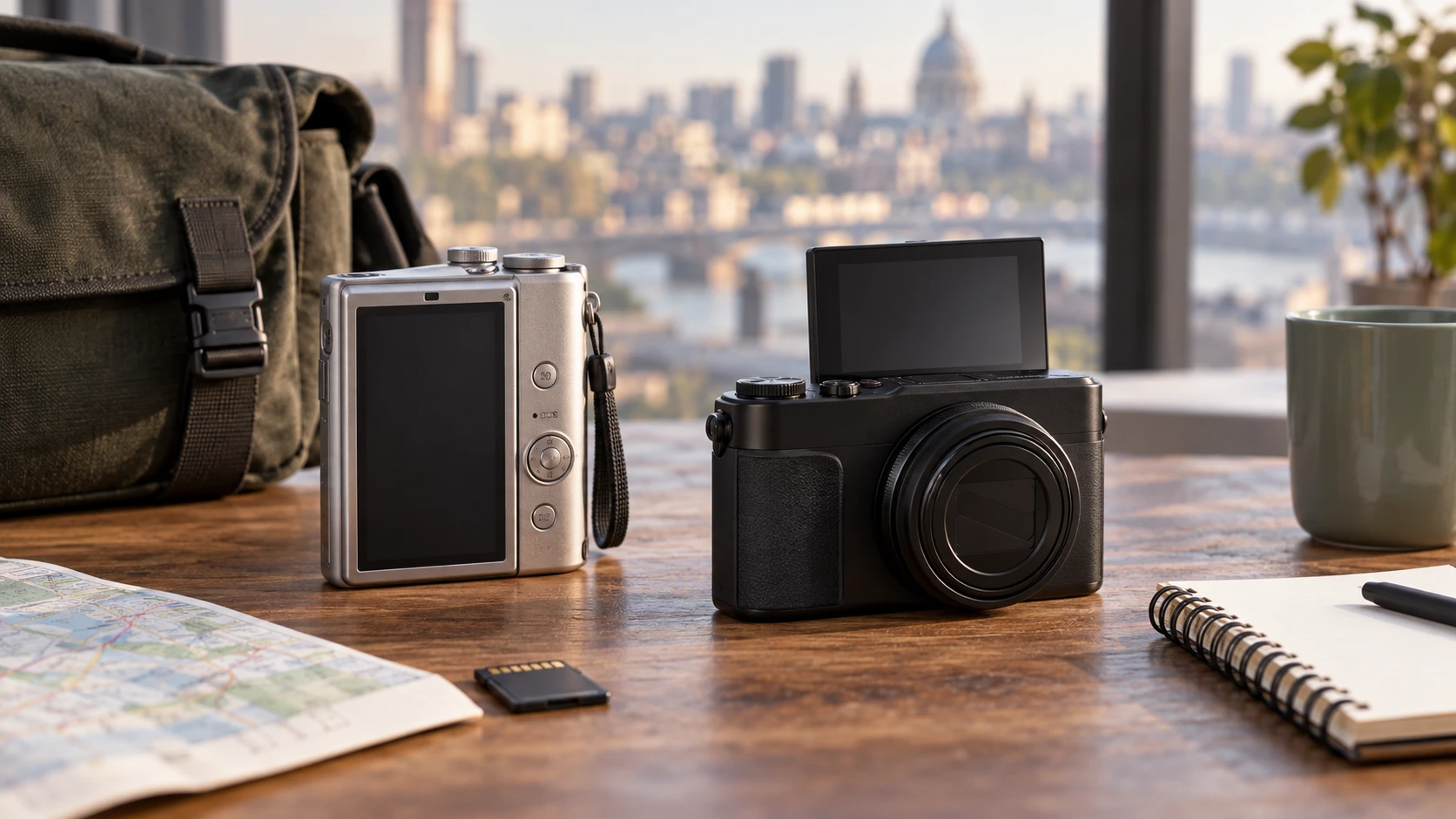
The conceptual editorial cover shows two generic compact cameras, a bag and an unlabeled memory card on a desk. It is not a photograph of either retail model, a supplied bundle inventory, a demonstrated recording mode or evidence of measured image quality.
Compact camera still and video requirements start with the output
For compact camera still and video requirements, identify the final material you actually need. A collection of separate travel photographs has a different purpose from a recorded interview or a video requested at a particular frame rate. An interest in paired pictures also needs clarification: ask what the camera's named mode creates and how you will view or share that output. Neither a mode name nor a still-image megapixel figure answers every part of that question. Keep the file requirement beside the selected camera's exact documentation rather than choosing from a broad travel or vlogging label.
Fujifilm's description identifies an 18MP, one-inch, vertical 3:4 CMOS sensor that captures still images. That is a stated sensor and still-capture description. It does not provide the complete menu of saved image sizes, file formats, orientation options or video recording modes. Ask for the applicable output specifications before assigning it a job with a particular delivery requirement. The vertical sensor wording can prompt questions about the composition you intend to make, but it does not by itself establish every file shape the camera can produce or how a paired-image result is stored.
Canon's description names a 20.1MP one-inch sensor and 4K UHD video without cropping. Keep the still and video claims separate. The megapixel figure does not supply a video frame rate, and the no-cropping statement is a retail claim without a common framing test against the X half. The selected text does not give a full recording-mode table, duration limits or the conditions behind its video description. If video is central to the trip, obtain the supported resolution and rate together for the exact Mark III rather than completing the missing details from another G7 X generation.
The actual guide to Sony ZV-1 II and a Canon G7 X Mark II recording brief explains that a resolution and frame rate need to belong to the same documented mode. It develops that issue with different cameras: Sony's listed 4K without its associated rate and Canon Mark II's stated 1080p60. Use that actual purchase distinction to form the question for the Mark III here. Do not borrow the Sony's modes or treat the Mark II's description as a complete recording reference for this kit.
Ask what the X half shooting modes actually deliver
The X half description names Film Camera Mode and 2-in-1 Mode as shooting options. It also lists thirteen Film Simulation Modes and twenty-six filters. These are documented labels, without a complete account of how the selected modes work or which settings apply to each. If combining pictures is the reason for choosing the camera, ask for an exact-model example and the corresponding output description. A name suggesting two images does not establish their arrangement, available editing choices, export method or compatibility with the program you intend to use afterward.
Choose one ordinary photograph you expect to make, then explain what you want the result to look like when viewed. You may prefer a vertical picture of a person or want two related views presented together. These are intended outputs to verify, not instructions for selecting a mode. The retail description does not give the operating sequence for the frame advance lever or tell you how a mode changes ordinary shooting. Obtain the correct model instructions if that handling is decisive. This guide does not supply a lever sequence, menu path or exposure procedure.
Fujifilm also names a rear vertical LCD, a sub LCD and an exposure compensation dial. The description says the displays provide composition and status views, but does not give their dimensions, resolution, articulation or behavior in particular modes. Inspect the exact layout and ask what information appears during the task you want to perform. A second display is not proof of a better view in sunlight or easier handling with one hand. The dial's presence likewise cannot predict how readily you will use it without the applicable instructions.
The selected Fujifilm wording does not provide a lens specification comparable to Canon's stated optical zoom. Leave that gap open instead of identifying a focal length from a similar product image or assuming a lens arrangement from the camera's name. If photographing distant subjects is necessary, request the actual lens and framing information for this exact offer. If the main attraction is the vertical and paired-image approach, confirm that output first. Keep the intended vertical or paired-image result with that lens inquiry, so the answer addresses the photograph you want.
Check the Canon video and travel-kit claims against the job
Canon lists 4.2x optical zoom, a flip-up screen and an external microphone input. The zoom statement is a concrete feature to investigate for different compositions, without a supplied focal-length range or common comparison of image results here. The screen may be relevant when the camera faces the person recording, but the retail text does not supply every articulation angle or a handling demonstration with a microphone attached. Ask how the exact camera and intended accessories fit the recording arrangement you want before treating the vlogging description as a ready setup.
The microphone input does not mean a microphone is included. The selected package list names the camera, NB-13L battery, CB-2LH charger, WS-DC12 wrist strap, shoulder bag and a 64GB memory card. It does not specify a microphone, its supported connection requirements or the complete conditions for external audio. Confirm those requirements against the exact camera documentation if recording speech is part of the purchase. This article supplies no plug specification, adapter recommendation or procedure for setting recording levels.
Canon promotes quick autofocus, continuous shooting and clear detail in low light. Those statements lack common measurements with the Fujifilm offer, so they cannot establish a performance winner for moving subjects or dim rooms. Ask for representative results applicable to the task that matters to you. Request examples made with the lighting and subject movement relevant to your trip. Keep any still-photo burst specification separate from video frame-rate evidence. The selected description does not quantify the burst rate or provide a shared autofocus test.
The Canon kit also names Wi-Fi, Bluetooth and the Camera Connect app for transferring photos and videos to a phone. Confirm the exact transfer operation, supported files and requirements for your phone before making that capability part of the trip plan. The description does not explain every supported control or file-handling limit. Fujifilm's selected description does not document an equivalent connection arrangement. That omission should remain a question rather than becoming a claim that the X half has no transfer options. There are no app setup or pairing instructions here.
Camera bundle contents checks keep accessories with the right offer
With camera bundle contents checks, separate the supplied recording equipment from the camera's own capability. Canon lists one named battery and charger, a wrist strap, shoulder bag and 64GB card. That inventory does not establish a spare battery, charging time, battery runtime or the card's full performance rating. Ask about the card model and its suitability for the intended recording mode. Capacity alone cannot tell you how much video the trip will produce or whether the card supports the required mode under the manufacturer's conditions.
Fujifilm's offer is named Bundle 1, but the selected description supplies no itemized accessory inventory. Ask which battery, charging equipment, memory card and carrying items are included with the exact SKU. Keep the answer written with the selected package rather than assuming that another X half bundle has identical contents. An accessory shown beside a generic camera in the conceptual cover is not part of that answer. Add the confirmed required accessories to the camera price before comparing your complete kit.
The guide comparing the Kodak FZ55 bundle and Remali CapturePro makes a real distinction between a photograph-first compact-camera purchase and an action-video kit. It also distinguishes an included card from a separately required card and separates case protection from the camera body. Those decisions directly support checking the selected Fujifilm and Canon packages. The other guide's Kodak lens, Remali video rate, card requirements, battery count and case ratings do not apply to either offer here.
Check the whole kit's physical fit if it will be carried throughout the day. The selected descriptions do not supply comparable complete weights, outside dimensions or an environmental protection rating. Request the actual camera measurements and the bag's interior dimensions if those determine the purchase. Neither a compact description nor the presence of a shoulder bag establishes weather protection or comfortable carrying with every extra component. Identify what must be carried together, including any separately confirmed audio or charging equipment, before choosing a storage space for the trip.
Read the price gap with the unresolved questions visible
The current $1074.99 difference belongs to these two offers. Fujifilm documents a vertical still-capture description and named shooting options while leaving the selected bundle inventory unresolved. Canon documents the listed travel accessories and a video description whose complete mode conditions still need confirmation. That is enough to form different inquiries, not to declare the dearer offer better value or the cheaper offer a saving for an equivalent job. Include only actual necessary accessories and the confirmed delivered total in your own comparison.
The Canon description says Canon USA Authorized. Treat that as an offer claim to verify where seller eligibility or warranty support matters, rather than a complete warranty agreement established here. Neither selected description supplies the full coverage, purchase eligibility and service process for the exact order. Ask how incorrect package contents or a damaged supplied accessory are handled. Read the applicable purchase and return terms before deciding that a trip-dependent feature can be tested after delivery. A reachable listing does not promise a departure-date arrival or a particular return outcome.
Resolve the camera question before cryptocurrency checkout
Keep the camera's unanswered recording and bundle questions separate from the choice to pay with cryptocurrency. Selecting a payment method will not identify the X half accessories or confirm a Canon video mode. Republeq.com presents crypto purchasing and shows USDT in its public payment choices, but inspect the actual checkout offered for your selected order. Match the asset and network to that request before deciding how to pay. A wallet setting used elsewhere is not evidence that the same route applies here. Save the camera SKU and purchase confirmation with the transaction information, so an accessory or shipment inquiry concerns the right package. For cryptocurrency purchases, the store's published policy excludes refunds and treats the sale as final. Its restriction includes stablecoins. USDT therefore does not create a refund option for a camera whose output proves different from your intended brief. Ask about capability gaps while you can still choose whether to purchase. Exchange eligibility follows a separate policy. Count its thirty-day request period from the date of the original purchase, rather than the day you first take the camera on a trip. For an eligible exchange, the item needs original condition and must not have been used or washed. Keep the packaging supplied with the order, along with its manuals, tags and accessories. Proof linking payment to the purchase is also required; retain the transaction reference and the order record. An exchange depends on stock availability, with the policy's other terms and exclusions still applicable. Seek the store's authorization and instructions rather than treating the exchange as automatic. Read those conditions before relying on a later change of kit or model. Bring the recording documentation, contents and payment terms together in your purchase notes. That lets the order follow the camera evidence without hiding an unresolved trip requirement.
Keep the trip output attached to the selected camera
For Fujifilm X half vs Canon G7 X Mark III, retain the intended output with the exact model and package answers. If the X half's vertical and 2-in-1 approach is central, confirm what the chosen mode produces and what the bundle supplies. If the Canon's video and audio features are central, confirm one supported recording-mode entry, its conditions and any separately required microphone. Keep unresolved file, lens, accessory or transfer requirements open. Save the applicable mode entry and confirmed package inventory before ordering for the trip.