Crypto Commerce
Frigidaire EFIC228 nugget ice maker vs Auseo 35 lb: planning nugget ice for a gathering
Compare Frigidaire EFIC228 nugget ice maker by first-batch timing, ready basket capacity, cleaning, water refills, ice shape, and saved prices.
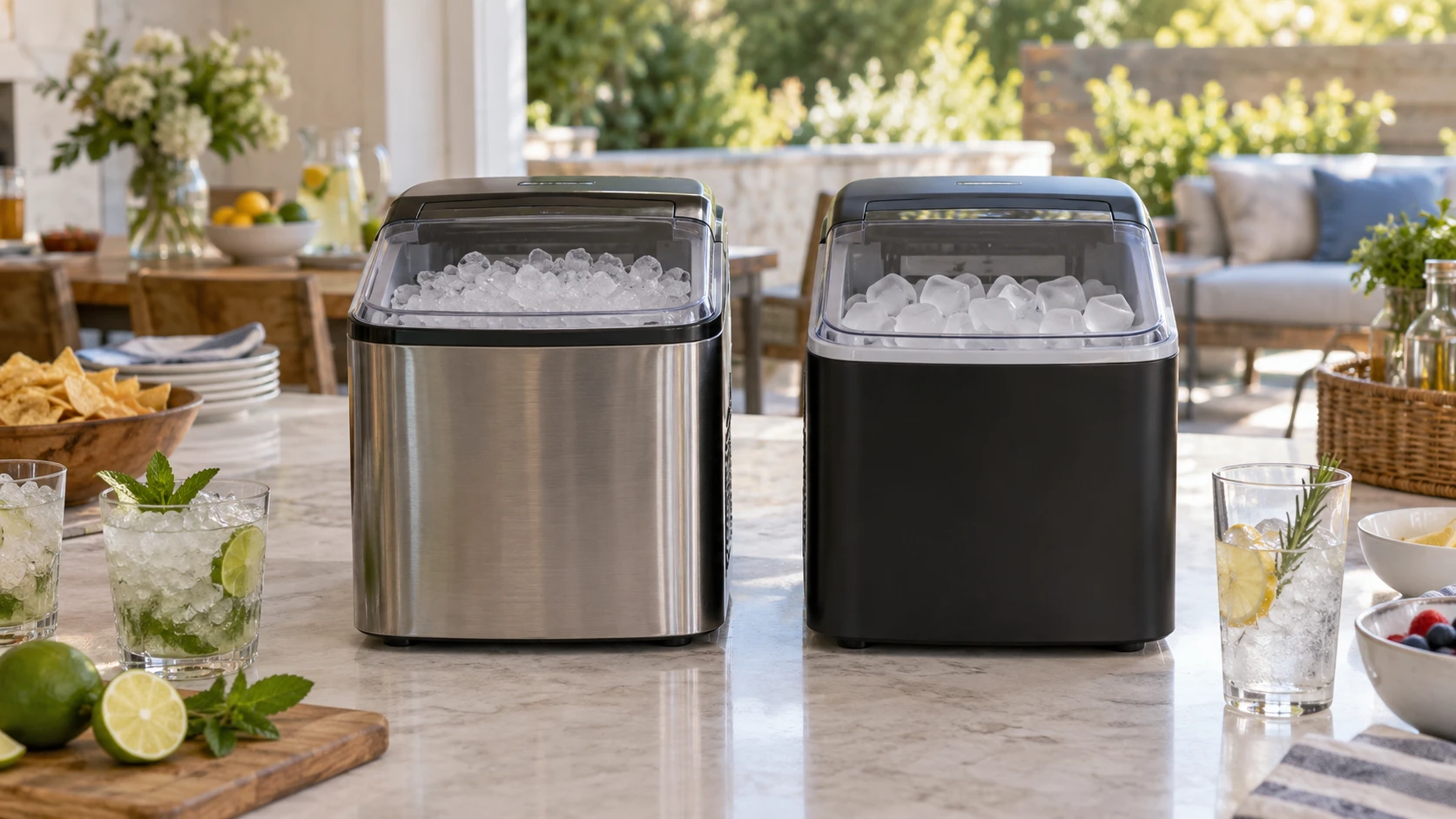
An ice maker's pounds-per-day figure can sound generous and still leave guests waiting when the first drinks are poured. The Frigidaire EFIC228 nugget ice maker lists up to 33 pounds a day, a first batch in 10 to 15 minutes, and a basket that holds up to 0.9 kilograms of ice. The related guide to ice-maker serving capacity explains why peak daily production and the amount ready at one moment need separate attention. The Auseo 35 lb countertop ice maker lists 35 pounds a day, a 10-to-25-minute cycle, and a self-cleaning control. Those saved claims are starting points for planning a party, not a shared laboratory comparison.
Count the ice needed at the first pour — guide to ice-maker serving capacity
Decide how many people will want ice within the same fifteen or thirty minutes. A machine that could produce 33 or 35 pounds across a full day might hold only a small amount when six glasses are filled at once. Frigidaire gives an ice-basket figure of up to 0.9 kilograms, about two pounds. That is storage inside the machine's basket, not a promise that the full amount will be ready ten minutes after start. The Auseo excerpt does not provide a basket capacity, even though it mentions an included ice spoon and a transparent cover. Ask for a current basket volume or a measured ready-ice amount before assuming the two machines can serve the same opening rush.
The difference between the advertised daily outputs is two pounds. It would be unwise to choose on that gap alone. Both figures are maximum claims in Republeq's catalog, with no shared ambient temperature, water temperature, cycle schedule, or test method in the saved rows. A warm kitchen and frequent lid openings may change the pace. For a gathering, work backward from the first serving time. Make ice ahead, move it to a suitable freezer if the manufacturer allows, and keep a food-safe way to scoop and serve it. The guests' short serving window matters more than a production number spread over twenty-four hours.
Frigidaire explicitly warns that its machine produces ice rather than storing it frozen. Ice left in the unit can melt and should be transferred to a freezer promptly. Do not treat the basket as an overnight ice chest. The Auseo row does not say whether its basket keeps ice frozen, so it needs the same question answered by the manual. Most planning mistakes come from imagining that the full daily production can wait in the machine until the event begins. The saved evidence supports no such assumption for either model.
Interpret the first-batch and cycle claims — Auseo 35 lb countertop ice maker
Frigidaire says the first nugget ice can appear in 10 to 15 minutes. It also includes a phrase about 150 minutes to full ice capacity. The row does not define that capacity, the starting water temperature, or the point at which its timing test begins. Use the first-batch figure as a rough scheduling clue. For guests arriving at a fixed hour, start the machine well ahead of time and check what the basket actually contains. If the machine needs cleaning or a first-use rinse, add that to the preparation window.
Auseo says each ice-making cycle takes 10 to 25 minutes. A cycle length is not necessarily the same as the wait for a first usable serving or for a full basket. The upper end is more than double the lower end, and the row does not explain which conditions produce either one. Test it with the water, room temperature, and fill level expected on the day of use. If a particular amount of ice must be ready for a meal, record the amount after thirty minutes and again after an hour rather than extrapolating a whole-day maximum.
Both machines need water. Frigidaire's entry says no water hookup is required: plug it into a 115-volt grounded outlet and fill the reservoir. That makes it a countertop unit needing regular refills. The row gives a water-tank capacity of 1.1 pounds, an unusual unit for a tank. Confirm the actual volume in a current manual or on the reservoir marking before planning how often to refill it. Auseo's saved excerpt does not state a water-tank volume or hookup requirement. Get those details from its exact model instructions. A refill in the middle of serving can be more disruptive than a small difference in daily output.
Verify what kind of ice Auseo makes — Auseo 35 lb countertop ice maker
Frigidaire describes soft, crunchy nugget ice, which it says floats in drinks. Its listing consistently calls the machine a nugget maker. Auseo's title promises a nugget or pebble ice maker, but its description also calls it a square ice maker and later refers to cubes. These terms describe different shapes to many buyers. The saved row does not resolve whether the shipped Auseo unit makes chewable nuggets, square pieces, or whether the description was assembled from another model's copy.
If ice texture drives the purchase, ask the Auseo Republeq's catalog for a current photo or video of ice made by the exact model number and for the manufacturer's specification. Do not rely on a generic countertop-ice-maker image. A household wanting pebble ice for drinks may be disappointed by larger hard cubes, even if the machine meets its output claim. Frigidaire's description is clearer about the intended texture, yet a buyer should still check the actual product and return terms. Ice feel and melt rate are best judged from a real batch under ordinary conditions.
The description of Auseo's casing is also uneven: the title calls it black while the body mentions stainless steel. Black stainless or a black finish could explain both, but the row does not specify the exact material or finish. Ask for photos of the model and note the color on the order. Appearance may matter when the machine stays on an open counter; it should not distract from the more important ice-shape uncertainty.
Measure counter space and access — Auseo 35 lb countertop ice maker
Auseo gives dimensions of 8.6 by 11.3 by 12.6 inches. The saved row does not identify which number is width, depth, or height, so confirm the orientation and required clearance. A countertop machine needs space for lid or cover movement, airflow, a stable electrical connection, water filling, and a route to carry ice to a freezer. Its transparent cover lets the user inspect the ice level without opening it, according to the listing. Check whether the cover is actually visible from the intended spot under upper cabinets.
Frigidaire's saved description does not give external dimensions or clearance requirements. Its black stainless steel finish may suit a kitchen counter, but the appliance still needs a practical place to live. Measure the available width and depth, then consult the current EFIC228 manual for its footprint and ventilation instructions. Do not push a heat-producing countertop machine tight against a wall merely because it physically fits. An outlet should be appropriate for the equipment and accessible without routing a cord across a wet preparation area.
Think about the user carrying the output. If the ice machine sits far from the freezer, frequent transfers become a chore. If it sits next to the drink station, people may open the cover often and touch the basket. Decide who will scoop the ice and where the scoop can rest cleanly. Auseo lists an included ice spoon; Frigidaire's excerpt does not specify one. Check box contents rather than assuming either machine includes every serving accessory.
Plan for cleaning, noise, and water quality — Auseo 35 lb countertop ice maker
Auseo advertises a self-cleaning function activated by holding its Ice/Clean button. That may simplify a rinse cycle, but the row does not say it replaces descaling, wiping the basket, draining old water, or sanitizing contact surfaces. Read the cleaning instructions for the shipped model and follow the recommended frequency and products. A button cannot remove every mineral deposit without some hands-on maintenance. Confirm where the drain is and whether the machine can be emptied conveniently in its chosen location.
Frigidaire's saved entry does not name a self-cleaning function. That is an evidence gap, not proof that cleaning is unusually difficult or that the function is absent from every version. Ask for the EFIC228 manual's care steps. A unit used only for gatherings may sit with water in its reservoir between events unless someone empties and dries it. Plan the end-of-party cleanup along with the start-of-party production. If water is hard where the machine will be used, check the maker's guidance on scale and acceptable water rather than improvising a harsh cleaner.
Auseo lists a 43 dB noise claim. The row does not give the distance or operating phase for that measurement. Frigidaire's saved entry has no noise figure. That prevents a fair numerical comparison, though noise may matter in a small kitchen or office. Listen to a running example if the machine will sit near conversation or a desk. A short compressor or ice-drop sound may be more noticeable than a single average number. Placement on a stable surface can also affect rattling, so test the proposed counter rather than judging from an isolated product video.
Read the price against the real job — Auseo 35 lb countertop ice maker
The saved catalog lists Frigidaire at $247.50 and Auseo at $280, a $32.50 gap in minimum USD prices. Those figures were captured in a snapshot and may differ from current checkout totals. The Auseo listing offers self-cleaning, a transparent cover, and an included spoon; Frigidaire offers a specified basket amount and a clear warning about ice storage. The 33-versus-35-pound daily-output claim is too close, and too dependent on unspecified conditions, to settle the price question alone.
For a buyer who wants recognizable nugget texture, Frigidaire has the clearer saved description. Its basket capacity and nonfreezing warning support a concrete plan to make and transfer ice in advance. Verify the tank's actual volume and the unit's dimensions before ordering. Auseo may suit a counter where its stated footprint, transparent cover, and self-cleaning control are helpful, but confirm the ice shape and reservoir details for the exact listing first. A purchase should be based on the machine that arrives, not on inconsistent wording in a listing.
Set a small trial before relying on either maker for guests. Fill it according to the manual, time the first usable ice, measure how much is ready at the event's first pour, and see how often water must be added. Then decide where the ice will go when the basket fills. That trial connects the advertised daily production to the actual serving window and exposes any cleaning or placement problem while there is still time to change the plan.