Crypto Commerce
Frigidaire 4.5 cu ft compact fridge vs Retro 3.1 cu ft compact fridges
Compare Frigidaire 4.5 cu ft compact fridge by storage layout, freezer access, door swing, and room fit.
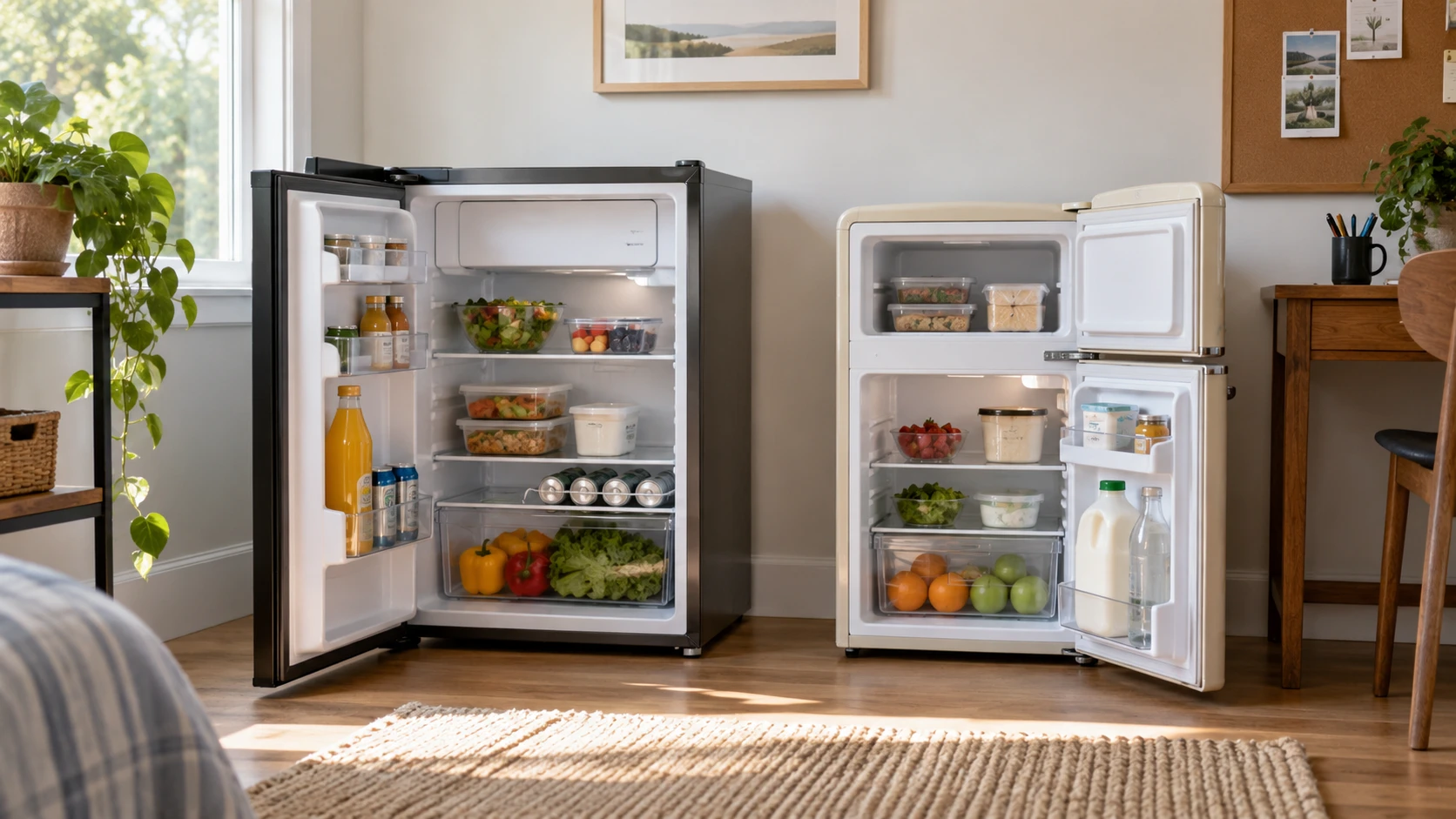
Two compact refrigerators can carry the same brand and still ask for different places in a room. The Frigidaire 4.5-cu-ft listing emphasizes a larger cabinet, glass shelves, a bottle basket, and a can dispenser. Its title calls it a fridge with a chiller. The Frigidaire Retro 3.1-cu-ft listing describes a two-door unit with a dedicated freezer compartment, two glass shelves, and a crisper bin. The saved descriptions do not give a matched set of freezer temperatures or measured usable space. Start with what you store and where each door can open.
The Frigidaire 4.5 cu ft compact fridge title gives exterior measurements of 20.59 inches wide, 21.26 inches long, and 32.91 inches high for the Slate offer. Its description mentions a flush-back design, glass shelves, a door basket intended for a two-liter bottle, and built-in can storage. It does not describe the chiller's size, temperature range, or door arrangement. Ask for the exact model label and current interior diagram before assuming the word "chiller" means the frozen-food storage you need.
The Retro product row gives 3.1 cubic feet of nominal capacity and says the unit has two doors. It names a freezer compartment, two glass shelves in the fresh-food section, a can dispenser, a two-liter door basket, and a clear crisper bin. Its text also claims a reversible door and a flush-back design, but does not explain which door or doors can be reversed. The saved row lacks exterior dimensions. Both listings supply useful starting points, yet neither is a full installation or food-storage specification.
Sketch the room before choosing a capacity — compact refrigerator door access
A 4.5-cu-ft label suggests more overall volume than 3.1 cu ft, but it does not reveal how much shelf space remains after bins and any chilling compartment take their share. Measure the place where the refrigerator will actually stand. Include the path a delivery box must travel, the outlet, and the space in front needed to pull out a shelf or a large container. The 4.5 model's listed width and depth are a useful first outline. Find a dimensioned drawing to confirm the orientation and add the maker's ventilation clearances.
The Retro model needs its own measured outline. A compact unit with two doors may be easier to use in one corner and awkward in another. If the doors swing toward a desk or bed, a person may have to stand sideways to load groceries. Ask for the current width, depth, height, handle projection, and open-door measurements. Mark each door's arc on the floor with tape. Then try walking through the room while those arcs are occupied. The listing's "compact" label is not a clearance dimension.
The published compact refrigerator door access guide provides a way to think through hinge position, obstacles, and reaching into a small cabinet. Use its method with the exact dimensions of these Frigidaire models. It does not verify that either model fits a particular room. A door might open enough to remove a drink while stopping short of the angle needed to pull out a glass shelf or crisper. Check both everyday access and the occasional cleaning job.
Flush-back construction appears in both saved descriptions, but it does not remove ventilation requirements. Leave the space the exact manual calls for at the rear, sides, and top. Keep cords clear of furniture legs and water. If the refrigerator will be placed in a cabinet-like recess, confirm that the maker permits that arrangement. A neat line against a wall is a poor trade if it blocks the unit's approved air path or makes the plug inaccessible.
Before buying, check the proposed floor or counter surface as well as the opening around it. The saved listings do not state the installed weights or leveling procedures for these two exact units. Find those in the manuals. A refrigerator that rocks on an uneven floor can make the door feel wrong even when the hinge side is suitable. If the destination is upstairs or across a narrow hallway, measure the delivery route and ask how the unit must be carried. Keep enough room to reach the plug for cleaning or service after the fridge is in place.
Separate a chiller from a freezer decision — Frigidaire Retro 3.1 cu ft mini fridge
The 4.5 model's title says "with chiller," while the saved description focuses on fresh-food and beverage storage. It does not identify the chiller's location, dimensions, temperature range, or suitability for keeping frozen meals. Check Republeq's product page for a photograph of the exact interior and the manual's temperature guidance. If your main purpose is storing ice cream or frozen ingredients, a vague title is not enough to choose this unit. Record the size of a typical frozen package and compare it with a documented compartment.
The Retro listing is more explicit about a dedicated freezer compartment and a two-door layout. That supports a clearer access plan, but the row still gives no freezer volume or verified storage temperature. Check the compartment's height and depth, how frost is managed, and whether the two sections share a temperature control. A separate door can keep the fresh-food side closed when you retrieve a frozen item. The saved listing does not measure any resulting energy saving or temperature stability, so treat the door arrangement as a convenience feature until the manual gives more detail.
Think about the foods you really keep for a week. A frozen pizza box, ice tray, and several meal containers ask for different shapes of space. Lay those items out and measure them, including lids and handles. A compartment might have enough volume on paper while a shelf lip prevents a wide package from entering. The same check applies to tall drinks and leftovers in the fresh-food section. Do not plan from the exterior size alone.
Map bottles, cans, and produce to shelves — Frigidaire Retro 3.1 cu ft mini fridge
Both descriptions mention a basket for a two-liter bottle and can storage in the door. The saved rows do not state how many bottles or cans fit, whether those door pieces adjust, or how much shelf width they consume. If canned drinks are the main load, a dispenser might be useful. If the door usually holds jars, sauces, and tall bottles, its fixed layout may be restrictive. Compare the dimensions of the containers you buy with an interior drawing rather than assuming the same features create identical storage.
The Retro model states that it has two glass shelves and a clear crisper. The 4.5 model mentions glass shelves without a count and does not mention a crisper in its saved description. Absence from a brief catalog entry is not proof that a component is missing. Confirm current box contents and shelf positions. If you store produce, consider whether a dedicated drawer helps your routine and whether there is enough clearance to remove it when the door is near a wall.
A larger nominal cabinet can still waste space for a particular household. For example, tall containers may require removing a shelf, leaving a large gap above short items. The Retro unit's crisper may organize fresh produce while taking floor area from larger meal containers. Put a week's normal groceries on a table and group them by where they would go. Include the occasional awkward item that currently forces you to rearrange everything. That exercise is more useful than guessing from an empty product photograph.
Check controls, cleaning, and the current offer — Frigidaire Retro 3.1 cu ft mini fridge
Neither saved description gives a temperature-control layout or a comparable annual energy-use figure. Ask for the exact manuals and current energy labels before comparing running costs. Check the manufacturer's temperature guidance for your intended food, then use an appliance thermometer after installation to learn what the selected setting achieves in your room. A dial position is not a measured food temperature. Ambient heat, a crowded shelf, and frequent door openings can all affect the result.
Also read the defrost and cleaning instructions. A chiller and a dedicated freezer may require different maintenance, but these rows do not establish either model's method. Find out how shelves and bins come out and where water goes during cleaning or defrosting. Glass shelves need a safe place to rest while washed. If the refrigerator will move between a dorm, office, and home, keep the installation and transport guidance with it. Check how long the manual says to wait after moving before starting the unit.
The listings do not provide a tested noise level, repair record, or complete warranty comparison. A refrigerator in a bedroom may draw attention every time its compressor runs; one in an office break room may be less noticeable. Look for the exact model's sound specification if one is available, and check the return terms in Republeq's offer before using it in a quiet room. Confirm the exterior finish and door hardware against current photos. A product page can be revised, and a color name alone will not tell you whether the surface matches nearby furniture.
The Frigidaire Retro 3.1 cu ft mini fridge is a better starting point when a documented separate freezer door and crisper match your storage routine. The 4.5 model deserves attention when the larger stated capacity and its documented bottle and can storage are the priority, provided its chiller details meet your needs. For either one, get the exact manual, mark the full door swing, and test the layout against the containers you will actually put inside.