Heating, Cooling & Air Quality
foldable fan height setup: desk and floor positions
A practical setup sequence for two adjustable rechargeable fans with different stated height ranges.
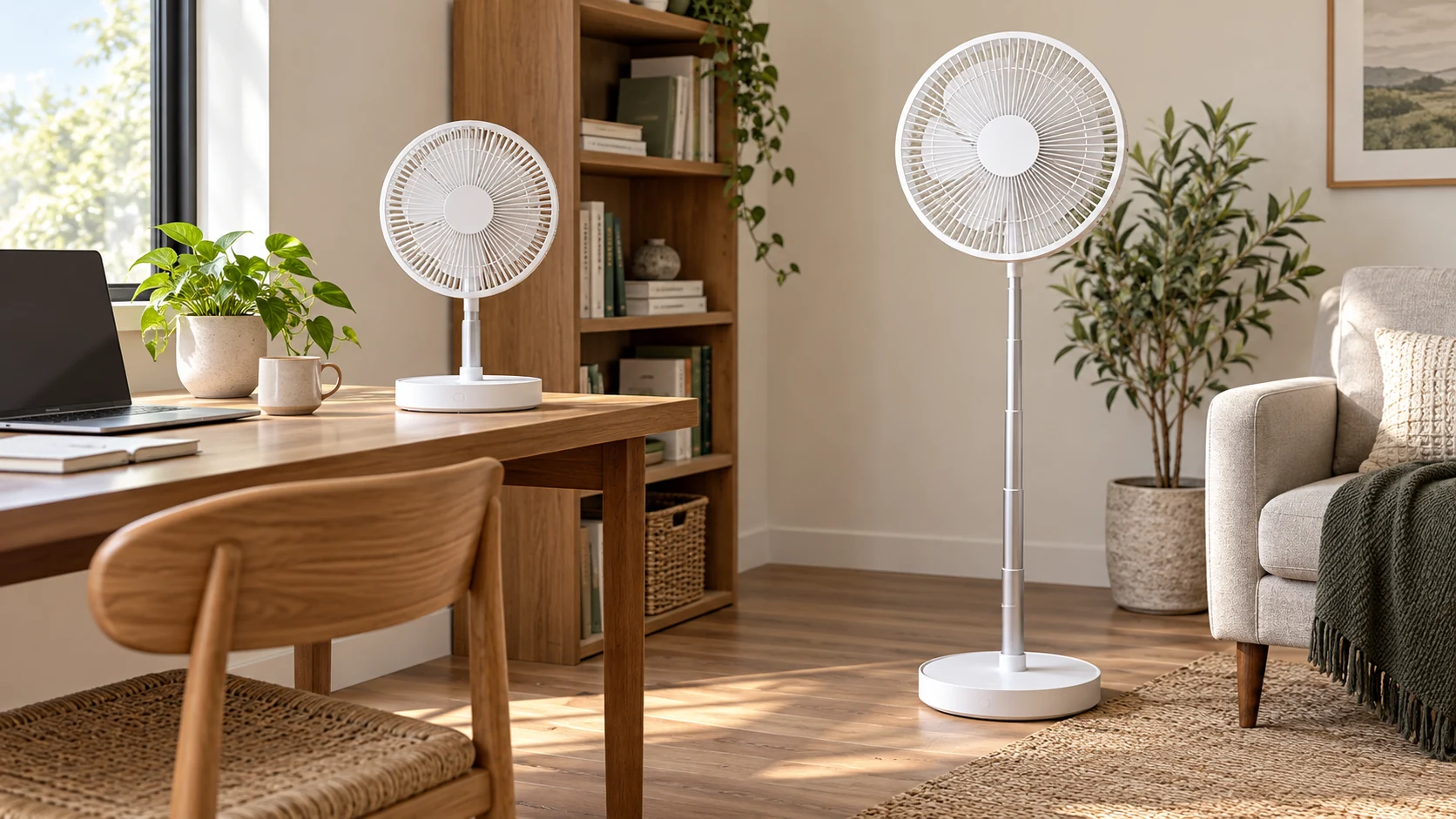
A folding rechargeable fan can move from a desk to a floor position, but extending the pole is only one part of making the setup useful. The base needs a stable place, the front grille needs a clear path, and the height and tilt need to suit the person who will use it. Foldable fan height setup begins with the room and the target seat, not the largest number in a product listing. Treat the fan as a movable tool with a changing footprint and direction each time you unfold it.
Choose the position before raising the pole
Decide whether the fan is meant to serve one person at a desk, someone seated farther away, or a shared area. Mark the chair, table edge and walking route. A short setup on a desk can point toward one place while a taller floor setup may clear the edge of furniture. Neither position is automatically better. Use a dry placement check with the fan off: set the base where it will stand, look along the intended airflow path, and move it if the grille faces a wall, loose paper, a curtain or another obstruction.
Keep the charging lead and any other nearby cable out of the path people use to move around. If the fan is running on its battery, put the cable away so it does not drag behind the base. If the maker allows operation while charging, follow its instructions for that mode and leave room for the connector rather than bending it against furniture. Do not assume that a listing’s maximum runtime describes a session at your chosen speed with oscillation or light active. This guide is about setting position and angle; battery behavior is a separate observation.
Start with the pole low and the head pointing slightly above the work surface. Sit where you intend to work before adjusting further. If the airflow falls short, move the base or change the permitted tilt first; raising the head may send air over the seat. If the stream hits papers or another object, a small position change can be more useful than a higher speed. Make one change at a time so you can tell which movement helped. Record the base location that works if you plan to fold the fan away after each use.
Read the two adjustable-fan examples literally
The CuYeHt eight-inch folding fan is listed with a 5.5-to-22.8-inch adjustable height range. Its native description names eight speed settings, automatic left-to-right oscillation, manual up-and-down tilt, a Type-C charging port and a remote that can attach to the fan for storage. The whole single gallery shows a circular fan head on an extending pole and broad round base. These are identity and setup clues, not measured room coverage or proof that the head reaches a particular point in your room once the base is placed on a table.
The CuYeHt ten-inch folding fan has a separate native listing and product identity. It states a 6.7-to-31.5-inch adjustable height range, nine speed settings, Type-C charging, side-to-side oscillation and manual tilt. Its single gallery likewise shows an extended circular fan on a pole and broad round base. The photographs are isolated product views with no common scale. Do not infer the exact height difference or a higher useful airflow at your seat from the apparent size of the two pictures. Use the stated range as a planning input, then verify the actual adjustment on the unit you receive.
The two offers have similar folding layouts, but their stated height ranges differ. That is the comparison relevant to this setup decision. An eight-inch versus ten-inch fan-head label does not tell you whether one can sit safely on your particular shelf or clear your monitor. A maximum height does not tell you whether the lowest stable position is comfortable next to a laptop. Put the height range beside your desk height, floor location and chair position. Leave any dimension the listing does not provide as an open measurement rather than filling it in from a product image.
Set the base, pole and head in that order
On a desk, put the base fully on the surface, away from a front edge where a hand or keyboard might nudge it. Check the width of the base on the actual fan; neither isolated gallery tells you the usable depth of your desk. Do not wedge the base between books to make it fit. If the available surface is too shallow, choose a floor position or another stable surface. A low fan can work well when its head has an unobstructed path; there is no need to extend the pole simply because the mechanism allows it.
On the floor, keep the base on a level spot where a person can pass without stepping around the fan. The head may need more height to clear a table edge or chair arm, but raise it only as far as the model permits and the base remains stable in the chosen location. Follow the maker’s unfolding and pole-locking instructions. If a section does not latch or remain at the selected height, stop and check the mechanism instead of using the running fan as a test. The product page does not establish how a damaged joint should be repaired.
Next set the manual tilt. Aim through the intended occupied area while the fan is off, then switch it on at a modest setting to check the actual path. Make one small tilt change at a time. A taller pole changes the direction from which air reaches a seated person; it does not automatically make the stream stronger. The useful result is a clear route from grille to seat without a curtain, plant, loose page or other object pressed against the fan. Avoid relying on a promised wind-speed or CFM number to predict that room-specific result.
Only after a stable base and useful tilt should you test oscillation. The native descriptions of both CuYeHt examples name automatic side-to-side movement, while their vertical tilt is manual. Watch one sweep in the real location. If part of the sweep points into a wall or over a doorway, reposition the base or use a fixed direction if the model’s controls allow it. Do not assume oscillation improves every setup. For one chair, a fixed aim may be enough; for a wider shared area, the moving head may be useful if the path stays clear.
Check controls without turning setup into a runtime test
Locate the power control, speed setting and any display before placing the fan somewhere awkward to reach. The two listings describe remotes, but the existence of a remote does not make the base unreachable or its physical controls unimportant. Keep the remote where it can be found after the fan is folded. Check how the selected speed and oscillation state appear on your actual model. If the controls are unclear, consult the included instructions rather than transferring a button sequence from another CuYeHt listing with a similar appearance.
After a normal use session, note where the fan stood and which settings worked. If it stops earlier than expected, the related rechargeable portable fan runtime guide owns the separate diagnostic: record speed, charge history, light and oscillation before interpreting a maximum-runtime claim. Do not turn this placement guide into a battery-fault conclusion. A fan that runs for a shorter interval at one setting may still be correctly placed; the questions of endurance and airflow path need different observations.
Another adjacent decision is the direction of air through an opening. The twin window fan airflow-mode guide compares intake, exhaust and split-direction settings on window units. A freestanding folding fan in this article is not one of those window-mounted devices. Use the adjacent guide if you are choosing a window-fan arrangement; for the portable fan, concentrate on base location, height, tilt and the sweep in the occupied space. Similar words about airflow do not make the two product types interchangeable.
Fold and move it without losing the good setup
Before changing rooms, turn the fan off and follow its own folding sequence. Lower the pole and return the head to a position the instructions permit. Carry it by a stated handle or supported part, not by a loose grille or charging cable. The eight-inch native description mentions a hidden carry handle; that does not prove the ten-inch unit has the same handle in the same location. Confirm the actual grip on the model you own. A fan that looked stable while extended on one floor should be set up again from the base when moved to another surface.
Keep a small location note if the fan moves often: “rear left desk corner, low pole, head toward chair,” or “floor beside side table, pole above armrest.” This is a record of your working position, not a universal height recommendation. If furniture changes, repeat the placement check rather than using an old height setting blindly. A charging point, cable route or walkway may be different in the new room. The folding design makes relocation possible, but every new spot needs its own stable base and clear path.
If you are deciding between the two listed height ranges before purchase, make a simple mock layout rather than guessing. Put a book or box at the proposed base position, then use a tape measure to mark the low and high head locations each listing states. Look from the chair, not only from above the desk. The exercise can reveal that a taller range is unnecessary for one room or that the shorter range may not clear a shelf in another. It does not show the real fan’s base size, its exact tilt angle or the airflow at either height. Write those unknowns beside the layout and check them against the model-specific dimensions or the delivered unit. The aim is to avoid translating one attractive product photo into a false promise about reach in your own room.
Finally, check the fan after unfolding it again. Make sure the base sits flat, the pole holds its selected height, the grille is clear and the head moves only as intended. The source listings identify adjustable, rechargeable fans with remotes and oscillation; they do not certify a particular desk, floor or room arrangement. A good foldable fan height setup is the position you can verify in the actual space. Use the stated range to shortlist a model, and let the real seat, surface and airflow path determine the final adjustment.