Crypto Commerce
five-format capsule and espresso-powder machine machine vs K-Supreme SMART: choose your coffee format
Compare five-format capsule and espresso-powder machine by pod fit, cup sizes, controls, water tank and cleanup.
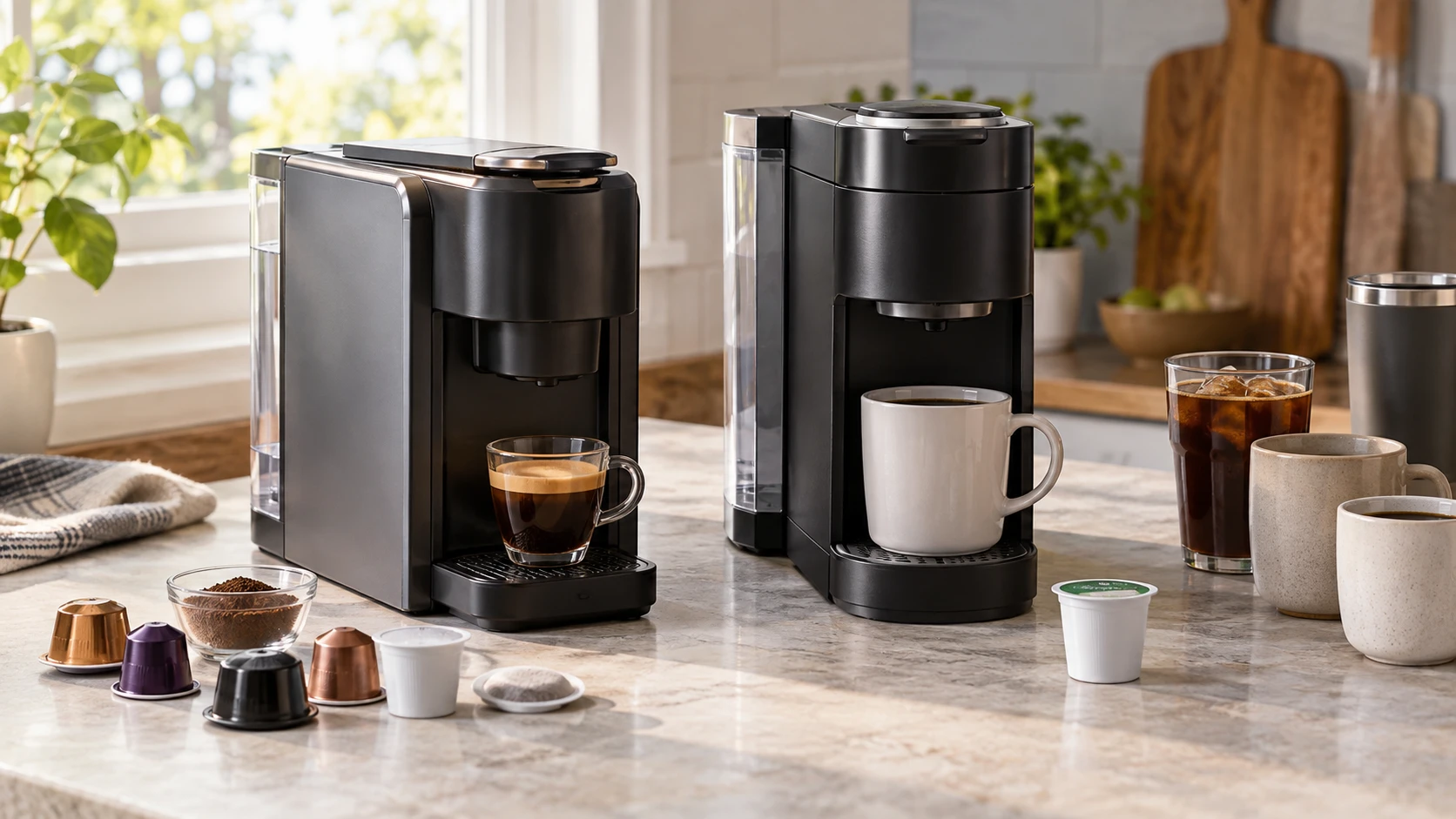
The five-format capsule and espresso-powder machine is marketed for several pod types and ground espresso in a compact body. The K-Supreme SMART listing focuses on K-Cup pods, with four cup sizes, adjustable strength and temperature, and stored preferences. Both make individual drinks, but the first question is what coffee you already buy. A machine that accepts a favorite pod reliably is more useful than a long list of formats you will never use.
These are Republeq's product descriptions, not a shared taste or extraction test. The five-format row uses abbreviated capsule names, and the K-Supreme row includes a generic note about espresso grounds and tamping that does not clearly belong to its K-Cup feature list. Confirm compatible products and the current selected model with the Republeq's catalog. Neither row establishes that every pod sold under a broad family name will fit.
Check pod fit before counting formats — choosing grounds or pods with a Ninja DualBrew XL
The five-format listing names Kcup, “Nes,” “DG,” E.S.E. pods and espresso powder. Those labels suggest flexibility, yet they are too broad to establish compatibility with every capsule size, generation or brand in each family. Ask for the exact compatible formats and any adapters needed for them. A buyer who already has a box of capsules should compare the capsule's full name and shape to the manufacturer's compatibility guide, not just its abbreviation in this row.
Using ground espresso is a distinct capability in the first listing. It may help a household that wants to choose beans or avoid being limited to capsules. The row does not tell us the required basket, dose, grind range or whether a grinder and measuring tool are included. Ask what is in the selected box and how grounds are loaded and cleaned out. A multi-format machine can save counter space if the changeover is easy, but the saved description does not show the changeover procedure.
K-Supreme SMART's row is narrower: BrewID recognizes a specific K-Cup pod and adjusts settings, while MultiStream Technology is described as saturating grounds more evenly. Its published sizes are 6, 8, 10 and 12 ounces. The row does not promise that it accepts the “Nes,” “DG” or E.S.E. formats named for the other machine. If the household already buys K-Cups and prefers larger coffee cups to small espresso shots, its focused system may be easier to evaluate. Verify the pod variants BrewID recognizes, because “specific K-Cup” does not mean every capsule can be identified.
Pod availability is part of the fit check. Look at the stores or delivery services you use and note the exact capsule names, pack sizes and prices. A five-format claim may offer several fallback choices if one preferred capsule disappears, provided the adapters really work. A K-Cup-focused brewer may be sufficient when the household is already happy with that format. The saved rows do not compare the price per drink or establish the long-term supply of any pod, so use current local offers for that calculation.
The published guide on choosing grounds or pods with a Ninja DualBrew XL concerns a different machine. It is useful for writing down whether convenience, choice of grounds or predictable cup size matters most. It does not certify either product's compatibility or brewing performance. Make a list of the drinks made during a normal week, including how many are brewed from a capsule and how many from ground coffee. That is a clearer starting point than a feature count.
Cup size and drink style differ — K-Supreme SMART coffee maker
The five-format row calls the machine an espresso maker and mentions a 19-bar pump, a stated brew temperature of about 195 degrees Fahrenheit and crema. Those are Republeq's product specifications and taste claims. Pump pressure alone does not tell us the pressure at the coffee puck or the quality of a particular shot. The row does not list programmable drink volumes, a milk frother or the capacity of a cup that fits under the spout. If espresso is the main goal, ask for the actual shot-volume choices and the dimensions of the cup space.
The K-Supreme SMART coffee maker explicitly lists four serving sizes from 6 to 12 ounces. It also has a “Brew Over Ice” setting, described as brewing hot coffee over ice. That does not mean it makes cold-brew coffee or chills the drink by itself. The row does not give a small espresso-shot size. For a household that mostly fills a mug before leaving home, its stated size range may fit better than a machine whose volume choices are unspecified in the saved row.
Think about the cup that is actually used each morning. Measure its height and usual fill line, then check whether it fits beneath the drip tray on each machine. The five-format listing calls its tray removable for cleaning but gives no cup-clearance measurement. The K-Supreme row provides brew volumes but no mug-height or tray dimensions. A 12-ounce option is less convenient if a travel mug cannot be placed where the coffee exits.
Settings and repeatability — K-Supreme SMART coffee maker
K-Supreme SMART lists five strength settings, six temperature settings and ten saved custom settings. Those could help a household where one person wants a milder 10-ounce cup and another prefers a hotter 6-ounce drink. Ask how a saved setting is named or selected, whether BrewID overrides it, and what happens when a pod is not recognized. The source gives the feature counts, not the full sequence of button presses. A quick demonstration may reveal whether personalization saves time or adds choices during a rushed morning.
The five-format description focuses on compatible inputs, pump pressure and compactness. It does not name comparable strength or temperature menus, so request the manual if a particular brew volume or temperature matters. A format adapter for several capsule types does not automatically create a repeatable recipe for each one. Check whether the machine returns to a consistent volume after switching pods or grounds.
The K-Supreme text includes a note that coarse grind, too little coffee or insufficient tamping can lower espresso pressure. That sounds generic next to the specific K-Cup description, and the saved row does not document a ground-espresso basket. Do not use that note as evidence that K-Supreme SMART accepts loose grounds. Confirm with Republeq which brewing method and accessories apply to this exact model, especially if grounds are a requirement.
Water and kitchen space — K-Supreme SMART coffee maker
The five-format machine lists a removable 600-milliliter water tank. That is a concrete number for planning refills, though the number of drinks per fill depends on the chosen volume and any water used during cleaning. It also describes a compact footprint suitable for limited counter space, but no width, depth or height is provided. Measure the intended counter location, including clearance for removing the tank and opening the pod compartment. A machine can be narrow and still need overhead room.
The K-Supreme SMART row does not give tank capacity or external dimensions. Ask for both before assuming it will require fewer refills or fit a tight cabinet. If the machine sits below upper shelves, test whether the water tank and used-pod area can be reached without pulling the unit forward. Place the nearest outlet and the usual cup location on a simple counter sketch. The brewer you can fill and clean comfortably is the one more likely to stay in use.
The five-format listing says it shuts down automatically after 15 minutes of inactivity and includes anti-dry protection. Those are useful operational claims, but they do not replace following the manual for water, cleaning and electrical safety. The K-Supreme row does not mention equivalent shutoff or dry-run protection. Ask for its manual rather than assuming an absence from this short row means the feature is missing.
Cleanup and ownership questions — K-Supreme SMART coffee maker
Switching among capsule families and ground coffee may leave different holders or baskets to wash. The five-format row says the drip tray is removable, but it does not list every piece that contacts coffee or whether any part is dishwasher-safe. Request the cleaning instructions for each input mode. If several people share the kitchen, label or store small adapters so that one format's holder is not mistaken for another. The convenience of several formats depends partly on how much handling each one adds.
K-Supreme's narrower pod routine could be simpler for a household that uses only K-Cups, although the saved row does not describe used-pod disposal, descale alerts or a cleaning cycle. Ask how frequently it needs descaling under the local water conditions. For either machine, budget for the coffee it actually uses. The cost of a brewer is only part of daily use; compatible capsules, any filters, cleaning supplies and replacement adapters can change the long-term total.
Try to verify the final listing's warranty and return policy, which neither saved row describes. The five-format machine makes a strong compatibility claim, and K-Supreme makes several customization claims. A return window provides a way to check those claims with the pods and cups already in the household. Keep the packaging until the machine has brewed the drinks that motivated the purchase.
The five-format machine is the listing to investigate if a household truly uses multiple pod systems or wants ground espresso from the same compact counter spot. Confirm exact capsule families, supplied adapters and shot-volume controls. K-Supreme SMART is the listing to investigate if K-Cup coffees in 6-to-12-ounce sizes and saved brew settings match the routine. Confirm tank size, mug clearance and BrewID behavior. Both decisions become easier after writing down the actual pods, grounds and cups used in a normal week.