Furniture & Home Organization
Set a firewood rack purchase budget before adding extras
A fictional household quote shows how a rack, delivery and an optional extra can fit a spending ceiling while leaving equipment suitability to its own assessment.
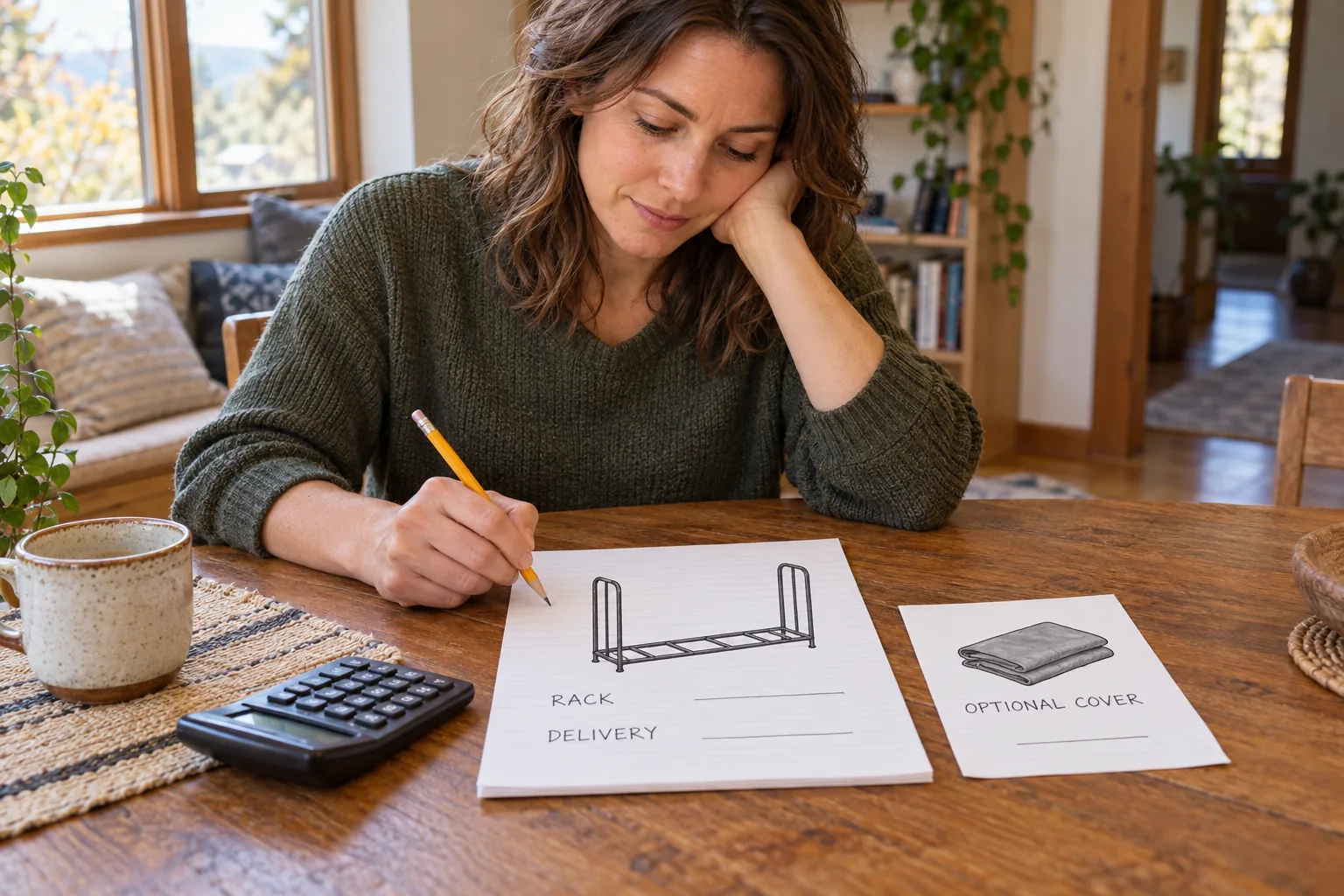
A firewood rack purchase budget can start with the amount you are willing to spend on the whole proposed purchase. Keep that ceiling beside the rack quote, any delivery charge and extras you are still considering. An attractive item price does not tell you what the complete proposal will cost. The example here uses invented amounts to make that distinction visible. It provides no current price, saving or purchase recommendation for either real rack linked below.
Give the spending ceiling an explicit meaning
Consider an invented household enquiry from Oona. She has set aside 180 units for a proposed rack purchase and wants that amount to cover everything she chooses for this purchase. The units are simply the currency of this fictional worksheet. They are not a conversion of a real listing price or a quotation from Republeq. Oona has not placed an order. Her note describes a proposal she can still change, rather than an expense that has already occurred.
Oona writes what the ceiling includes before adding numbers. In this example it includes the rack, the stated delivery charge, a separately stated transaction charge and any optional cover she decides to request. She does not use the same 180 units again for a second household project. If someone else reads the note, they can see the boundary of the decision. A different real purchase may have different charges; use the actual applicable quotation instead of importing this example’s lines.
Retain the identity behind each real rack enquiry
The selected Demifill mesh-sided rack offer identifies model WLHYWQ19632HS, SKU 17199610396. Its description names a bolted metal-tube frame, deer and tree decoration and assembly instructions. The whole gallery shows the mesh-sided storage form and staged wood. No cover or separate fireplace tool set is established as supplied. This article adopts no load, rust-resistance, drying, indoor-placement or assembly result from the offer.
The selected Champion 100541 rack offer identifies SKU 986841230 and UPC 817198021621. It describes a powder-coated steel frame and stainless-steel hardware. The whole gallery shows an open tubular rack, including loaded scenes. The listing contains differing dimension statements, which this budget example does not resolve. No cover, logs or separate fireplace tools are established as supplied, and no capacity or fit result is adopted here.
Those are two distinct equipment enquiries. The invented amounts that follow belong to neither real offer. Oona would need the applicable price and supplied-content answer for whichever item she actually considered. A quote for one rack would not settle the price of another. Nor would a completed sum answer whether either rack belongs in her intended arrangement. She leaves that equipment decision separate while using a small fictional worksheet to understand her spending choices.
Read rack quote totals before considering the extra
For these rack quote totals, suppose Oona writes an invented rack charge of 120 units, delivery of 18 units and a separately stated charge of 12 units. Their required subtotal is 150 units: 120 plus 18 plus 12. Subtracting that subtotal from her 180-unit ceiling leaves 30 units. That remainder is room within the proposed budget. It is not money refunded by a merchant, a discount on either real rack or proof that the purchase is worthwhile.
Now suppose Oona has also requested a fictional quote of 24 units for an optional cover. Adding it to the 150-unit subtotal gives 174 units, leaving six units below the ceiling. The cover remains a separate choice on her note. Nothing in the two real rack accounts establishes that this hypothetical cover exists, fits either product or is needed. Before any real addition, she would need its own identity and applicable information. The arithmetic supplies none of those answers.
Change the proposal when a charge changes
In a second invented version, delivery is quoted at 29 units rather than 18. Oona replaces the delivery entry instead of leaving both amounts in the current total. Her revised required subtotal is 161 units: 120 plus 29 plus 12. With the optional 24-unit cover, the proposal becomes 185 units. It exceeds her unchanged ceiling by five units. The old six-unit remainder no longer describes the revised proposal, even though the rack charge itself has not changed.
Oona can leave the optional cover out of this fictional proposal. The required subtotal would then remain 161 units, with 19 units below her ceiling. She has changed what she is considering buying; she has not obtained a 24-unit merchant discount or verified that a cover is unnecessary. Another possible response is to leave the whole purchase undecided. A budget note can show the present choice without forcing an order merely because some version of the numbers fits.
Keep an unanswered charge out of a finished total
Suppose the delivery reply instead says that the charge will be confirmed later. Oona can retain the known entries without treating the missing amount as zero. In this example, 120 plus 12 gives 132 units before delivery. That is a known partial amount, rather than a complete required subtotal. Writing “delivery awaiting quotation” beside it tells another reader why the full comparison with 180 units is still open. A neat total with a guessed delivery entry would conceal the actual question.
The same distinction applies if a quoted line has an unclear meaning. Oona asks which proposal the line concerns and what it includes. She does not add a second delivery amount simply because a later message uses different wording. Equally, she does not delete a separately payable amount on the assumption that the earlier quote covered it. The real seller’s applicable answer would settle a real enquiry. This invented exchange supplies no rule about any merchant’s pricing or tax treatment.
A storage plan and a spending plan answer separate questions
The household firewood routine guide discusses the separate decisions behind an outdoor reserve and a limited ready-use supply, with source-specific storage and placement context. This worksheet supplies no firewood-care, fire-safety or rack-loading method. Resolve the actual household and equipment requirements with their applicable guidance before treating a price comparison as permission to use either rack.
Oona also avoids dividing her fictional total by an unspecified number of logs. No count of her actual wood has been established. A rack’s advertised capacity would not supply that missing count, and this article does not translate capacity into a household’s future supply. She can compare a proposed cash total with her stated ceiling without inventing a cost per log, a season of use or a saving on fuel. Those would be different claims with different information to establish.
Do not let a pictured item become a budget line by assumption
The bike repair stand budget guide separates a support’s stated contents from pictured or separately needed tools. Its equipment remains specific to that guide. The useful purchasing question here is whether an item is actually included in the exact rack offer. A loaded scene does not establish that the photographed wood, gloves or surrounding objects belong in the parcel or in the rack price.
Before a real order, Oona would keep the selected rack reference with the seller’s supplied-content reply. If a separately quoted extra is then offered as part of a different package, that package needs its own complete quote. She would not retain the old extra charge automatically, nor assume the new package has the same total. The purpose of the note is to make the current proposal understandable, including the questions that remain. It does not record an unpacking or certify a delivered inventory.
Leave a deliberate reserve visible
Oona can also decide that she wants ten units of the ceiling to remain unallocated. That is a new choice in this fictional worksheet, so she writes it beside the other assumptions. Her initial 174-unit proposal leaves only six units, which falls four units short of that chosen reserve. The proposal can fit the overall ceiling while failing her separate preference to leave ten units unused. She can see both results without calling the cover affordable by one measure and forgetting the other.
For the later version without the optional cover, the 161-unit required subtotal leaves 19 units. Keeping ten of those units unallocated leaves nine units she could consider for another optional choice within this particular proposal. She has not received nine units from anyone. She has divided the remaining room in her own spending plan. If she later changes the ceiling or reserve, she can date the revised note and retain the old assumptions separately. Someone reading it should be able to reproduce the current result from the amounts still in force. An earlier version remains useful history, but its remaining amount does not become an extra source of money for the revised proposal.
Keep the Republeq crypto choice with the complete proposal
If this enquiry leads to a proposed purchase through republeq.com, retain the exact rack reference and the applicable complete quotation before choosing a payment method. A preference for cryptocurrency does not identify the supplied goods, settle delivery charges or establish that an optional cover fits. Oona’s fictional numbers remain an illustration, rather than amounts to enter in a real checkout. Use the information presented for the actual order and resolve any necessary product or price question with the merchant before authorising a transaction. If the real checkout offers cryptocurrency, including USDT, consider the methods and conditions available for that particular basket. This article does not establish token availability for an order, select a network, provide an address or give a transfer procedure. Keep any unclear payment instruction with the merchant’s applicable process rather than filling it from the worksheet. Read the terms offered for the actual purchase, including delivery and returns, before deciding whether to proceed. A quote within a spending ceiling is still a proposal; it does not show that payment has occurred or that a parcel has been supplied. Retain the actual transaction response with the order it concerns. If the transaction result is uncertain, establish that recorded state through the merchant before another payment is considered. Choosing a different rack, package or extra needs its own applicable quotation and product answers. The choice of USDT or another available method does not confirm storage capacity, loading suitability, assembly requirements or a household’s firewood plan. Keep those questions attached to the information that can answer them.
Finish with a proposal you can still understand
Oona’s completed example shows a ceiling, the required quoted lines and an optional extra with its own amount. When delivery changes, the current subtotal changes visibly. When a charge remains unknown, the proposal stays incomplete. A useful firewood rack purchase budget lets you see what you are considering and what you still need to ask. It leaves the real equipment choice and the actual transaction attached to their own evidence, without turning unused budget room into an invented saving.
A proposed rack purchase keeps the required subtotal and optional extra visible.