Office Supplies & Stationery
A farewell conversation: the speech that stayed in its folder
In an invented theatre farewell, Mira sets aside her formal speech and asks Otis to help tell one small story from their years of work.
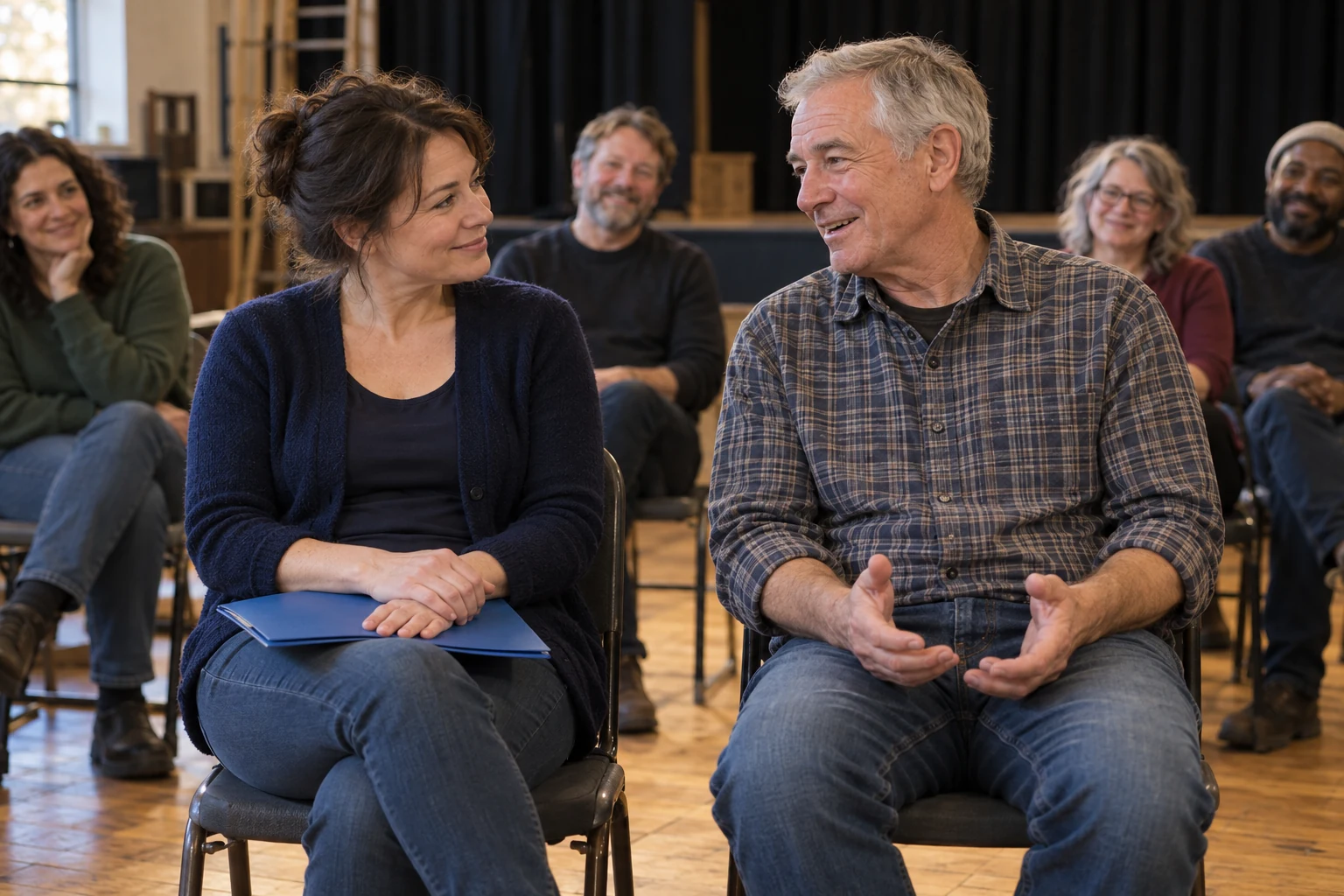
This farewell conversation is an original fictional scene. Mira, Otis, Jules, the theatre, and their shared history are invented. The ordinary folder in the story is a prop, not an identified retail product. Actual file-folder references appear separately after the ending. The scene offers no rule for retirement events, public speaking, or how another person will respond to an invitation.
The rehearsal in the empty hall
Mira had written three pages about Otis and could not say the first sentence without sounding like somebody announcing a delay. She tried it again to the empty chairs. “In recognition of your valuable contribution.” The words reached the dark curtain and seemed to remain there, waiting for a train that would never arrive. She looked down at the blue folder. She had chosen a larger typeface so she would not lose her place. Now there was more of the sentence to dislike.
Jules came through the side door carrying two folded tablecloths. He paused behind the last row and listened while Mira started once more. “You make him sound like a grant,” he said. She told him that she had asked for help on Tuesday and that he had sent her a photograph of a cake. Jules put the cloths on a table. “It was a useful photograph. We still need a cake.” Mira closed the folder over her thumb and asked whether he remembered when Otis had first joined them.
“Before the yellow chairs,” Jules said. This was not a date. Mira already had the date, as well as a list of productions, repairs, and things that people had remembered too late for her to fit them neatly on the second page. The yellow chairs were presently stacked against the wall because no two of them stood at quite the same height. Otis had once called them a committee. Mira had put that joke in her speech and then taken it out. On paper, it looked as though she were explaining why it was funny.
Jules pulled two ordinary chairs away from the wall and set them near the front. Mira asked what they were for. He said that people might want to sit down. She looked at the row of seats she had already arranged, then at the two facing slightly toward one another. He left them there while he went to find the tablecloth clips. Mira opened her folder again. Beneath the formal first sentence she had written, in smaller letters, “Speak slowly.” She crossed that instruction out. It was making her speak even more slowly than before.
The guest who came early
Otis arrived carrying the cake. Mira stared at it until he asked whether he had brought the wrong thing. She said that the person retiring was not supposed to provide his own farewell refreshments. He explained that he had been passing the bakery and had remembered how often this group forgot to eat. The box contained a plain round cake, without a name on it. He had declined the icing message because he could not decide what he would want to read while somebody cut into it.
They put the box on the table. Otis noticed the two chairs and sat in the one nearest the curtain. Mira remained standing with her folder against her side. He asked whether that was the speech. She admitted that it was. “Three pages,” he said, looking at the edge. She told him that they were not crowded pages. He nodded with exaggerated relief and asked whether she had included the yellow chairs. Mira said she had considered it. “You can leave them out,” he said. “They have had enough attention.”
She sat beside him, meaning only to stay for a moment. From that position, the chairs she had arranged looked different: no longer an audience, just empty places where familiar people would soon leave coats and bags. Otis asked whether she wanted him to look at the speech. Mira held it out, then drew it back. She did not want him to correct a sentence praising himself. She said that it was supposed to be a surprise. “I know I’m leaving,” he replied. “We may have exhausted the surprise.”
Mira told him that she had wanted to say something properly. Otis waited while she tried to explain what that meant. She had collected dates, names, and the titles of plays because she did not want the afternoon to sound careless. None of that was untrue. Yet each time she read the pages, she imagined herself standing at the front while he sat politely through an account of a person he already knew. She rested the closed folder on her knees. The speech was becoming a large object between two people who usually talked without one.
Three pages and one chair
“Could I ask you something instead?” she said. Otis looked at the room and then at her. “In front of them?” She said that she would ask now first, and that he could tell her to forget it. She wanted to ask about the door in the old production of The Orchard. He laughed before she reached the end of the title. It had been a door built for a set, not a real entrance, and its fictional importance had greatly exceeded its willingness to remain where the actors expected it.
“Which part?” Otis asked. Mira said that she remembered standing behind it with a tray, waiting for an entrance, while he stood on the other side telling her that everything was perfectly ordinary. “You were asking whether I could make it open toward you,” he said. “After we’d spent the afternoon making it open away.” She said that she had been new and had not understood that a stage door could have such firm opinions. Otis shook his head. “The door was willing. The wall had objections.”
She asked whether he would mind telling that story later. He said that he would not mind if she stayed in the other chair and admitted to the tray. Mira agreed. He added that she should not pretend he had been calm. She had remembered him as calm because he had spoken quietly. Otis said that he had been using all his spare concentration to keep from laughing. Mira looked toward the side door through which Jules had disappeared. This was already more like the conversation she had hoped the speech would somehow become.
The first guests arrived while they were discussing the tray. A coat landed on a seat, a bag beneath another. Jules came back with clips in one hand and discovered that the cake had solved itself. He asked whether they should move the two chairs closer to the table. Mira said that they were all right where they were. She slid the folder beneath her hand so she would stop opening it. Otis asked whether there was anything in the speech that she particularly wanted him to hear. “Yes,” she said. “But I think I can say it sitting here.”
A question instead of the list
When everyone had found a seat, Mira stood only long enough to thank them for coming. She said that she had prepared some remarks and that Otis had arrived too early for his own good. Somebody at the back asked whether that meant he had heard them already. “Worse,” Mira said. “He has found out how long they are.” Otis held up three fingers, then quickly lowered one when she looked at him. She sat down again. The folder remained closed across her lap.
She asked him about the door. He began with the wall, as promised, and Mira had to interrupt because nobody else yet knew about the tray. Her interruption produced the first small argument of the afternoon: whether she had been carrying six cups or merely a tray that sounded like six cups. They agreed that the sound had been substantial. Otis described the space behind the set, where everyone had needed to stand sideways. Mira supplied the line she was supposed to say when she entered. She still knew it, although she had forgotten the next one.
Someone in the second row remembered holding a lamp while they waited. Jules said that he remembered being told not to touch anything. “You touched the curtain,” Otis replied. Jules said that this was a fair distinction. The story acquired pauses where people laughed and places where somebody asked for a detail. Mira no longer needed to plan where she would breathe. She had questions because Otis was answering, and he sometimes turned a question back toward her. The room could hear both the old mishap and the conversation they were having about it now.
At the end, Mira told him the part she had wanted to preserve from her third page. On her first evening there, she had believed that everybody else understood what they were doing. Otis had given her a small job and then waited while she learned it. She had meant to thank him for that. He looked down at his hands for a moment. Then he said that she had come back the following week, and that this had helped. Mira had prepared a much more elaborate answer to his work than he had prepared to hers. She was glad hers was still in the folder.
The room joins the conversation
Jules asked whether he was now allowed to touch the cake. They moved the two chairs toward the table, and the afternoon broke into smaller conversations. Otis had to explain the wall once more to someone who had arrived late. Mira fetched plates and found herself beside a colleague who wanted to know whether the speech had really been three pages. She opened the folder and showed her. The colleague read the first line and made a face that was both sympathetic and unhelpful. Mira told her that she was not accepting revisions.
For a while, the folder lay on a spare chair under Mira’s cardigan. Nobody needed it to keep the afternoon going. A piece of cake disappeared from Otis’s plate while he was speaking, and he spent several minutes pretending to investigate. People who had not worked together recently compared the rooms in which they now spent their days. Someone asked Otis what he would do next. He answered with a plan for Monday morning so ordinary that nobody could turn it into a ceremonial announcement: he was going to have breakfast without looking at the clock.
The folder at the end of the evening
When the last plates were gathered, Mira found Otis returning the two chairs to the wall. She told him to stop helping with his own farewell. He said that he was only moving the chairs out of the way, not repairing them. She took the other one. They carried them side by side, and for a few steps she could not see his face beyond the chair back. It gave her time to decide whether she wanted to offer him the speech. She had imagined him taking it home. Now she was less sure that it belonged to him.
He asked about it before she could decide. Mira said that he could have it if he wanted it. Otis considered the closed folder. “Would you mind keeping it?” he asked. “You’ve done all the writing.” She said that she would keep it. He thanked her for asking about the door, and she thanked him for answering in front of everybody. There was no second ending in which she finally read the pages aloud. They turned off the room lights, checked that Jules had the cake box, and left through the ordinary side door together.
Actual folder references outside the fiction
The Pendaflex Divide It Up folder offer describes letter-size folders with integrated sections and tabs. Its seven original images show those folder forms with staged papers and receipts. These are retail disclosures, not Mira’s belongings. The invented scene demonstrates no retention, capacity, or preservation result.
The Pendaflex Earthwise Blue 04302 offer identifies flat paper file folders; its first image shows blue folders. Three supplemental images instead show an unrelated black accordion organizer. Those inconsistent images are preserved and excluded from supplied-feature and accessory claims. No accordion organizer is asserted included. Mira’s generic folder is not authenticated as either offer.
Keep the neighboring stories distinct
The second-person folder story addresses a named sibling while an unfinished drawing becomes a continuing shared project. This farewell uses third-person human narration and ends an actual invented occasion; it does not divide childhood papers or keep a joint drawing unfinished.
The collective narrator exercise revises which speakers belong to “we.” Mira and Otis are separate human speakers throughout. Their exchange is not an alternative account, a missing-memory correction, or a speaking-object exercise.
Review any separate order on its own terms
If you plan to purchase an item on republeq.com, check the particular offer and current checkout before ordering. This guide does not establish that any cryptocurrency payment option is available. If USDT is offered for the intended order, verify the requested asset, network, amount, receiving destination and order reference with the responsible service before authorizing a transfer. Review the actual product identity, selected variant, quantity, delivery details, total charge and applicable terms. Use the confirmed order details when checking the payment instructions. Confirm any fee, conversion term or exchange rate from the current transaction information. Determine the applicable cancellation, return and refund process, including how a refund would be handled for the selected payment method. Keep the relevant instructions and transaction records, with dates and confirmed references. If essential instructions change, ask the responsible service to confirm the change against the exact order. An acknowledgement should identify the order and the agreed details; it does not replace checking whether the selected product is the one you intended to buy. If payment or order status remains uncertain, reconcile that status before considering another transfer. Do not treat an unresolved transaction as evidence that nothing happened. This article supplies no wallet address, transfer guarantee, recovery procedure or assessment of a counterparty. A product enquiry does not authorize a payment or resolve an uncertain order. If support provides an answer, retain the exact question and response so a later reviewer can understand what was confirmed. Decide whether to proceed only when the conditions of the particular transaction are clear, and retain the confirmed transaction information with the exact order.