Crypto Commerce
Faitaliicy semi-automatic espresso machine vs Acekid espresso machines for different morning routines
Compare Faitaliicy semi-automatic espresso machine by grinder settings, milk preparation, cleaning work, and details to confirm before buying.
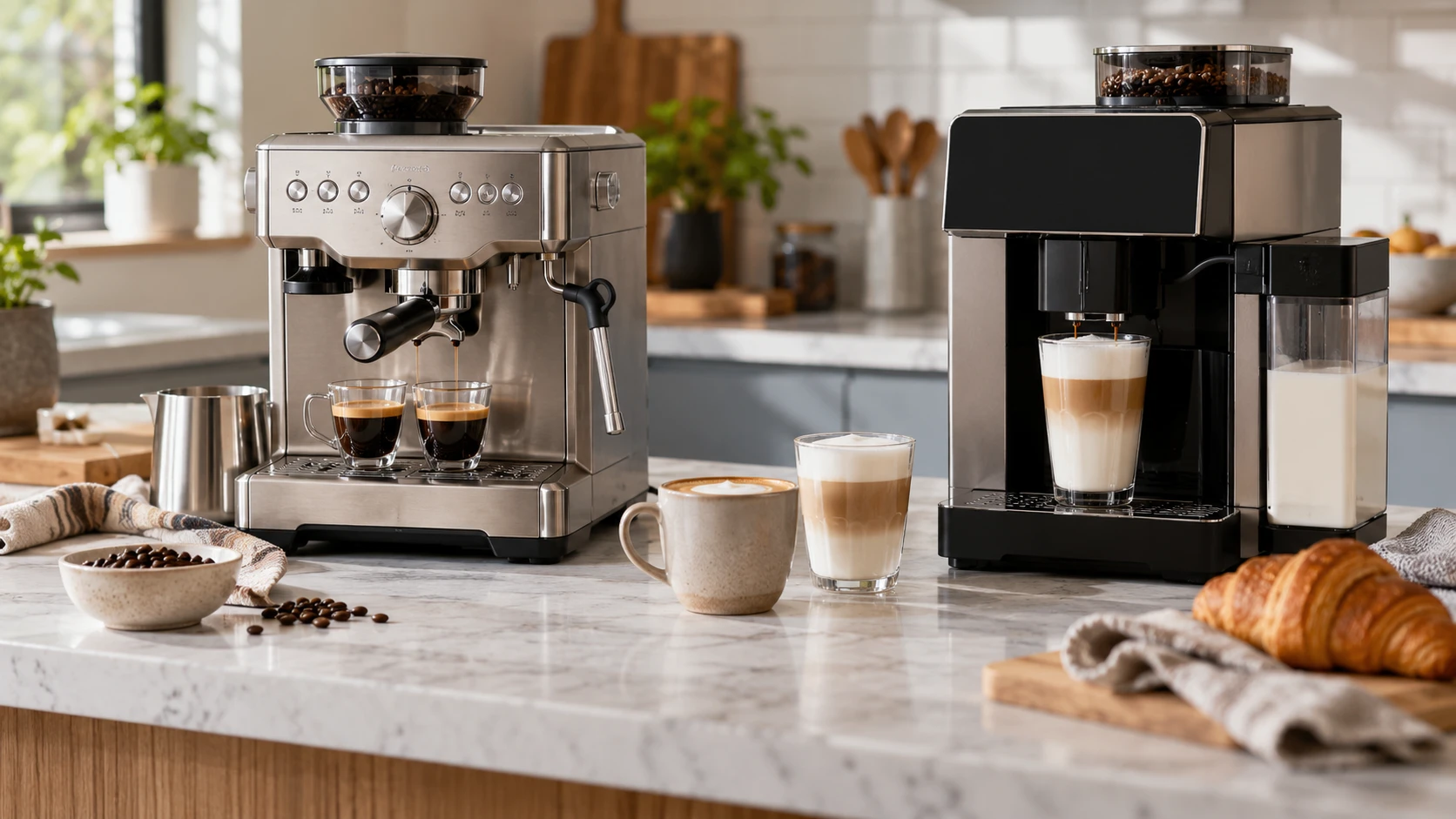
The Faitaliicy semi-automatic espresso machine and the Acekid model both bring a grinder and milk preparation to the counter. They ask different things of the person making coffee. Faitaliicy’s title uses “automatic milk frother” wording, while its description explains a steam wand; confirm the exact milk workflow on the selected model. Faitaliicy describes an adjustable grinder, an espresso-brewing setup, and a steam wand that you use yourself. Acekid describes a touch-screen machine that grinds, brews, and prepares milk drinks through programmed selections. The better choice depends on whether you want to control each step or reduce the number of steps you perform before work.
These are descriptions from the current product listings, not results from hands-on testing. The pages do not establish how either machine tastes with your beans, how durable the grinder will be, or how long cleaning takes in a real kitchen. Use the comparison to decide which details to confirm with the Republeq's catalog and the machine manual. Check the selected offer at checkout, since a product page can group versions or accessories under one listing.
How much of the process do you want to run? — Acekid fully automatic espresso machine
Faitaliicy calls its machine semi-automatic. The listing describes a built-in conical burr grinder with 30 adjustable levels and a removable steam wand. That arrangement gives the user choices about grind setting and milk texture. It also means there is a sequence to learn: select beans, adjust the grinder, prepare the brewing path, pull a shot, and steam milk when a drink needs it. The page does not explain every control or include a complete operating sequence. Read the manual for the exact model before assuming that a particular step is automated.
Acekid describes a fully automatic machine with a touch display, a conical burr grinder, a milk container, and seven drink varieties. Its page says the user can choose beverage settings, including strength and temperature, and save preferred drinks. This may suit a household where several people want a repeatable drink without learning to steam milk. Automation shifts the work rather than removing it: the bean hopper, water tank, milk container, waste bin, and drip tray still need attention. Verify which drink choices are available on the selected unit and what the screen actually lets each person save.
The word “automatic” does not tell you whether you will like the resulting espresso. It tells you more about the interface and work pattern. A person who enjoys changing the grind between beans may welcome Faitaliicy's hands-on route. Someone who wants one familiar cappuccino before leaving home may prefer Acekid's preset route. Either buyer should look beyond the feature count and picture making the same drink every day for a month.
Grinder adjustment and the beans you use — grinder settings for espresso beans
Both listings mention conical burr grinding, but the controls differ on paper. Faitaliicy advertises 30 grind positions. Acekid advertises 15. Neither count measures grind quality by itself. The useful question is whether the machine lets you move in small enough increments around the setting that works for your beans, and whether the grinder stays consistent as the hopper empties. The product pages do not provide grind-size distributions or independent extraction data.
If you change beans often, note how a setting is recorded. A numbered dial is helpful only if you can return to a previous setting and the machine reacts predictably. For an automatic machine, also ask whether changing a preset alters the grind, beverage volume, strength setting, or several of those at once. The published guide on grinder settings for espresso beans gives a useful way to think through adjustment. Its comparison concerns other machines, so its particular settings should not be copied onto either model here.
Freshness and maintenance matter as much as the number on a dial. Ask how the hopper seals, how beans are removed when changing varieties, and how the grinder is cleaned. A household that alternates regular and decaf beans may need a practical way to empty the path between them. If that swap is difficult, a machine with more nominal settings can still feel cumbersome. The listings do not document the amount of retained coffee in either grinder, so treat easy bean switching as a question to verify rather than an established advantage.
Faitaliicy also advertises dual PID temperature control. Its description pairs this with an unusually broad temperature tolerance figure, and the page does not supply a test method. Do not use that figure in Republeq's catalog as proof of temperature precision. Confirm the actual operating range and control behavior in manufacturer documentation. Acekid mentions temperature adjustment through the screen but does not show what temperatures are selectable. If milk drinks are your main use, these unknowns may matter less than whether the drinks suit your taste. For someone who experiments with straight espresso, they are worth investigating.
Milk drinks put the difference in your hands — Acekid fully automatic espresso machine
Faitaliicy lists a stainless steel steam wand and a hot-water function. A wand allows the user to work with the milk in a separate pitcher, but learning to heat and texture it takes practice. Ask whether the wand has enough clearance for the pitcher you would use and how it is purged and wiped after each drink. The listing promises fine foam and latte art; those outcomes depend on technique, milk, and the machine's actual performance. They are not guaranteed by the presence of a wand.
Acekid describes a built-in milk frother with a separate milk container. The page presents one-touch lattes and cappuccinos as part of the machine's appeal. Check what the milk path consists of, whether it can be disassembled, and which pieces can be washed in a dishwasher, if any. A milk container that makes weekday drinks easier can still be inconvenient if it must be emptied, chilled, and cleaned after every use. The listing says the machine has cleaning prompts and performs cleaning at startup and shutdown, but it does not give the full milk-system cleaning schedule.
Imagine the last drink of the day as well as the first. With a steam wand, you clean the wand and pitcher. With a container and internal milk path, you may have more components to rinse. The faster drink button is only part of the routine. If one person drinks straight espresso and another makes a latte, map both routines, including cleanup, before deciding which interface saves your household time.
Counter space, water and waste — Acekid fully automatic espresso machine
Neither listing provides every dimension a buyer needs for a confident fit decision. Confirm width, depth, height, and any extra space needed above or beside the machine to fill beans and water. Include the travel of a removable tank, the reach needed to remove a drip tray, and room for cups under the spouts. A machine that technically fits under a cabinet may still have to be pulled forward daily for filling.
Faitaliicy's separate steam pitcher, if you use one, adds another item to store and wash. Acekid's milk container and removable waste components need counter or refrigerator space during use and cleaning. Check what comes in the selected box. Do not assume a photograph showing cups, pitchers, beans, or milk includes those items. The listing price and available bundle can change, so compare the actual accessories at checkout rather than a photo alone.
Water quality affects both machines. Ask what descaling process the manufacturer specifies, whether a filter is included or optional, and how the machine signals maintenance. Acekid mentions automatic cleaning functions but does not make its entire maintenance schedule clear. Faitaliicy's description highlights brewing controls more than cleaning. The absence of a detail on a short product page does not mean the machine lacks that function; it means the buyer needs the model manual to assess it.
Waste handling deserves its own check. An automatic unit collects spent coffee internally and may ask you to empty a bin. A semi-automatic workflow usually requires handling spent coffee after a shot. The product pages do not specify the exact basket, portafilter, or bin capacity for these offers. Those details affect how many drinks you can make before stopping, particularly when guests visit. Confirm the parts and capacities for the exact model rather than inferring them from the general machine type.
Claims that need closer inspection — Acekid fully automatic espresso machine
Both listings use “20 bar” language. That number alone cannot establish the pressure at the coffee bed during extraction, and it does not tell you whether a shot will taste balanced. Ask for the machine's brewing specifications and focus on the controls and maintenance you can actually use. Neither page supplies an independent performance test. A high pressure number should not settle a decision between a manual workflow and a programmed one.
Faitaliicy's page uses broad claims about professional results and suitability for home, office, and commercial settings. Acekid's page promises consistent drinks and easy maintenance. Treat those as Republeq's product descriptions, not verified outcomes for a particular kitchen. If you plan to use either machine in a workplace, confirm electrical requirements, warranty terms, expected drink volume, and service support. A home machine that can prepare several drinks does not automatically have a commercial-duty rating.
The product pages also leave open questions about warranty coverage, parts availability, and repair. Grinder and milk-system components are especially relevant because they face frequent use and cleaning. Find the exact model number, then check the manufacturer's current manual and support path. A lower upfront price can lose its appeal if a routine replacement part is hard to obtain. Conversely, a more elaborate machine is not necessarily less reliable; these listings do not provide enough evidence to rank durability.
A decision to make before checkout — Acekid fully automatic espresso machine
Choose Faitaliicy if you want to learn and control the steps of espresso and milk preparation, and if you are willing to verify its brewing controls and steam-wand cleanup. Its stated 30 grind positions may appeal to someone who changes beans and keeps notes, provided the controls work as described. The purchase should still depend on the exact model's dimensions, included parts, manual, and warranty.
The Acekid fully automatic espresso machine is the stronger candidate for someone who wants drink selections on a screen and would rather maintain a milk container than steam each pitcher by hand. Confirm its seven stated drink choices, preset controls, milk-cleaning steps, and the space required to remove its parts. A programmed drink can simplify the morning only if the cleaning routine fits the evening.
Before ordering either one, write down the drinks you make most often, the number of people using the machine, the available counter dimensions, and how much cleaning you will reliably do. Compare the selected offers and current checkout terms with that list. It is a more useful basis for this choice than a bar-pressure claim or a photo of finished foam.