Crypto Commerce
eufy X10 Pro Omni robot vacuum and Laresar L10: plan the cleaning after the cleaning
Compare eufy X10 Pro Omni robot vacuum by mopping upkeep, carpet handling, room control, navigation and dock space.
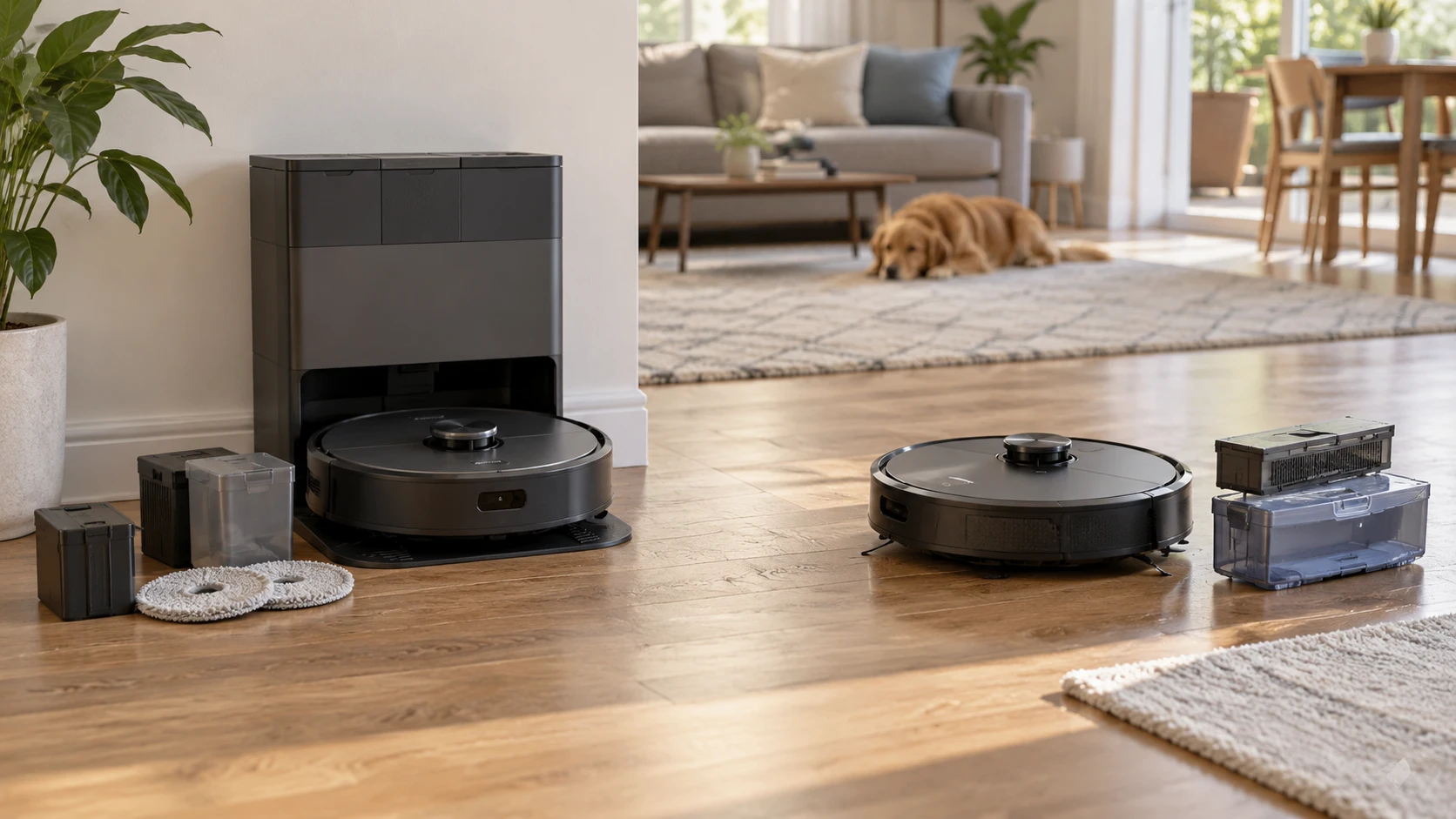
Robot vacuums still leave someone with a maintenance routine. The eufy X10 Pro Omni robot vacuum is listed with a station that empties its dust bin, washes its mop pads, and dries them. Laresar's L10 is described as a LiDAR-guided vacuum and mop with an attachable water tank and app-based room scheduling. If wet cleaning is frequent, the dock chores may decide more than the suction figure. If room-by-room vacuuming is the main job, mapping controls may matter more.
These details come from a September 30 catalog snapshot. Both exact product pages and the related guide were reachable when checked on October 3. The descriptions do not amount to a shared cleaning test or a complete maintenance manual. An absent feature in a short listing should be checked in current model documentation before it is treated as unavailable.
Count the work left at the dock — Laresar L10 robot vacuum and mop
Eufy's station is described as washing the mop pads with clean water and drying them with air heated to 45°C, or 113°F. It empties the robot's bin into a 2.5-liter bag. This particular saved offer includes a six-pack of large-capacity dust bags, which is worth checking if you compare it with another X10 Pro Omni bundle. The listing suggests replacing a bag about every two months. A household with pets, a dusty entrance, or frequent runs may use bags at a different rate, so confirm the bag model and current replacement price.
The station also has a stated three-liter clean-water tank. Eufy estimates that it can mop a 1,500-to-2,000-square-foot home two or three times before a refill. Treat that as a estimate in Republeq's catalog rather than a schedule for your floors. Water use depends on settings, floor area, and how often the pads are washed. You will still have to refill clean water, handle dirty water according to the station's instructions, and keep the wash area clean. Measure the dock and choose a spot where those chores are comfortable.
Laresar describes mopping with an attachable water tank. The saved entry does not specify an automatic pad-washing or drying station. If either function is essential, inspect the current L10 package and manual instead of inferring its presence or absence from a short paragraph. Ask how the tank is filled, how the pad is removed, and what must be washed after a wet run. A simpler arrangement could suit a small hard-floor area if you do not mind handling the pad yourself.
Estimate the runs you actually want each week. A large kitchen and several hard-floor rooms may make automatic pad cleaning valuable. A home that mainly needs dry passes over crumbs and pet hair may rarely use a mop station. List the water, bag, pad, and brush jobs each model would leave you after a typical run. The point of automation is to move work, and the work still has to fit somewhere in the household's routine.
Check rugs before sending a wet robot across them — robot vacuum mapping and room controls
Eufy's listing says its dual mop pads rotate 180 times per minute, press down with a stated one-kilogram force, and lift 12 millimeters when the robot detects carpet. It also advertises 8,000 Pa of suction. These are product specifications, not a measured comparison with the L10 on your floors. A thick rug may still contact a lifted pad. Check the maker's carpet guidance against the pile and edges of the rugs you own, and use exclusion settings where the manual recommends them.
Laresar lists 6,500 Pa suction and an automatic carpet-boost feature. Its short description says the attachable tank is used to mop hard floors, but it does not explain whether the mop lifts at a rug or how a wet run behaves when it crosses a carpet edge. Ask that question before scheduling a route through mixed rooms. If you need to keep a rug dry, confirm whether its app can apply a no-go zone specifically to mopping and whether the setting persists between runs.
The two suction numbers may have been measured under different conditions, and a peak pressure figure does not show how a brush handles rice, hair, or grit on your floor. Brush shape, debris size, surface texture, and repeated passes all matter. Eufy describes a reversing roller brush and a comb intended to remove wrapped hair. That could reduce one common cleaning job, but the saved catalog does not quantify how often a household would still need to inspect the brush. Look for a comparable floor test if pickup is your deciding factor.
Make a room plan before testing the app — robot vacuum mapping and room controls
Laresar says the L10 uses LiDAR to map a home and follow orderly paths. Its app is described as supporting no-go zones, room scheduling, and maps for multiple floors. Those are useful claims if one room needs a daily pass while another contains cables or a fragile rug. Ask how many maps the current software stores, how a floor is selected, and what happens when furniture moves. A map is helpful only when it stays understandable and editable for the people who use the home.
Eufy's description says the app can customize cleaning routines. It also claims the obstacle-avoidance system identifies more than 100 kinds of objects, including wires, shoes, and toys, even at night. The saved entry says less about its exact room-map controls than Laresar's does. Check current eufy documentation if no-go zones, room selection, or multi-floor use are central to your decision. Object detection also deserves a real trial; a thin cord or a dark object beside a rug may be harder than a demonstration image suggests.
The published guide on robot vacuum mapping and room controls gives a way to turn those claims into household questions. It does not certify either robot in your rooms. Mark the floors, rooms, thresholds, cables, and areas you want excluded. Then decide what you need the app to remember and who will update it when the layout changes. Keep the dock in a stable place during mapping unless the specific manual says otherwise.
Laresar's title also mentions Alexa control, while the saved description confirms app scheduling and no-go zones. Eufy lists app-based routines. Ask which actions require an account, Wi-Fi, or a voice assistant, and what basic controls remain available during a network outage. If several people share the home, check whether someone else can start or pause a run without borrowing one person's phone. Neither short listing settles that question.
Treat coverage estimates as different measures — Laresar L10 robot vacuum and mop
Laresar claims up to 180 minutes of runtime and coverage of up to 2,150 square feet in one session before returning to the dock to recharge. Eufy's entry instead gives an estimate for how many wet runs its clean-water tank can support in a 1,500-to-2,000-square-foot home. One is a robot runtime and area claim; the other is a water-tank claim. They cannot be compared as if both were the same test. Floor setting, obstacles, furniture, and suction level can alter actual coverage.
Ask what happens when a job is interrupted. The Laresar description says the robot returns to recharge but does not explicitly establish that it resumes an unfinished assignment. Eufy's saved description focuses on station maintenance and gives no matching runtime-and-resume sequence. Check both current manuals. If your home is large, a robot that completes the most important rooms first may serve you well even if it needs a second session for the rest.
Dock placement can determine whether those claimed routes are practical. Find a place with the manufacturer's entry and side clearances, a suitable outlet, and a path to the rooms you want cleaned. For eufy, include room to lift tanks, replace a bag, and dry or store supplies. For Laresar, include a place to handle the removable mopping tank. A dock hidden behind furniture may fit on paper yet be awkward to service or leave.
If the robot has to work on more than one floor, plan the human part of that trip. Someone may need to carry the machine, choose a stored map, and handle water or pads upstairs. The saved Laresar entry says it keeps maps for multiple floors, but it does not spell out every step of that routine. The eufy entry gives no comparable detail. Ask how each model handles a floor without its dock before treating multi-floor use as automatic.
Compare the current packages and recurring costs — Laresar L10 robot vacuum and mop
At the September 30 capture, eufy's minimum listed price was $574.99 and Laresar's was $220, with both marked available. Those are dated catalog values rather than current checkout quotes. The eufy offer includes six dust bags; confirm the exact bundle before comparing prices. Add the cost of replacement bags, pads, brushes, and any recommended cleaning supplies. The saved descriptions do not give a complete lifetime-cost calculation.
Eufy deserves a closer look if you intend to mop often and want the dock to wash and dry pads and empty the bin. Verify its station footprint, water handling, consumable costs, carpet behavior, and current app controls. The Laresar L10 robot vacuum and mop may suit a household that values LiDAR mapping, room scheduling, and no-go zones and is comfortable checking an attachable mopping tank after use. Verify its mop and rug behavior, map limits, and recharge routine.
Before buying, write down three repeat jobs: a dry pass over rugs, a wet pass over hard floors, and cleanup after a busy day. Mark the rooms and obstacles, then trace how each machine would start, finish, and be prepared for the next run. That short exercise makes the maintenance difference visible long before a suction number or product photo can answer it.