Crypto Commerce
EQCOTWEA ten tray food dehydrator vs FOHERE Eight Tray for food drying
Compare EQCOTWEA ten tray food dehydrator by usable tray space, temperature and timer ranges, airflow, accessories, cleaning, and batch workflow.
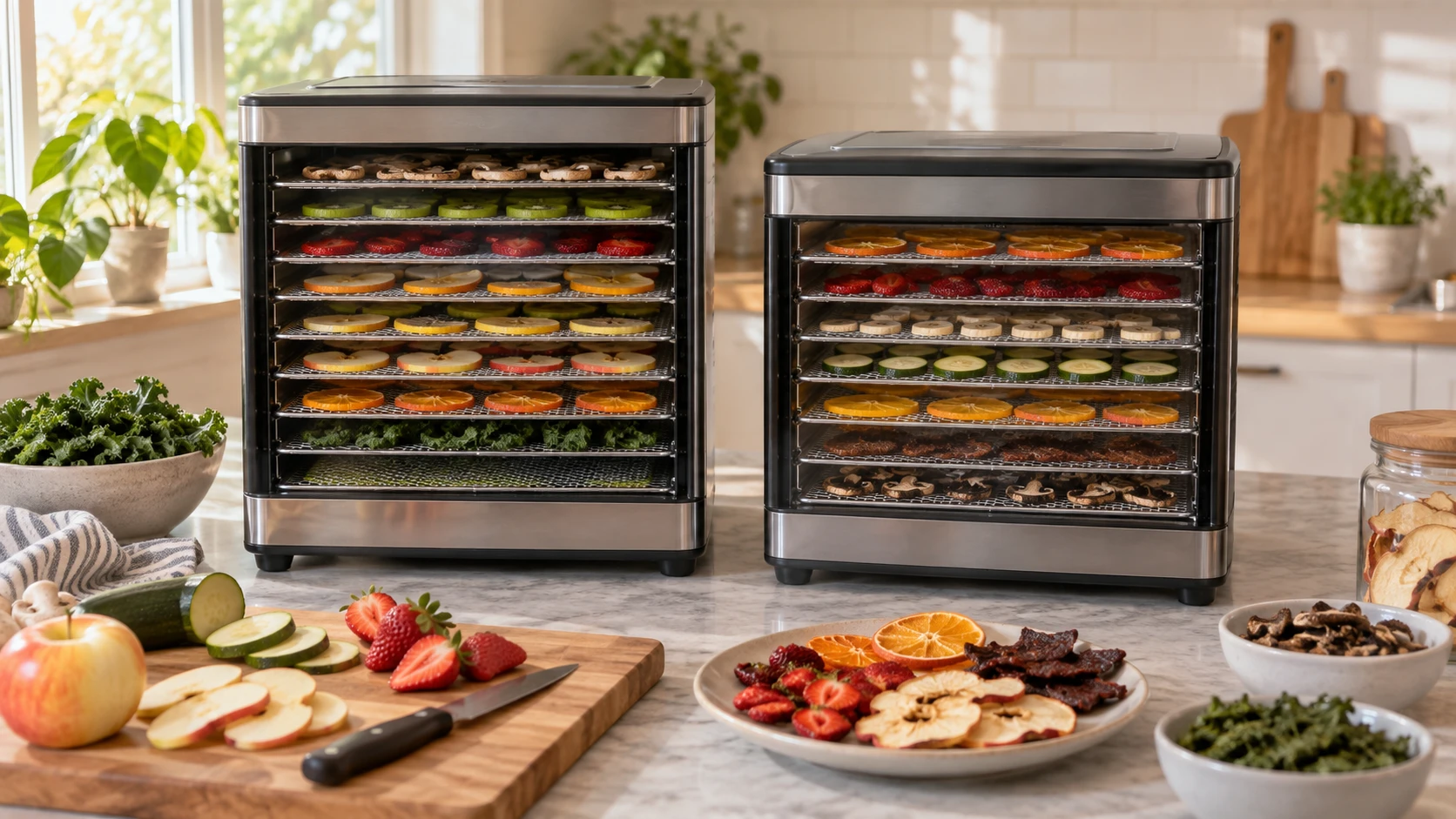
The EQCOTWEA ten tray food dehydrator lists ten stainless-steel mesh layers, an 800-watt rating, and a temperature range of 30 to 90 degrees Celsius. FOHERE lists eight stainless-steel trays, an 800-watt rating, and settings from 95 to 176 degrees Fahrenheit. The extra two layers may help with a large harvest, but tray count alone does not describe usable area, clearance for thick slices, or how evenly the food dries. Start with the quantity and thickness normally prepared, then ask for each tray's dimensions and the distance between tray positions.
The published guide to dehydrator tray rotation requirements points to a practical test. Put a similar piece of food near the front and back of a tray, and repeat on high and low shelves. Record which locations finish first. EQCOTWEA describes 360-degree airflow, while FOHERE describes a rear fan and 360-degree circulation. Those phrases do not establish that all positions dry identically with a full load. If the manual calls for rotating trays, allow time and counter space for that step even if the product page says the airflow is even.
The FOHERE eight tray food dehydrator listing includes four mesh screens, a drip tray, fruit roll-up paper, oven mitts, and an instruction and recipe booklet. EQCOTWEA's pinned excerpt identifies its ten food-grade stainless mesh trays but does not give a full accessory list. Ask what arrives in the EQCOTWEA box before buying liners or screens separately. Small berries, herbs, and fruit puree may need a different surface from apple slices. A tray count is only useful when the supplied surfaces suit the foods being dried.
Measure batch area and food clearance — FOHERE eight tray food dehydrator
EQCOTWEA calls its ten-layer arrangement large-capacity, but the source does not give tray width, depth, or mesh spacing. FOHERE states eight trays without tray measurements in its excerpt. Calculate usable area from the actual tray dimensions, leaving gaps between pieces as the manual directs. Ten small trays can have less total working area than eight larger ones. Ask how much weight each tray supports and whether a tall piece needs an empty level above it. Removing a tray to create headroom changes total batch space.
Try laying out one usual batch before choosing. A basket of sliced fruit may look modest until the slices are placed in a single layer with room between them. Herbs can take broad space without much weight, while meat strips may demand closer attention to spacing, temperature, and food-safety instructions. Count the pieces that fit on a paper rectangle matching one tray. Multiply by the number of usable levels, then consider whether the appliance can finish that amount before the food has to be stored. The pages do not supply tested capacity by food type.
Tray shape affects cleanup. EQCOTWEA describes stainless-steel mesh layers, and FOHERE lists stainless-steel trays plus separate mesh screens. Sticky fruit can catch on wire and require soaking or gentle brushing. A flexible liner or fruit roll sheet may be easier for puree, if the manual approves it and leaves proper airflow. Ask whether trays and accessories can go in a dishwasher and whether a replacement tray is sold separately. The pinned descriptions do not settle those care questions, so do not assume that stainless steel makes every piece dishwasher safe.
Compare controls by the recipes used — FOHERE eight tray food dehydrator
EQCOTWEA's digital touch panel sets temperature from 30 to 90 degrees Celsius and a timer from half an hour to 24 hours. FOHERE lists a timer from 30 minutes to 48 hours and a temperature range of 95 to 176 degrees Fahrenheit. Convert recipe instructions into the unit shown by the appliance and check the manual's setting increments. The two ranges overlap substantially, but FOHERE's longer stated timer may reduce the need to restart a long cycle. Neither excerpt explains what happens after a timer ends or after a brief power interruption.
An 800-watt rating appears on both pages. It describes electrical input, not the heat delivered to every tray or the cost of a finished batch. Actual energy use depends on the chosen temperature, duration, insulation, and whether the heater cycles. Ask for model-specific power data if operating cost matters. A fast-drying claim also needs a defined food, slice thickness, room conditions, and load size. EQCOTWEA says it dries some foods faster than others; FOHERE advertises rapid heating. Neither excerpt gives a comparable controlled test.
Food safety deserves its own check. FOHERE's title mentions beef jerky and pet snacks; EQCOTWEA's listing names beef jerky, seafood, and other foods. Those examples are uses the Republeq's catalog entries advertise, not a complete safe preparation procedure. Follow a tested recipe and the appliance manual for meat or fish, including any required handling or temperature steps. Use a suitable thermometer if the instructions call for one. Do not infer that setting an air-temperature number is enough to establish the food has reached a safe condition throughout.
For fruit, vegetables, and herbs, examine texture at several tray positions near the end of a cycle. A piece that feels ready while warm can change as it cools, and thicker slices may take longer. The pinned excerpts do not define a dryness endpoint or storage method. The recipe booklet included with FOHERE can be a starting point, but compare it with reliable food-preservation guidance for the food being made. Record slice thickness and settings for a successful batch so the next one can be prepared consistently.
Look closely at airflow and noise claims — FOHERE eight tray food dehydrator
EQCOTWEA describes airflow that circulates around the food at 360 degrees. FOHERE says a rear fan produces 360-degree circulation. Both are product-description claims, not measurements of moisture removal on every shelf. Ask whether trays must be swapped or turned for a full load. Check how the fan inlet and outlet should be kept clear on the chosen counter. Packing pieces against a wall or covering vents can change the air path. The best way to assess a batch is to check high, low, front, and back locations with the same food.
FOHERE claims a noise level capped at 45 decibels and describes the motor as quiet. The pinned excerpt does not state the measuring distance, room, or operating mode. EQCOTWEA gives no noise figure. A dehydrator may run for many hours, so location matters even if a Republeq's catalog calls it quiet. Listen to a running unit if possible and check whether the counter transmits vibration to nearby cabinets. Plan its placement where ventilation and household routines permit a long cycle without blocking meal preparation.
Neither excerpt gives exterior dimensions or weight. Ten trays may require more vertical storage space, but the actual footprint and door clearance are unknown until measured. Ask for the assembled dimensions, cord length, and clearance around vents. Sketch the appliance in its intended counter location and leave room to pull a hot tray straight out. FOHERE's included mitts suggest handling can involve heat; let trays cool or use protection as the manual directs. If a unit is stored in a cabinet between batches, account for the weight of the appliance and the accessories.
Plan the cleaning routine — FOHERE eight tray food dehydrator
FOHERE includes a drip tray. Check where it sits and how much space must remain beneath lower food levels. A juicy piece can leave residue on the tray or cabinet floor, so inspect the machine after every batch according to the manual. EQCOTWEA's excerpt does not identify a drip tray. Ask whether it has one and how its interior is cleaned without wetting electrical parts. Stainless-steel construction can help a surface resist corrosion, but it does not remove sticky syrup or fat by itself. Follow the specific cleaning directions for the panels, fan area, and trays.
Small accessories are easy to misplace. Keep FOHERE's mesh screens, fruit roll paper, and recipe booklet with the appliance. Ask whether the fruit roll material is reusable and whether additional sheets are sold for all eight levels. EQCOTWEA's basic tray list may be enough for sliced fruit, but puree or herbs can call for liners whose size must match its shelves. A cheap accessory that fits poorly can block airflow or leak through a mesh tray. Measure before ordering substitutes and use only materials the manual allows at the selected temperature.
Check warranty terms and replacement-parts availability for both models. The pinned excerpts provide neither. A damaged tray, failed fan, or unreadable control can end the appliance's usefulness long before its metal housing wears out. Confirm the exact model and power configuration on the rating plate, then ask for parts that match it. Keep a record of the successful first batch and any uneven results. That will help distinguish a loading problem from a machine problem if a later batch takes much longer to dry.
Choose around the regular batch — dehydrator tray rotation requirements
EQCOTWEA is the listing to investigate for ten mesh levels, a 30-to-90-degree-Celsius range, and a digital 24-hour timer. FOHERE is the listing to investigate for an eight-tray bundle with mesh screens, drip tray, and a stated 48-hour timer. Both claim 800 watts and circulating air. Their tray area, clearance, exterior size, and actual uniformity remain unverified in the pinned excerpts. Measure a typical batch, request tray and cabinet dimensions, and read the rotation and cleaning instructions before choosing.
Start with one modest load after installation. Place similar pieces in several positions, note the time and setting, and inspect the results after cooling. That test shows whether the selected tray arrangement and recipe work together in the household's kitchen. For meat, fish, or pet treats, follow an established safe recipe and the manual instead of adapting a fruit schedule. The best dehydrator for a household is the one that can dry its usual food evenly while leaving enough room, time, and attention for the checks the process actually needs.