Home & Living
Giving an empty basket gift as a finished present
An invented gift handover considers an empty basket as the complete present, without filler or a future household task assigned by its giver.
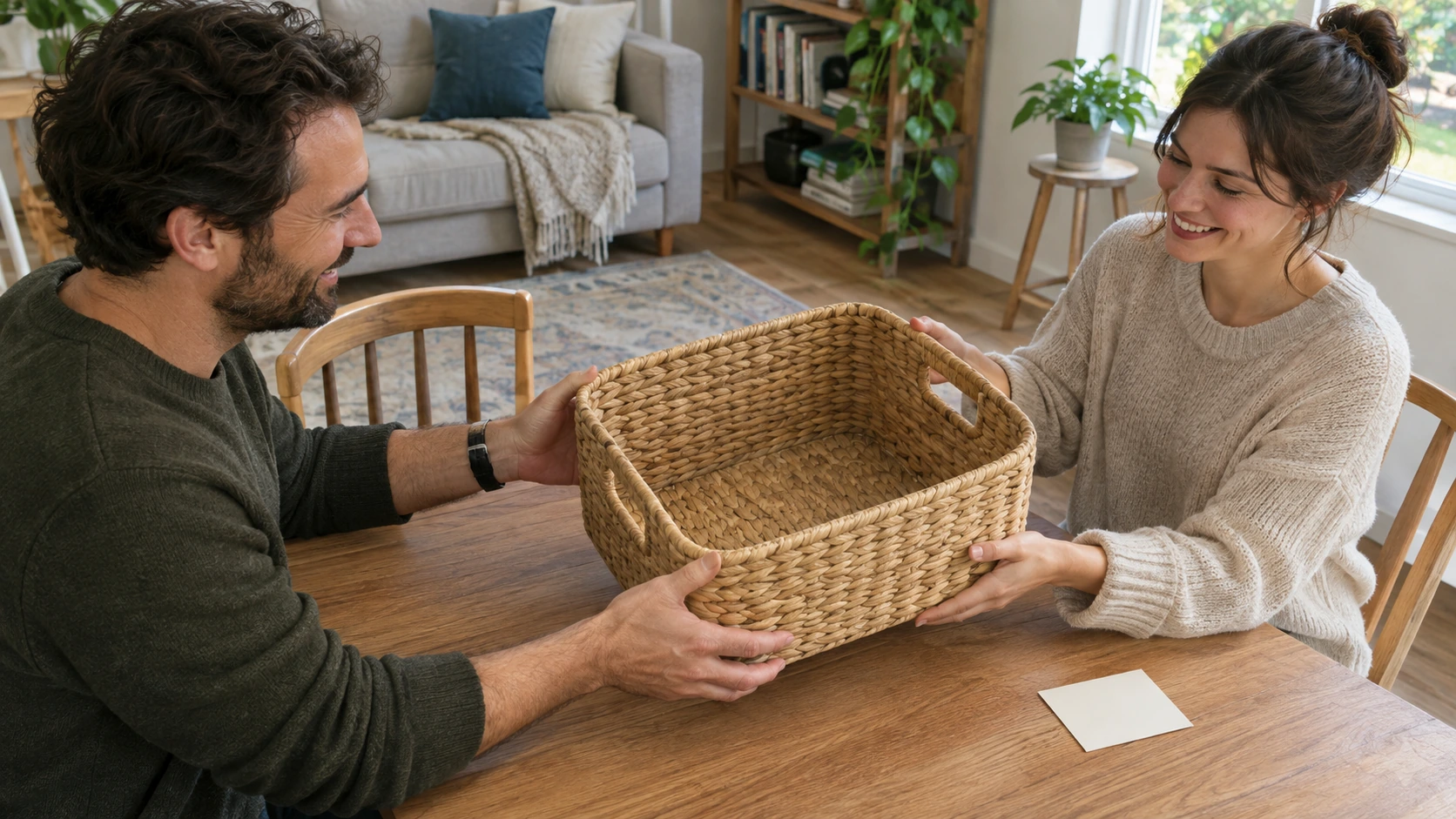
An empty basket gift can arrive with nothing hidden inside it. The basket is the present. Its giver may have imagined a place for it, but the recipient can leave that possibility undecided. The invented visit below follows a giver who keeps wanting to add something and a recipient who has made no request for a particular storage arrangement. It offers one way to finish a present without choosing its future contents.
Iris and Noor, their conversation and the visit are fictional. Neither character stands for a tested response to either retail basket discussed later. The scene concerns what Iris means to give and what she leaves for Noor to decide. It provides no claim that an empty basket will please every recipient. Their exchange remains a particular imagined occasion, with room for a different preference.
The things Iris almost puts inside
On Saturday morning, Iris places a basket on her kitchen table. She has chosen it for Noor, who is coming over that afternoon. A little card rests beside it. Across the room, a folded cloth lies on the back of a chair. Iris brings the cloth to the table and lays it inside the basket. Now there is something to arrange. She folds it again so a corner hangs over the rim.
She moves the card in front of the cloth. The basket looks like the beginning of another present, one that still needs its main object. Iris opens a cupboard, then shuts it without taking anything out. She had chosen a basket. No one had asked her to assemble a collection. The empty space has given her a new task only because she has started treating it as unfinished.
Iris removes the cloth and returns it to the chair. She can see the bottom of the basket again. That view makes her hesitate. She imagines Noor lifting the card to find the thing beneath it. There would be no thing beneath it. Iris picks up a pen and writes, “For your evening reading corner.” She looks at the line for a moment before setting the pen down.
Noor has never mentioned an evening reading corner. Iris remembers a chair beside a window, but she cannot remember what Noor keeps there now. The line on the card has quietly furnished part of someone else's home. Iris turns the card over. On the other side she writes, “A basket for you. I liked this one and thought of you.” That is the message she keeps.
A present without a hidden second part
By the time Noor arrives, the basket is on a small table near the kitchen. Iris has put the card beside it rather than across its opening. They make tea first. Noor tells her about a film she watched the night before, and Iris forgets the basket for several minutes. It remains empty while an ordinary visit takes place around it. Nothing needs to be added during the pause.
When Iris brings it over, she says, “This is for you.” Noor looks into it and then at the card. Iris feels the urge to explain the cloth, the cupboard and the first message. Instead, she waits while Noor reads the words she actually kept. The card offers no clue to another package. Noor lifts it out and sets it on the table.
“I like the shape,” Noor says. “Have you been keeping something in it?” Iris answers that she chose it as a present and has left it empty. She does not describe Noor's chair or suggest a blanket collection. Noor turns the basket to look at the other side. The exchange has reached the object Iris meant to give, without a second reveal.
Iris could still turn this into a guessing game. She could ask what Noor will put inside or list the uses she imagined on the way home. She notices that she is waiting for an answer Noor has not offered. The question can remain unasked. Noor has just received something; she has not agreed to produce a plan for it before her tea cools.
Giving a basket without filler
For Iris, giving a basket without filler means leaving out an addition she did not intend to give in the first place. The cloth would have become another object for Noor to receive, keep or decline. It also would have changed the message: a folded cloth can suggest that the giver has already settled the basket's role. In this scene, Iris wants the basket itself to be enough.
That choice does not establish a universal rule against including something. Another gift could deliberately contain several items, with each chosen for the recipient. This one began with a basket and almost grew because Iris disliked the sight of an open interior. Keeping those motives visible helps the scene stay specific. She removes an accidental extra rather than claiming that every filled present carries an obligation.
Noor asks whether Iris wants the rejected side of the card back. Iris laughs and says she can keep the whole card. Noor turns it over, reads the first line and asks where the imaginary reading corner came from. Iris admits that she invented it around a chair she remembered. Noor says that chair is somewhere else now. They leave the old line as part of the card's history.
There is no argument about which household use would have been best. Iris does not propose another room when the remembered corner disappears. Noor puts the card inside the basket for the moment. That temporary action does not become its assigned purpose. A card can rest there during a visit without obliging its recipient to start a correspondence collection.
Two actual basket accounts, within their limits
The separate REGALWOVEN rainbow basket account names a one-pack cotton-rope basket. Its six-image gallery shows one striped basket with integral openings for handles, alone and in staged rooms. Those observations identify the offered primary object. They do not authenticate material, care, load or delivered contents.
The Household Essentials basket account names paper rope and model ML-4124. Its title includes “Natural Woven”; its selected color and pictures are red. Seven gallery entries show a basket with integral round handles. A pictured throw is staging, with no supplied blanket established here.
Neither account supplies Iris or Noor's fictional preferences. No readable maker or model label in the reviewed pictures independently authenticates the catalog identity. The scene does not depend on either basket's exact dimensions, and it gives no carrying or cleaning method. An actual purchase needs the information relevant to the exact offered item and any intended use; the imagined handover supplies none of those confirmations.
The recipient chooses the basket use
The phrase recipient chooses the basket use describes a choice the giver can leave out of the visit. Noor does not need to promise a photograph after she gets home. Iris does not need to remember a proposed task so she can ask about it later. In their scene, the exchange ends with the basket received and the conversation moving on.
Noor brings the basket over to the chair beside her while they talk about the film. Iris notices that the card is still inside. She almost asks whether Noor will keep cards there, then asks about the ending of the film instead. There is no concealed lesson for Noor to discover. Iris is the person choosing to leave an idea unspoken because it would reopen a question the present did not require.
Later, when Noor gets ready to leave, Iris finds her coat. The basket remains in view, with its open interior and the small card. Noor says thank you again. Iris says she is glad she could give it to her. She does not add “for your blankets” to the goodbye. No final sentence assigns the object to the chair that has already moved.
The story stops before Noor decides what happens at home. That stopping place belongs to this gift's meaning. A later use would be a new event, chosen by Noor, rather than proof that Iris's present finally became complete. The basket can leave the scene empty without leaving an unfinished assignment behind. Its recipient has accepted the object, and its giver has finished giving it.
Other gift questions keep their own boundaries
The lamp gift and no-gifts request story follows a different decision: closing an unmade spending plan after a recipient asks for no gifts. An empty basket would still be a gift. This scene supplies no permission to work around a refusal by changing what a proposed present contains.
The housewarming visit with a closed bedroom door concerns a guest accepting a private room's boundary while the visit continues. Receiving a basket likewise establishes no invitation to inspect where it will go. Iris's imagined reading corner remains her invention, with no claim on Noor's actual rooms.
If someone wants to discuss a proposed present before receiving it, that discussion can concern the actual person and occasion. This invented exchange makes no prediction about their answer. Its narrower choice is available to a giver who already intends to offer a basket: decide whether added contents belong to the gift you mean to give, and leave a future use unassigned when it is not yours to choose.
A separate purchase, if you choose one
If a later order at republeq.com offers USDT or another cryptocurrency at checkout, consider that actual transaction separately from this invented visit. Identify the exact basket, selected variant and stated supplied contents before deciding whether to order. Keep unanswered product questions open while the responsible seller explains them. A payment choice cannot authenticate material, confirm a package count or tell you whether a recipient wants the item. Review the current total, delivery information and return terms for the order you are building. Use the payment methods and instructions actually displayed for that transaction. Check the asset, network and receiving details through the authorized service before proceeding. This article verifies no current checkout availability, address, exchange rate, charge, settlement time or financial protection. Never provide a wallet recovery phrase or private key in a product enquiry. Retain the item reference, any relevant seller clarification, displayed terms and resulting order confirmation. If the order or payment status is uncertain, obtain a determination through the responsible service before considering another payment. An unanswered amendment request does not establish that the order changed. If you select a different basket, check whether an earlier answer still concerns that offer and variant. After delivery, compare the actual identity and supplied contents with the retained order record, and obtain the applicable product information for any intended use. No payment acknowledgement completes that inspection. The visit described here happens only in fiction, and it promises no arrival date or successful gift response. You can leave a purchase undecided while keeping the meaning of a possible present clear.
Leave the next choice with Noor
Iris's empty basket gift ends at the goodbye. Noor takes the basket and the card; the cloth stays on Iris's chair. There is no missing object to send later and no photograph due from Noor. Their visit has its own finished exchange. Whatever the basket holds on another day belongs to a part of the story its recipient has not yet chosen to tell.