Crypto Commerce
Elite Kitchen Supply EKS-KR49 refrigerator for a commercial prep room
The Elite Kitchen Supply EKS-KR49 refrigerator has listed dimensions of 54.2 inches wide, 32 inches deep and 81.9 inches high, with 43 cubic feet of capacity and a 115V/60Hz supply requirement. Those specifications support an initial prep-room assessment. They do not establish that the proposed installation will work: ventilation clearances, electrical load details and the exact door construction still need confirmation before you commit space to this model.
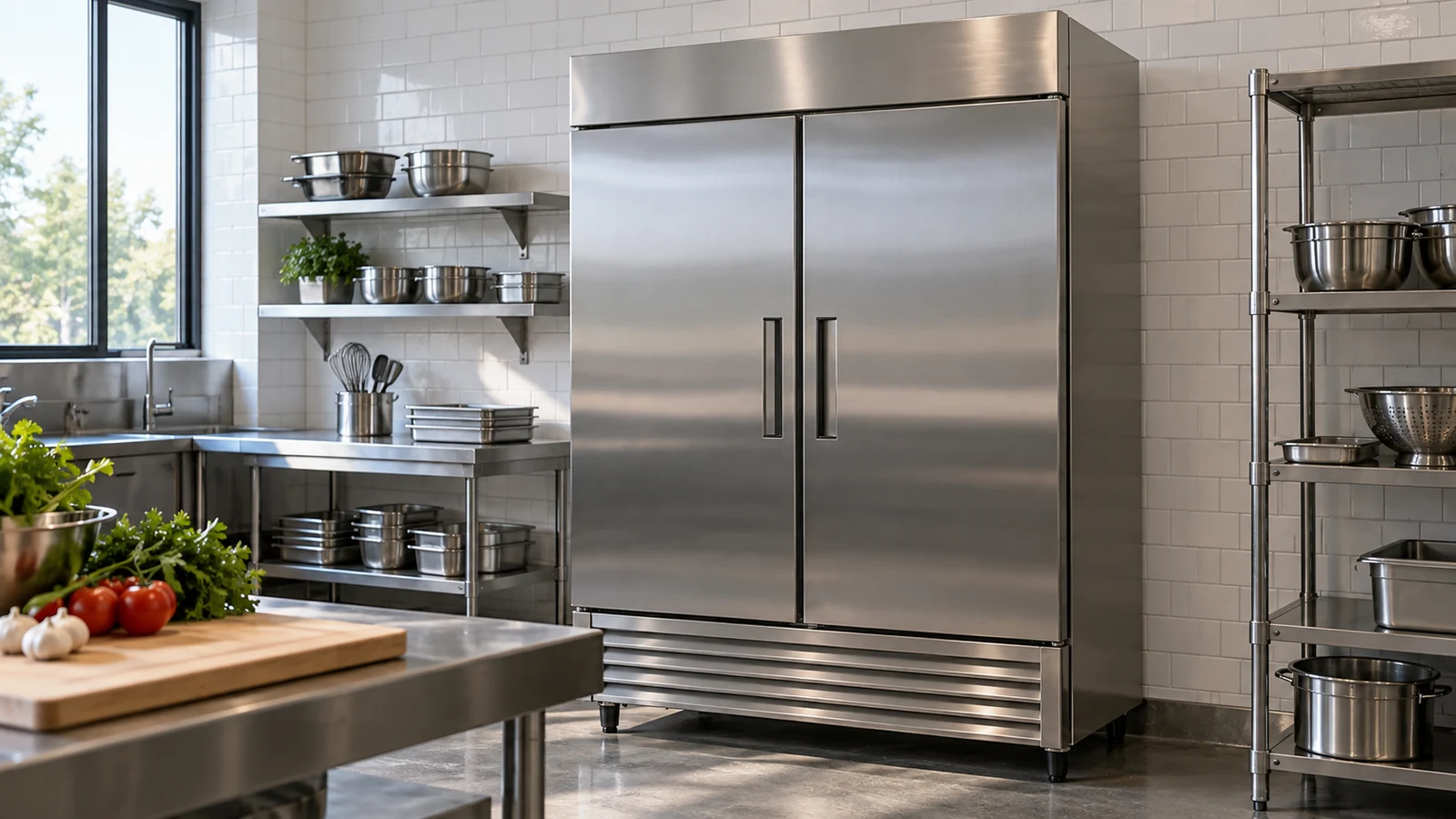
The Elite Kitchen Supply EKS-KR49 refrigerator has listed dimensions of 54.2 inches wide, 32 inches deep and 81.9 inches high, with 43 cubic feet of capacity and a 115V/60Hz supply requirement. Those specifications support an initial prep-room assessment. They do not establish that the proposed installation will work: ventilation clearances, electrical load details and the exact door construction still need confirmation before you commit space to this model.
For a prep-room buyer, the immediate question is whether this particular cabinet belongs in the planned equipment layout. Start by resolving its identity, then assess the installation against your room and working routine. The narrower COOLSKI reach-in provides a comparison if you are still deciding how much room to allocate to refrigeration. Neither listing supplies every measurement needed for a final installation decision.
The approved Elite Kitchen Supply EKS-KR49 refrigerator listing identifies model EKS-KR49, SKU sku-15150211015 and UPC 764749182402. Use those identifiers when requesting a specification sheet or clarification. Its general 54-inch description is less precise than the stated 54.2-inch width, so use the detailed measurement when sketching the proposed position.
There is a material inconsistency in the description: the source title describes two glass doors, while the body specifies two solid doors. Ask which construction applies to the exact unit being offered. A product name or image should not settle that disagreement by itself. If seeing stored ingredients through closed doors is part of your purchasing requirement, keep that requirement unresolved until the configuration is confirmed.
Also confirm the condition of the offered unit and what accompanies it. The supplied product information does not establish whether the individual unit is new, previously used or otherwise classified. Request a description of its condition and included equipment that refers to the same model and SKU. This helps prevent a room plan based on one configuration from being attached to an order for another.
Compare Refrigerator Compartment Capacity Beyond The Total In A Prep-Room Plan
Begin with a drawing of the intended refrigerator position beside the actual prep equipment. Mark the EKS-KR49 cabinet dimensions, then leave the required installation clearances undecided until you have the model instructions. The listed width and depth describe the appliance; the supplied facts do not specify the complete space that the manufacturer requires around it. Avoid treating a cabinet-sized rectangle as an approved installation envelope.
Height deserves a separate check. Record anything above the proposed location, including shelving or other fixed obstructions, and compare it with the listed 81.9-inch height. The listing also names 4-inch casters but does not explain whether the stated overall height includes them. Ask for the installed dimension instead of adding or subtracting a caster allowance yourself. A dimensioned drawing should resolve what the published measurement covers.
Next, walk the route from the receiving point to the proposed location. Record restricted openings and turns for whoever will assess the move. The supplied information does not give packaged dimensions or shipping weight, and an unpacked cabinet measurement cannot answer every handling question. Establish whether the unit can reach the room before arranging surrounding equipment around its intended position.
The prep-room assessment should include how people will work beside the refrigerator. On your layout, show where a worker would stand while loading ingredients and where a cart would wait. For example, if the proposed position faces a preparation table, ask whether loading the cabinet would interrupt use of that table. This is a planning scenario to examine in your room, not a claim about the refrigerator's operating clearance.
The listing describes doors that close automatically when opened less than 90 degrees and remain open beyond 90 degrees. That behavior is relevant to loading, but it does not provide a door-swing measurement or establish the position needed for servicing. Ask for the door projection and any access requirements in the installation documentation. Keep this check tied to the confirmed glass-door or solid-door configuration.
For a separate explanation of capacity terminology, read Compare refrigerator compartment capacity beyond the total. Here, the immediate task is deciding whether the EKS-KR49's listed storage provision belongs in your prep room. Its capacity should be considered alongside the space assigned to the cabinet and the work that will take place around it.
Compare Refrigerator Compartment Capacity Beyond The Total With The Listed Shelving
The EKS-KR49 description states 43 cubic feet of capacity and eight shelves, with each shelf rated for 155 pounds. These are useful specifications to bring into an equipment discussion. The supplied facts do not include shelf dimensions, spacing options or a complete loading diagram. Ask for those details before deciding how your existing containers will be arranged.
Prepare a short inventory of the containers you expect to store during an ordinary prep shift. Include their actual dimensions and loaded weights where known. You can then ask whether the intended arrangement fits the supplied shelves and complies with the manufacturer's loading instructions. Avoid treating the individual shelf rating as a combined cabinet rating; the description does not state a total permissible load.
Consider a prep room that will transfer covered ingredient containers into the refrigerator after each preparation task. The useful purchasing question is whether the intended shelf arrangement accommodates those containers while preserving the access and clearances specified by the manufacturer. If you cannot yet identify that arrangement, the shelf count is a starting point for a question, not a completed storage plan.
The cooling description lists a compressor, fan cooling, automatic defrost and a digital temperature controller. It gives a temperature range of 33°F to 41°F and also specifies a digital-control range of 0.5°C to 4.5°C. Ask what each range describes and which operating instructions apply to the offered unit. The listing does not establish temperature recovery during repeated loading or performance under your room's particular conditions.
Record the conditions that the supplier needs to assess, such as the proposed position relative to heat-producing equipment and the room's expected operating environment. Request the model's permitted ambient conditions and ventilation requirements. A stated temperature range alone does not resolve whether an installation beside other equipment is suitable. Keep any food-handling procedures separate from the product comparison and use the requirements applicable to your operation.
The Elite Kitchen Supply EKS-KR49 refrigerator is listed for 115V/60Hz power. The supplied description does not establish its current draw, plug configuration or required circuit arrangement. Give the model documentation to the person responsible for the room's electrical installation and have them assess the intended connection. The voltage label by itself is insufficient to approve an existing outlet for this appliance.
COOLSKI Refrigerator Alternative For A Different Space Allocation
The approved COOLSKI refrigerator alternative is described as a 27-inch-wide commercial reach-in with 19.32 cubic feet of capacity. It gives you a narrower listed format to consider if allocating space to the EKS-KR49 would constrain the rest of the prep room. Its supplied description does not include complete exterior dimensions or electrical requirements, so it needs its own installation assessment.
The comparison is therefore between different space allocations, with incomplete installation information for both. The EKS-KR49 supplies a larger listed capacity and a complete set of exterior dimensions. COOLSKI supplies a narrower width in its title and a smaller stated capacity. Choosing between them depends on the storage you intend to assign to this position and the dimensions still to be confirmed.
COOLSKI lists four adjustable shelves rated for up to 210 pounds each, while the EKS-KR49 lists eight shelves rated for 155 pounds each. A higher individual shelf rating does not settle which cabinet is more useful for your prep work. Consider the intended arrangement and obtain the loading instructions for each model. The available descriptions do not provide enough information to compare total cabinet loading limits.
The COOLSKI description also specifies stainless steel inside and outside, a digital temperature display and a stated range of 33°F to 41°F. Those details allow a limited feature comparison. They do not establish equivalent temperature control under working conditions, equal energy consumption or comparable service requirements. No measured performance results are supplied for either refrigerator.
For loading access, COOLSKI describes self-closing doors that stay open at 180 degrees. The EKS-KR49 description uses the less-than-90-degree and beyond-90-degree behavior noted earlier. Ask how the respective mechanisms work in the actual configurations being offered. The stated angles should not be used as a substitute for dimensioned access drawings, especially where a nearby work surface or wall affects installation.
A useful comparison request would describe the same proposed task to both suppliers: the location, intended containers and expected loading routine. Ask each to identify the applicable installation requirements and any limitations. This keeps the decision attached to your prep room instead of letting a single specification, such as shelf load or total capacity, determine the purchase without the missing context.
If the wider cabinet would require moving existing equipment, establish that work before choosing it. If the narrower cabinet would leave some planned ingredients without an assigned storage location, resolve that gap before choosing the alternative. Neither outcome automatically makes one model unsuitable. Each changes what else the room plan must accommodate, and those consequences belong in the purchasing decision.
Before ordering, consolidate the unresolved EKS-KR49 questions into one model-specific request. Seek confirmation of door construction and unit condition, followed by the installed dimensions and clearance drawing. Request the electrical specifications and loading instructions with that same response. Keeping the identifiers attached to these questions helps ensure that the answers describe the unit you are considering.
Review transaction details separately once the equipment choice is settled. Check the current total and any delivery arrangements shown for the actual order; neither is established by the cabinet dimensions. If using a crypto payment option, read the displayed asset, network and payment instructions before proceeding. This guide does not establish accepted networks, fees, payment deadlines or refund conditions for a future transaction.
Use the EKS-KR49 product page to request the documentation needed for your proposed installation. A purchasing decision is ready when the confirmed configuration can be placed in the room, connected as specified and assigned a workable storage role. If the answers leave a physical or electrical incompatibility, retain the room measurements and reassess the narrower comparator against the same requirements before committing to either cabinet.