Crypto Commerce
Edifier R1280T powered speaker pair vs Dayton IO800BT: a desk pair or an installed speaker
Compare Edifier R1280T powered speaker pair for a desk, room, patio, or distributed audio system.
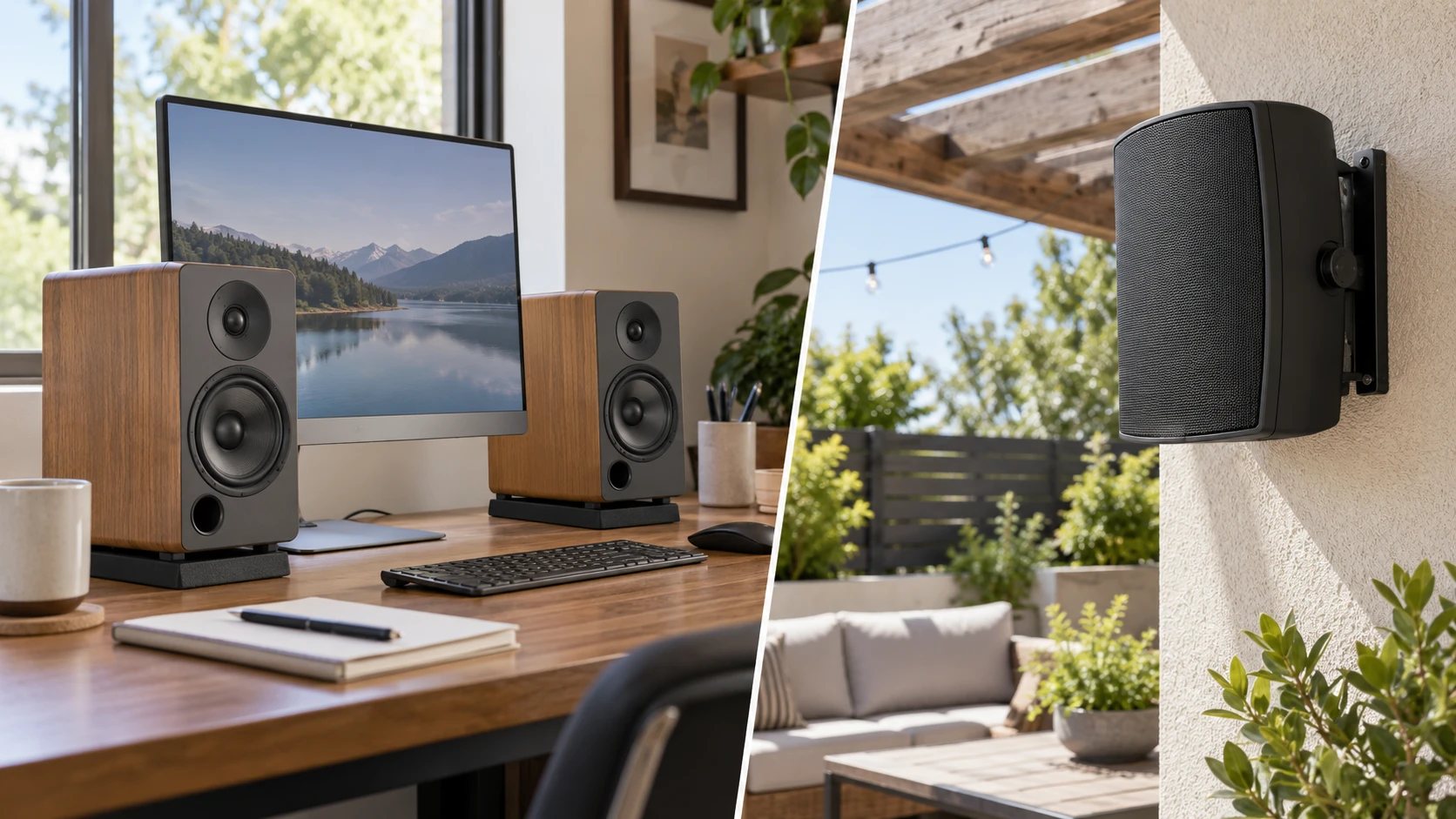
These speakers belong to different kinds of systems. The Edifier R1280T listing is a powered pair bundled with SS5 isolation pads. The Dayton Audio IO800BT listing describes one passive eight-inch indoor/outdoor speaker with an eight-ohm bypass and a selectable 70V transformer. If your source is a computer on a desk, the Edifier package is the more direct starting point. If you are planning sound for a patio or a distributed installation, the Dayton is a component to design around, with amplification and wiring to account for separately.
The Edifier R1280T powered speaker pair has two AUX inputs. Its listing says you can connect devices with a 3.5 mm headphone output or dual RCA outputs and leave two source devices connected. The package includes the SS5 pads, which can be arranged at different angles under the speakers. Check the actual outputs on your computer, television, turntable, or other source before assuming it will connect directly. The listing does not establish that every device has the required analog output, and it does not promise Bluetooth in this package.
Start with the signal path — Dayton Audio IO800BT speaker
A powered speaker system has amplification built into the speaker package. For a simple desk setup, that removes the separate receiver or power amplifier from the shopping list. You still need a suitable signal connection and a place to power the speakers. Confirm the supplied cables and their lengths in the current product package before placing the speakers far apart. The two AUX inputs are convenient if, for example, a computer and another analog source share the desk; they are inputs, not evidence of a digital or wireless feature.
The IO800BT is a different purchase. Its eight-ohm bypass is intended for use with a compatible consumer amplifier, while its transformer taps support a 70V distributed audio system. A source device alone cannot drive this passive speaker at normal listening level. Plan the amplifier, cable run, speaker connection, and any required outdoor-rated installation parts as part of the system. The product row does not say those items are included. This difference matters more than a comparison of cabinet dimensions or nominal wattage: buying the Dayton as a direct replacement for powered desktop speakers would leave you without a working signal path.
For room-by-room routing, the published speaker wiring for an indoor-outdoor setup guide is useful context. Its topic is wiring choices, so use it to think through where a source, amplifier, and speakers will sit. Then check the actual terminal and amplifier instructions for the equipment you choose. A plan that works for one powered desk pair should not be copied mechanically to a long passive-speaker run.
Two speakers in a package versus one installation unit — Dayton Audio IO800BT speaker
The Edifier offer is explicitly a pair. Place the speakers to the left and right of the listening position, leaving enough room for the cabinets and the pads. You can try different pad angles to aim sound toward your ears, then settle on the position that fits the desk and remains stable. The listing describes high-density acoustic sponge and an anti-skid surface. Those details support placement and vibration control; they do not guarantee that the pads will cure every resonance in a particular desk. A hollow surface, a cabinet pressed against a wall, or a loose object may still change what you hear.
The Dayton product row describes a single speaker. One unit may be appropriate for a particular background-music location, but do not mistake the catalog unit for a stereo pair. A stereo plan normally needs two correctly placed channels and an amplifier that supports the chosen connection. A wider patio or several zones may need more speakers, cable, and an amplifier selected for the total load. Work out coverage and channel requirements before multiplying a single-speaker price into a project budget. The listing's examples include patios, gardens, porches, pools, bars, hotels, restaurants, and conference rooms; those are possible settings, not a claim that every location can use the same mounting or electrical design.
A desk also imposes different physical demands from an installation wall or eave. The Edifier speakers and pads need flat, stable surfaces with practical access to power and source cables. The Dayton needs a secure installation location and a protected route for its speaker cable. Check the chosen mount, hardware, placement clearances, and local electrical requirements separately. The product description does not specify an ingress-protection rating. “Indoor/outdoor” in the listing should not be read as permission to expose the cabinet, terminals, or wiring to every kind of weather or water contact.
Interpreting the Dayton's eight-ohm and 70V modes — Dayton Audio IO800BT speaker
The IO800BT listing gives 65 watts RMS and 130 watts maximum power handling in its eight-ohm description, plus a bypassable 70V transformer with 6.25, 12.5, 25, and 50 watt taps. Those figures describe different ways to integrate the speaker. In eight-ohm bypass mode, select an amplifier that can handle the speaker load at the intended volume, and follow both manufacturers' connection instructions. Do not treat the maximum power-handling number as a target for continuous playback or as a substitute for amplifier compatibility.
A 70V system is commonly used when several speakers share a distributed line. Each speaker's transformer tap assigns a portion of the amplifier's available power budget. If you add speakers, add their selected tap values, then follow the amplifier manufacturer's guidance for margin and wiring. A 50-watt tap and a 6.25-watt tap represent different allocations on that kind of line. The taps do not turn this one cabinet into a powered speaker. Nor should the eight-ohm bypass and a 70V tap be treated as interchangeable connections on the same amplifier output. Check the switch or terminal setting before energizing the system.
The Dayton listing also gives an 87 dB sensitivity figure at 1 W/1 m and a stated 38 Hz to 20 kHz frequency response. These catalog specifications can help when comparing installation candidates, but they do not predict the sound at your seat by themselves. Distance, placement, room surfaces, outdoor noise, amplifier limits, and the selected mode all matter. Avoid promising a certain loudness or bass result from the numbers alone. If the intended use is speech on a patio, the required coverage can differ considerably from close music listening at a desk.
Where the Edifier package fits — Dayton Audio IO800BT speaker
The R1280T pair suits someone who wants a compact stereo arrangement near analog sources. The two inputs may reduce cable swapping when a computer and another device remain in place. Check how each source controls volume and how you will switch between them in the actual product instructions. The listing supports the existence of two AUX inputs; it does not specify every operational detail of source switching. For a television, verify the television offers a compatible analog output, or plan a separately appropriate interface. An optical-only output cannot be assumed to plug straight into a 3.5 mm or RCA analog input.
The supplied isolation pads are a meaningful part of this specific Edifier bundle. Their two-piece design permits several angles, and the anti-skid surface is intended to keep the cabinets in position. The useful angle depends on the height of your desk and the distance to your ears. Try a placement that keeps the tweeters sensibly aimed without pushing the speakers into the edge of the desk. Give the cabinets and cable connectors enough clearance. If you are comparing listings elsewhere, verify that the pads are actually included there; the bundle described here is not necessarily the configuration of every R1280T offer.
There are limits to the desk-pair approach. A powered pair placed close to a workstation is not, by itself, a plan for a long outdoor run or multiple remote rooms. Extending analog source and power connections across a property raises practical routing questions. The Dayton's passive architecture and 70V option are there for a different installation problem. If you need that broader layout, design the amplifier, speaker count, and cable routes before choosing hardware.
Where the Dayton speaker fits — speaker wiring for an indoor-outdoor setup
The Dayton Audio IO800BT speaker makes sense when a passive speaker belongs in a planned indoor or outdoor zone. Its description names an eight-inch mineral-filled polypropylene woofer with a rubber surround and a one-inch fabric-dome tweeter. It also describes 70V taps for background music or paging, and eight-ohm bypass for a consumer-amplifier installation. The choice of mode follows the amplifier and the rest of the speaker layout, not a simple preference for the largest watt figure.
A single unit gives you a starting point for coverage, not a complete kit. Count the zones, choose where listeners will be, and note how far the cable must travel. For several 70V speakers, document each proposed tap and compare the combined demand with a compatible amplifier's instructions. For an eight-ohm stereo installation, check the load presented by the planned number of speakers and the way they are wired. Series and parallel wiring change the electrical load; do not improvise an extra pair onto an amplifier that was selected for one speaker per channel.
Installation details deserve their own check. Indoor/outdoor placement may expose cable joints and hardware to temperature changes and moisture even when the speaker is under cover. Use the mounting and environmental directions supplied with the actual unit, and choose wiring and fittings suited to the site. The catalog description does not state a formal water-resistance grade or provide enough information to design a poolside electrical installation. A qualified installer is useful when cable routes, building penetrations, or local code requirements are outside your experience.
Which should you choose? — Dayton Audio IO800BT speaker
Choose the Edifier bundle when you want a powered left-and-right pair near a desk or shelf, have compatible analog source outputs, and value the included adjustable pads. Confirm available outlets, cable reach, and speaker spacing before ordering. Choose the Dayton when you already have, or are designing, an amplifier-led system for a specific indoor or outdoor listening area. Determine whether that system uses eight-ohm operation or a 70V line before selecting amplifier capacity and wiring. In either case, inspect the current package contents and manufacturer instructions to identify every needed part.
The products can also serve different parts of the same home: a powered pair beside the computer and installed passive speakers elsewhere. That arrangement still requires separate signal and power plans for each location. A useful buying decision starts with where listeners sit, what source output is available, and where amplification belongs. Once those are settled, the Edifier and Dayton listings stop looking like two versions of the same speaker and become two distinct ways to build the sound system you need.