Writing & Documents
A duplicated paragraph repair keeps the intended scene
A complete before-and-after manuscript example removes one accidental adjacent paragraph copy while preserving the chosen scene and its deliberate repeated words.
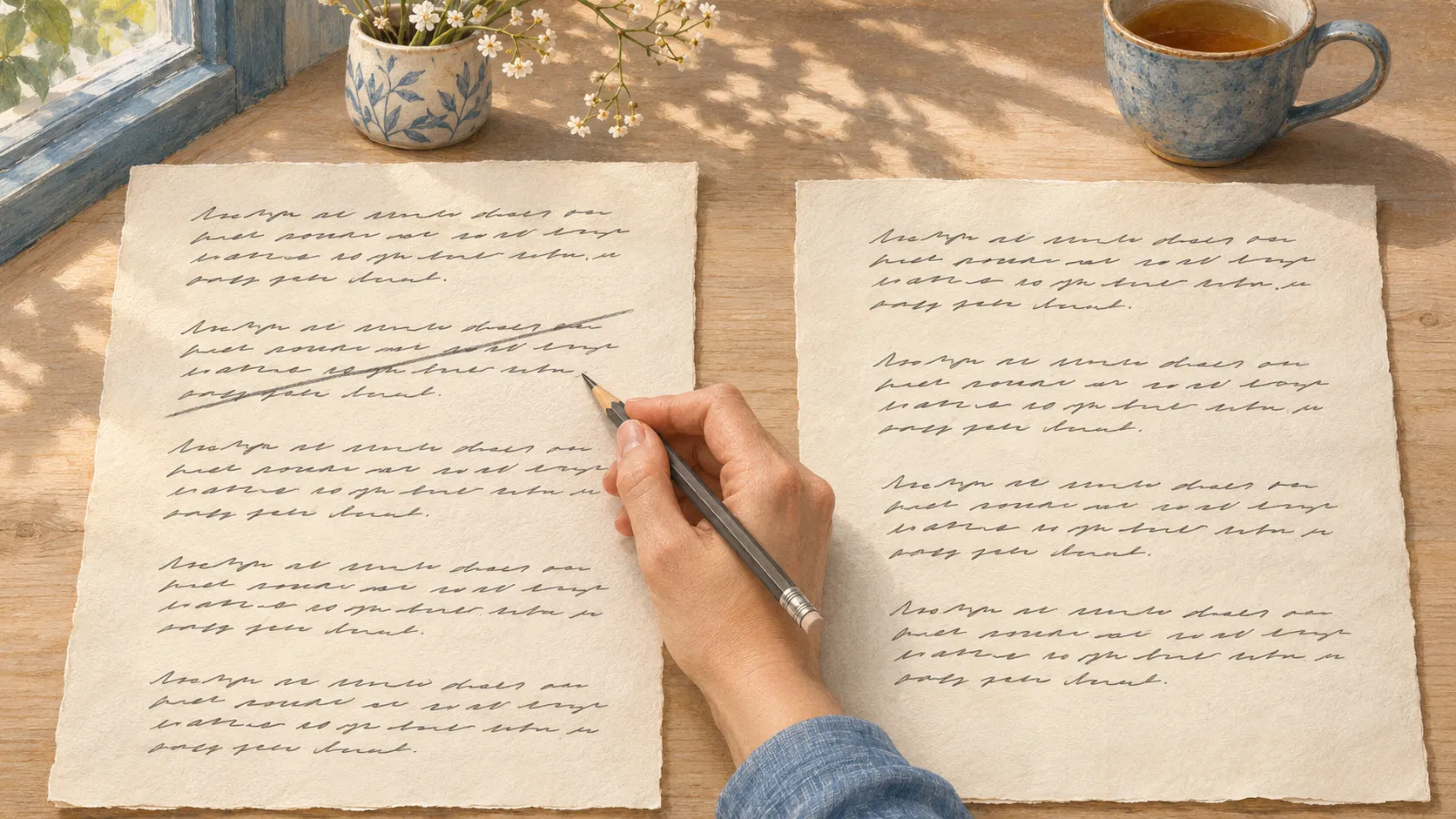
This duplicated paragraph repair removes one accidental paste from an original manuscript. The author intends the descriptive paragraph to appear once. The two spoken replies “Leave it open” are deliberate and stay where they are. Sera, Kit and the entire scene are fictional.
Keep the selected manuscript in view
Suppose you are preparing this short scene to send to a willing reader. While arranging the working copy, you accidentally paste its cushion-and-bowl paragraph immediately after itself. You have not chosen a new description or a second visit to the same place. The extra copy is a copying accident in this declared example.
Keep that working copy before editing it. It lets you see the exact paragraph that appeared twice and compare the result with what you intended to keep. A vague note saying “cut the repetition” would leave several possible targets, including the repeated spoken reply you actually want.
The correction here concerns the manuscript text. It supplies no command sequence for a particular editor, no hidden-formatting inspection and no account of what another person's unfinished draft was meant to say. If you are editing someone else's work, establish their intention before treating a repeated passage as an accident.
Read the complete working copy
Sera sat on the window seat while Kit looked for the letter he had promised to show her. He pulled the shallow drawer halfway out, found a bundle of ribbon and left it resting against his knee. “Shall I shut this?” he asked. “Leave it open,” Sera said. She could see the corner of an envelope beneath the ribbon.
A patched green cushion filled one end of the seat. Its pale repair ran around the corner nearest the window, where the fabric had worn thin. Beside it stood a small blue bowl containing two loose buttons. The bowl had a chipped foot, hidden against the wood, and a white line around its rim.
A patched green cushion filled one end of the seat. Its pale repair ran around the corner nearest the window, where the fabric had worn thin. Beside it stood a small blue bowl containing two loose buttons. The bowl had a chipped foot, hidden against the wood, and a white line around its rim.
Kit lifted the ribbon and found the envelope. There was nothing inside. He held it toward the light, then put it beside the bowl. Sera turned it over and saw her own handwriting on the back. “That was the one I brought you,” she said. Kit sat on the chair opposite her, with the ribbon still looped around his fingers.
A breeze pushed the curtain against the envelope. Kit caught it before it fell between the seat and the wall. “I could close the window,” he said. “Leave it open,” Sera answered. She moved the empty envelope beneath the bowl, then drew the curtain behind the cushion. The drawer remained open beneath Kit’s chair, with one end of the ribbon trailing over its edge.
Mark the complete extra copy
The repeated descriptive paragraph begins “A patched green cushion filled one end of the seat” and ends “a white line around its rim.” Those boundaries identify the whole passage. Both adjacent copies contain the cushion, its repair, the bowl, the buttons and the hidden chipped foot in the same wording.
For this example, the second adjacent copy is the extra pasted paragraph. Keep the first copy, which places the description between Sera noticing the envelope and Kit lifting the ribbon. The author's intended sequence already includes that description there. You do not need to decide whether a different position would make a better story.
Read the text just before and after the extra copy. The preceding paragraph is the first copy of the same description. The following paragraph begins with Kit lifting the ribbon. Removing the surplus paragraph will therefore bring the first description directly beside that action. It leaves the intended descriptive passage available to the reader.
Keep the paragraph break after the retained description. Deleting the surplus words should not merge the description with Kit's next action in this selected version. The resulting manuscript has four paragraphs, matching the four original paragraphs supplied for the exercise. Other stories can have as many paragraphs as their writers choose.
Leave the intentional echo alone
The words “Leave it open” occur in the first and last scene paragraphs. In the first exchange, Kit asks about the drawer. In the last, he proposes closing the window. Sera's answer recurs, but the surrounding sentences give it a different immediate object each time.
The author has deliberately kept those two replies. A command or editing habit that removes every repeated phrase would change the chosen dialogue. The current correction selects one complete adjacent descriptive copy. It does not require either spoken answer to be rewritten, combined or removed.
You can make a separate note that both replies should remain in the retained scene. That note helps you check your edit without inserting an explanation into the story. Neither Sera nor Kit needs to discuss the manuscript's paste accident. Their conversation can keep following the envelope, drawer and window.
Retain the complete corrected scene
Sera sat on the window seat while Kit looked for the letter he had promised to show her. He pulled the shallow drawer halfway out, found a bundle of ribbon and left it resting against his knee. “Shall I shut this?” he asked. “Leave it open,” Sera said. She could see the corner of an envelope beneath the ribbon.
A patched green cushion filled one end of the seat. Its pale repair ran around the corner nearest the window, where the fabric had worn thin. Beside it stood a small blue bowl containing two loose buttons. The bowl had a chipped foot, hidden against the wood, and a white line around its rim.
Kit lifted the ribbon and found the envelope. There was nothing inside. He held it toward the light, then put it beside the bowl. Sera turned it over and saw her own handwriting on the back. “That was the one I brought you,” she said. Kit sat on the chair opposite her, with the ribbon still looped around his fingers.
A breeze pushed the curtain against the envelope. Kit caught it before it fell between the seat and the wall. “I could close the window,” he said. “Leave it open,” Sera answered. She moved the empty envelope beneath the bowl, then drew the curtain behind the cushion. The drawer remained open beneath Kit’s chair, with one end of the ribbon trailing over its edge.
Compare what stayed
Read the opening in both versions. Sera is on the seat, Kit opens the drawer and the corner of the envelope is visible. Those sentences are unchanged. The description still follows them once, and the paragraph about Kit finding the empty envelope still comes next. The repair adds no event to explain the former repetition.
Now compare the ending. Kit catches the envelope, Sera asks him to leave the window open and she places the envelope beneath the bowl. The drawer and trailing ribbon stay in the final view. Removing the extra pasted paragraph has not supplied the missing letter or decided where its contents went.
Keep the whole corrected copy as the selected manuscript, with any editing explanation in a separate record. A reader receiving only the scene can follow its actual paragraphs. They should not need a private instruction telling them to ignore one of two descriptions that still appear in the delivered text.
You have removed the declared surplus copy and preserved the selected wording, including both intentional replies. It does not certify every aspect of the story, predict a reader's response or make another editing decision on the author's behalf. A later rewrite can have its own before-state and chosen changes.
Two optional desk-lamp accounts
The Adesso Bryn desk-lamp account names 3760-12 in its native details. Its sole original shows a cone-shaped head attached by a collar to a straight wood-colored pole, above a round base. No readable maker or model label authenticates those catalog identifiers. Adjustment, touch switching, materials and dimensions have not been independently tested here.
The Adesso Wallace desk-lamp account names 3754-01. Its sole original shows a dark dome shade, golden-colored interior, visible bulb, curved neck and tiered round base. No readable on-product maker or model label was observed. The stated USB feature establishes no tested charging result or separately supplied device.
Both desk-lamp accounts remain optional references outside the scene. Neither establishes delivered quantity, electrical safety or an editing result. The pictured assemblies and catalog statements do not authenticate every supplied component or performance claim.
Keep neighboring repairs distinct
The duplicated room entry repair replaces an unintended second entrance with a different movement inside the room. This example deletes a surplus exact descriptive copy. Every intended scene sentence stays unchanged, with no replacement action.
The opening-only cue card revision changes one selected cue while retaining another intentional matching occurrence. Here the declared accidental copy is a whole adjacent paragraph, and both intentional spoken replies stay unchanged.
The retained scene is the complete four-paragraph version printed above. Keep it with the record of the removed copy if that record is useful to your own project. The corrected manuscript can then be read on its own, beginning with Sera on the seat and ending with the ribbon beside the open drawer.
Read any optional order on its own terms
If a later purchase on republeq.com leads you to consider crypto or cryptocurrency, review the payment choices actually presented for that particular order. This fictional editing example establishes no current checkout option, price, supported network or payment destination. If USDT is offered, confirm the specified asset and network, the amount requested and the authorized instructions tied to your order before deciding whether to pay. Keep any unresolved product question with the seller, including the exact offered reference, selected variant and supplied contents. A photograph and a catalog model field do not authenticate the unit that will arrive. Read the applicable delivery, cancellation, return and refund terms, and ask the responsible support contact to clarify any material omission. Where a refund arrangement matters to your decision, establish its denomination and any stated deductions before proceeding. An intended payment asset does not supply those terms. If you do proceed, preserve the order acknowledgement and the transaction record that actually result. An opened wallet or a submitted instruction alone does not prove the purchase is complete. An uncertain payment needs reconciliation before another attempt. Keep the product account and any seller clarification with the order so that the delivered item can be checked against the actual offer. Do not infer delivery, condition, electrical suitability or successful use from a payment confirmation. Obtain the instructions applicable to the supplied unit before using it. The scene can be read and this manuscript correction considered with materials already at hand; neither activity depends on buying a lamp or completing a transaction. Any later order remains a separate decision under the merchant's actual terms.