Crypto Commerce
Dukers DUC72F undercounter freezer vs Norpole NP2F-36UC for undercounter cold storage
Compare Dukers DUC72F undercounter freezer by footprint, doors, shelving, temperature controls, electrical requirements, and service details.
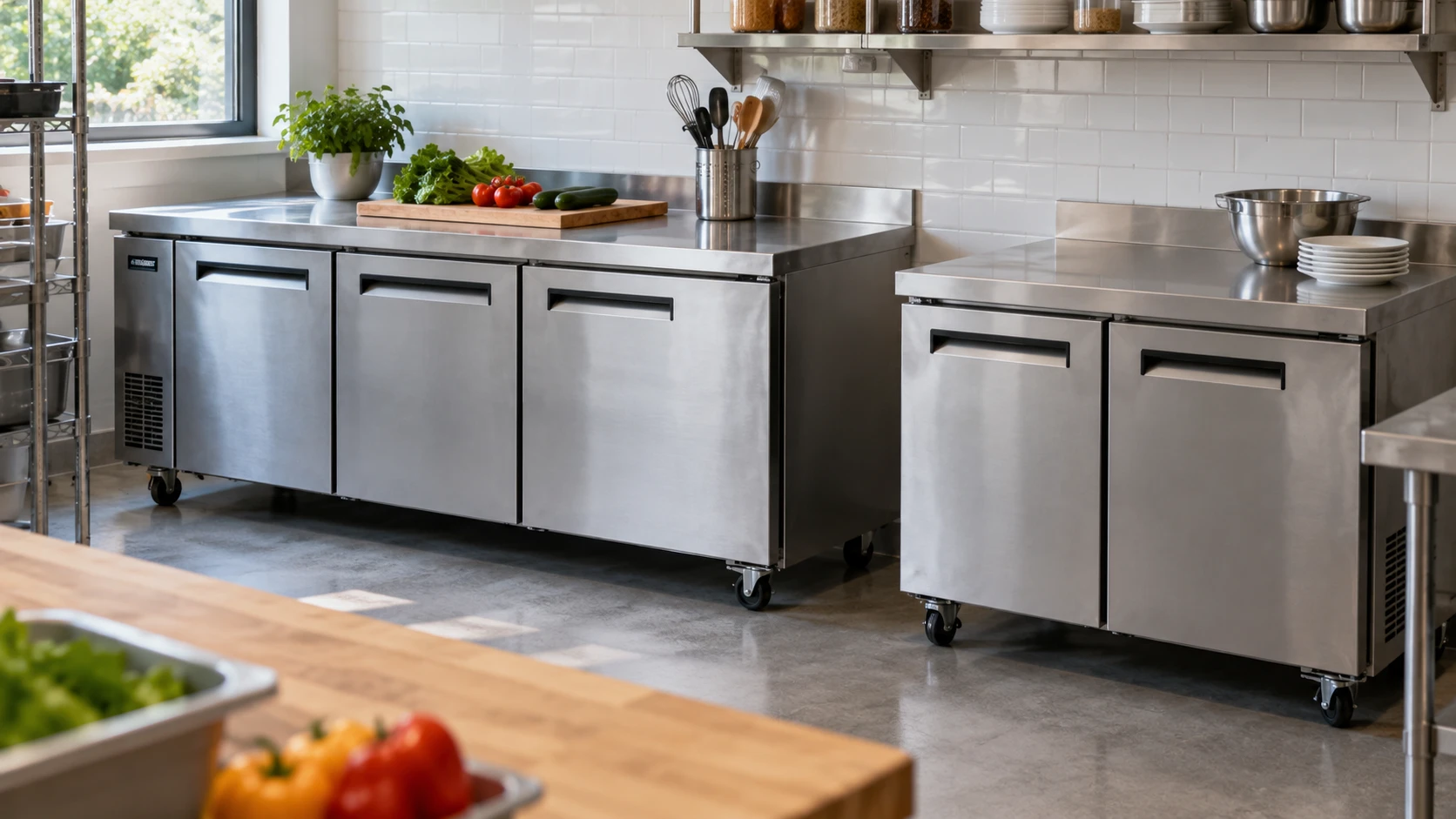
The Dukers DUC72F undercounter freezer and Norpole NP2F-36UC are both listed for undercounter freezing, but their stated widths lead to different kitchen layouts. Dukers measures 72 1/4 inches wide; Norpole's listing identifies a 36-inch width. Both have digital temperature controls and casters, while their door, shelf, electrical, and service descriptions differ. Before asking which freezer holds more, map the intended food inventory, the available run of counter, and the delivery route. A larger outside cabinet does not reveal how many usable pans or boxes fit within it.
The published guide to freezer capacity and size planning addresses a similar problem: a capacity or width label needs to be tied to the actual compartment. Neither pinned product excerpt gives a cubic-foot interior capacity for these two models. Write down the dimensions of the freezer pans, containers, and packaged stock used most often. Check each Republeq catalog entry for the interior width, depth, height, shelf positions, and load ratings. A shelf that can hold a carton may still leave insufficient clearance to lift that carton out through the door.
The Norpole NP2F-36UC undercounter freezer listing describes two self-closing doors that can stay open at 90 degrees. Dukers' excerpt does not state its number of doors or their opening angle, despite giving detailed overall dimensions. Ask for a front view of the exact DUC72F and check how its door swing interacts with an aisle, prep station, or neighboring appliance. A narrow kitchen can lose usable working room when a freezer door opens into the path between cooking and service.
Measure the entire installation space — Norpole NP2F-36UC undercounter freezer
Dukers states overall dimensions of 72 1/4 inches wide, 31 1/2 inches deep, and 36 inches high. Its four locking casters are listed as four inches. Verify whether the published height already includes the casters and whether the top can sit beneath the existing counter with the ventilation clearance the manual requires. A long undercounter unit can cross a floor seam or slope; the installation plan should account for leveling and locking the wheels. Measure the narrowest doorway and turning corner on the delivery route as well as the final bay.
Norpole's page gives a 36-inch width, but no depth or height in the pinned excerpt. Request its complete assembled dimensions, including casters and any handle projection. A 36-inch cabinet may leave room for another station, yet that conclusion depends on its required service and ventilation space. The two doors need enough clearance to reach shelves and clean their tracks. Stand where staff will open them during a busy service period and check whether the door swing blocks a sink, an oven, or another person's route.
Plan the electrical outlet before delivery. Dukers lists a NEMA 5-15P plug, 115-volt 60-hertz operation, 12.4 amps, 1,050 watts, and a nine-foot power cord. Those figures provide a concrete starting point for a qualified site review. Do not assume a free outlet on a crowded kitchen circuit can support it. The Norpole excerpt gives no plug, voltage, current, wattage, or cord information. Request the model-specific nameplate and installation manual so an electrician can verify the outlet and circuit against the actual equipment.
Compare the usable storage layout — Norpole NP2F-36UC undercounter freezer
Dukers lists three adjustable, removable wire shelves. The excerpt does not state whether that is a total count or a per-compartment count, and it does not give shelf dimensions. Ask for a shelving diagram, maximum load per shelf, and the clear space at each setting. Wire shelves can let cold air move around packages but may require trays or bins for small items. Check whether the restaurant's existing storage containers sit securely and whether the front lip or door opening makes them hard to slide out.
Norpole describes adjustable heavy-duty PVC-coated shelves and rounded interior corners. It does not state the number or dimensions of shelves in the pinned description. Rounded corners could make wipe-down easier, but the shape may also reduce the fit of a square container near an edge. Measure the usable shelf area, not just the cabinet's 36-inch exterior width. The two-door arrangement might help staff reach different stock groups, provided each compartment and shelf is large enough for what will be stored there.
Make a simple inventory map. Assign high-turnover items to the easiest shelf, heavier containers to positions allowed by the manual, and rarely used stock to less accessible space. Check whether each model's shelves can be removed for cleaning without moving the whole freezer. If several staff members will use it, label locations so the doors are not held open while someone searches for an item. Neither listing supplies a temperature-recovery test after repeated openings, so the way the unit is loaded and used should be part of an in-kitchen trial.
Read the temperature and defrost details — freezer capacity and size planning
Dukers states a digital control with an LED display and a range from 0 to minus 8 degrees Fahrenheit. Norpole gives digital controls from minus 7 to 0 degrees Fahrenheit. These setpoint ranges are close on paper. They do not establish how stable the air or food temperature stays under load, how quickly either unit recovers after a door opens, or where a probe should be placed. Ask for the manual's control procedure and use an independent thermometer to verify the cabinet after installation. Follow the food-storage rules applicable to the kitchen.
Dukers lists automatic defrost. The pinned excerpt does not explain the defrost schedule or how it affects displayed temperature. Norpole's excerpt says nothing about defrost, so its maintenance method needs confirmation before a purchase. Ask how each unit handles condensate, where any pan or drain sits, and whether staff must perform routine cleaning around it. A freezer that is easy to load but difficult to service can disrupt the kitchen later. Keep access to the mechanical compartment clear as specified by the manufacturer.
The Dukers listing identifies a 3/4-horsepower bottom-mounted compressor and R290 natural refrigerant. Norpole's pinned text does not identify its compressor location or refrigerant. Those omissions matter for service planning, not as proof of inferior performance. Ask the installer where each unit needs breathing room and how a technician reaches its components. Follow the manufacturer's directions for moving and commissioning the appliance. Refrigeration equipment should not be installed by guessing the clearance from a product photograph.
Check mobility, construction, and cleaning — Norpole NP2F-36UC undercounter freezer
Dukers' four casters are described as locking, while Norpole lists heavy-duty caster wheels without stating whether they lock. Verify Norpole's wheel brakes and leveling method if the freezer will serve as a work surface. Staff should not have to steady a rolling cabinet while opening a door or placing a pan above it. Norpole's self-closing doors may limit how long a door is left ajar, but the 90-degree stay-open feature should be checked against the actual hinge and floor plan. Ask whether door gaskets can be replaced separately.
Both products describe stainless-steel construction. Dukers specifies stainless steel inside and out; Norpole says the body is stainless steel and calls out rounded interior corners. Confirm the actual food-contact surfaces, seams, and cleaning instructions for the shipped unit. A metal exterior can still collect grease at handles, door edges, and caster brackets. Try opening the door and removing a shelf with the space available in the planned installation. A cleaning crew needs access to the floor beneath and the wall behind the cabinet without disconnecting protected equipment.
Noise and heat rejection are absent from both pinned excerpts. A compressor under a prep counter can affect nearby staff comfort and surrounding appliances. Request operating sound and ventilation details from model-specific documents if either unit will stand in a small room. The electrical rating alone does not establish energy use over a day, since the compressor cycles in response to load and room conditions. If utility cost is important, seek comparable energy-use data under the same test basis instead of extrapolating from Dukers' 1,050-watt input figure.
Verify the commercial paperwork and service path — Norpole NP2F-36UC undercounter freezer
Dukers' listing says it complies with NSF/ANSI 7 and is ETL listed. Norpole's excerpt claims ETL and ETL Sanitation certification. A buyer should verify the exact model in the relevant listing or certificate and ask what installation or local inspection requires. The terms are not interchangeable proof that every configuration passes every requirement. Keep model plates and documentation available for the person responsible for the kitchen. Confirm that the offered unit's suffix matches the certification record rather than relying on a family-level description.
Norpole states a five-year compressor warranty and four years on parts and labor. Ask for the written terms, including any registration, service-area, and commercial-use conditions. Dukers' pinned excerpt provides no warranty duration, so request its terms and local service contact. A freezer failure can put stored food at risk even if a repair is covered later. Ask about technician availability, replacement shelves and gaskets, and the process for obtaining a temperature-control part. A known service route can matter as much as the purchase price.
The Dukers DUC72F is the listing to inspect when a kitchen has a full 72-inch run, wants the stated three adjustable shelves, and can meet its documented electrical and ventilation needs. The Norpole NP2F-36UC is the narrower listing with two self-closing doors and a stated warranty, though its missing depth, power, and shelf details need to be filled in. Neither excerpt provides interior volume or a measured recovery test. Confirm the fit with real containers, verify site utilities and certification with model-specific documents, and test the installed temperature before stock is moved in.