Furniture & Home Organization
Drawer organizer trays sliding: find the cause and steady the layout
Find whether tray gaps, contents, drawer motion or surface contact make organizers shift during everyday opening.
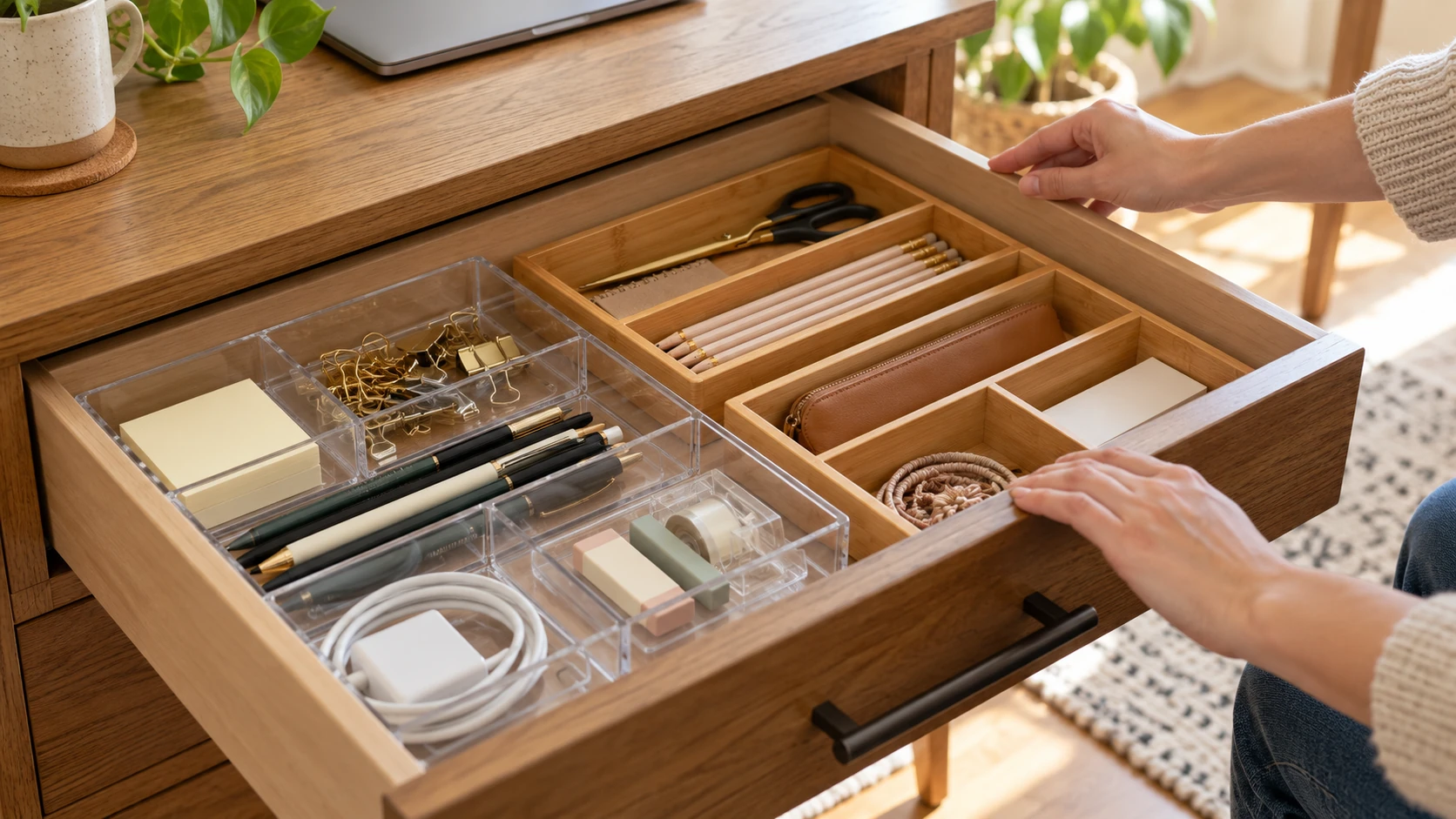
Drawer organizer trays sliding whenever you open a drawer can scatter the very things you meant to keep sorted. The first useful question is what moves: one tray, a whole group of trays, or the drawer itself. A tray that shifts across a smooth bottom needs a different fix from a group that collides with the drawer front. Empty the drawer, note the original positions, and test one cause at a time.
Two current product listings illustrate different layouts. The Highcool acrylic drawer organizer is listed with 11 compartments and seven removable dividers. The Coolnut wooden drawer organizer set is listed as 12 separate trays that form 24 compartments. One is a larger compartmented unit; the other is a set of separate pieces. Neither listing establishes how much grip its bottom has in your drawer or whether the trays will stay put under a particular opening speed.
Find what moves first
Open the drawer gently and mark where each organizer sits. A small paper note outside the drawer can record the starting layout without putting adhesive on the furniture. Close and open it normally a few times. Does a single tray creep toward the front? Do several trays move as one block? Do the contents slide while the trays stay still? Watch from above while another person opens the drawer if that is safe and practical.
Before moving anything, check whether the drawer itself travels smoothly. A drawer that catches and then releases suddenly can jolt every loose object inside. Remove the organizer and test the empty drawer. If it still sticks, follow the furniture maker's instructions for checking tracks, load and installation. Do not mask a damaged or misaligned slide by wedging trays tightly inside the drawer.
Our drawer organizer clearance guide helps identify why an insert or its contents prevent the drawer from closing. That is a different diagnosis. This article assumes the drawer can close and asks why a fitted tray moves during ordinary opening and closing. If the drawer scrapes a tray's top, resolve the clearance problem before testing movement.
Empty, clean and measure the drawer
Lift out the trays and remove loose crumbs, dust and small items. Check the bottom for a slick coating, an uneven liner or a raised seam. Wipe the drawer according to the furniture finish instructions and let it dry completely. A damp liner may temporarily feel grippy but can trap moisture or mark a surface. Do not sand the drawer, apply adhesive or scrub a delicate finish to solve a storage problem.
Measure the usable interior width and depth, including any space taken by hardware or a curved side. Record the flat area on which a tray can sit. A tray may fit between the side walls but still rest partly on a rail, screw head or uneven bottom. If the drawer narrows toward the back, measure both ends. This is a placement measurement, not a reason to force a rigid tray into a tight opening.
Set one empty tray in the drawer and press lightly at its corners. Does it rock? Does its entire bottom touch the drawer? Is there a gap beside it large enough to let it accelerate before hitting the wall? The same tray can behave differently when placed against a side wall or in the middle. Test each proposed position with the drawer empty before putting small objects back into the compartments.
For a group of separate pieces, sketch the intended layout or take a quick photo. Count the gaps between trays and along the drawer walls. The Coolnut set's modular nature gives you several arrangements, but it does not mean every arrangement is stable. Narrow, light trays can move independently when there is open space around them. A tighter grouping may help, provided you can still lift a tray out and the drawer closes without scraping.
Test the load and contents
Add items back gradually. Put heavier objects low and toward the center of each tray, where they do not tip a narrow compartment. Avoid putting a tall bottle or a long object across two trays; it may catch the drawer structure or push a neighboring piece when the drawer moves. A tray that stays still when empty but shifts when loaded may be responding to an uneven weight distribution.
Watch the contents separately from the container. Pens can roll in a long channel even while the organizer base stays put. Clips or beads can gather at one end and make it appear that the entire tray moved. The Highcool listing's removable dividers may help divide a channel for certain small items, but it gives no tested movement rating. Use the actual divider positions available on the delivered product and check that each divider seats as its maker intends.
Try a normal opening with only one tray loaded, then add another. If the first tray moves only when a second tray is present, the pieces may be hitting one another or transferring force. If both move together, check whether the drawer bottom or a loose liner is traveling under them. You are looking for the first contact that starts the motion, not a way to pack every remaining gap with objects.
Do not overload a drawer to hold the organizers in place. A tightly wedged collection may seem stable, yet it can rub the sides, block closure or make cleaning difficult. Leave enough room to remove trays for care and to reach frequently used items. Follow the furniture maker's drawer load guidance. A storage layout should work through repeated ordinary use, not only in a still photograph.
Choose drawer organizer grip carefully
If the drawer moves smoothly and a tray still slides on a clean flat bottom, consider a removable liner or pad that is compatible with the drawer finish and the tray material. Follow the liner maker's directions, including any recommendation to test a small hidden area. Some materials leave residue, transfer color or become tacky over time. An unsuitable pad can cause more damage than a moving organizer.
Cut a liner to lie flat under the tray without folding against the sides or obstructing a drawer runner. Test whether the liner itself stays still. If it travels with the trays, the friction point has simply moved. Do not attach a liner permanently before observing how it behaves during everyday opening. The goal is a stable base that you can lift for cleaning and inspection.
Check the delivered organizer for feet, coating or protective pads before adding anything. Neither saved listing proves a particular nonslip treatment on the underside. A generic photograph of a similar organizer cannot supply that fact. If a protective foot is already present, keep it intact and consult the maker before changing it. Removing it may scratch the drawer even if it seems to increase grip at first.
Use a small reversible spacer only if the drawer and tray maker permit it and it cannot jam the drawer. A spacer between a tray and side wall can reduce travel, but it should not exert force on the drawer box or hide a fit problem. Avoid loose packing that can fall into the track. Check the full path from closed to open with the drawer empty of sharp or fragile items.
Compare a single unit with separate trays
The Highcool page describes an acrylic organizer with compartments and removable dividers. Its listed expansion dimensions are internally unclear, so measure the actual delivered unit rather than treating the listing as a precise fit guarantee. A single larger footprint may move as one piece and make the cause easier to see. It may also leave a substantial gap along a wide drawer wall. Test that gap instead of assuming the tray's size solves it.
The Coolnut page describes 12 wooden trays and 24 compartments. Separate trays allow you to choose a layout for pens, notes or small accessories. Their individual motion is the main question here: a corner piece may stay against two walls while a center piece drifts. Place a small number of trays first and observe each one. The listing's claim that pieces can sit beside one another does not establish movement resistance inside your drawer.
Our reading-corner bookcase guide concerns what to keep within reach around a chair. The same practical idea applies to a work drawer: frequently used things should be accessible without dragging every tray across the bottom. The guide does not test drawer hardware or organizer friction; the actual movement test remains part of this article.
Choose an organizer layout around the items you use, then test movement with those items in place. If you refill every compartment for the sake of symmetry, the weight and reach pattern may change. A modest arrangement you can remove and clean is often easier to diagnose than a tightly filled drawer. Neither material, acrylic nor wood, proves that a tray will stay fixed on every finish.
Use a short repeatable test
After each change, close the drawer gently, open it at a normal speed and check the tray positions. Repeat several times. Then remove the item you use most often and close the drawer again. This catches movement caused by the hand reaching in, which a simple open-and-close test may miss. Do not slam the drawer to create an artificial challenge; a hard impact can damage the furniture or spill the contents.
Try one change at a time: shorten the group, move a tray against a side wall, redistribute contents, or add a compatible removable liner. If you change several things together, you may not know what helped. Keep the starting photo and a brief note of the result. The record also helps you notice slow movement that takes a week of normal use rather than a single test.
Inspect the drawer bottom after a few days. Look for liner bunching, scratches, residue or dust caught beneath the tray. Lift the organizer rather than dragging it when cleaning. If a pad discolors the finish or a spacer interferes with closure, remove it and follow the furniture maker's care advice. A fix is useful only when it protects the drawer and keeps the contents reachable.
If the drawer begins to stick, sag or come off its track, stop treating this as a tray-grip issue. Remove the load and inspect the furniture according to its instructions. Do not force it closed or wedge the organizers to compensate. A storage insert cannot repair a failing slide, and a forceful test may make the furniture problem worse.
Know when to replace the organizer
Replacement makes sense when the existing tray is warped, cracked or too small to sit steadily in any useful position. If it rocks on a flat surface outside the drawer, inspect it for damage. If it only moves in one drawer, the drawer bottom, liner or layout may be the decisive factor. Compare the actual footprint of a replacement with the flat interior area you measured, and allow space to lift it out.
Before buying, look for dimensions that describe the base and height, not just the number of compartments. A divider count will not tell you whether the bottom contacts the drawer evenly. The Highcool listing offers compartment information but ambiguous expansion figures; the Coolnut listing gives a modular tray count but no tested grip value. Treat those as planning facts with limits, then verify the delivered organizer in your own drawer.
The useful endpoint is a drawer that opens normally while trays and contents stay in their intended places. First confirm the furniture moves smoothly. Then clean and measure the bottom, test one tray at a time, distribute contents sensibly and use only a compatible reversible grip treatment if needed. Those observations tell you whether to adjust the layout, care for the drawer, or choose another organizer.