Home Decor & Table Settings
doormat backing compatibility: check vinyl-floor instructions
Read named vinyl-floor care restrictions and ask for the exact entry mat backing before deciding whether direct contact is supported.
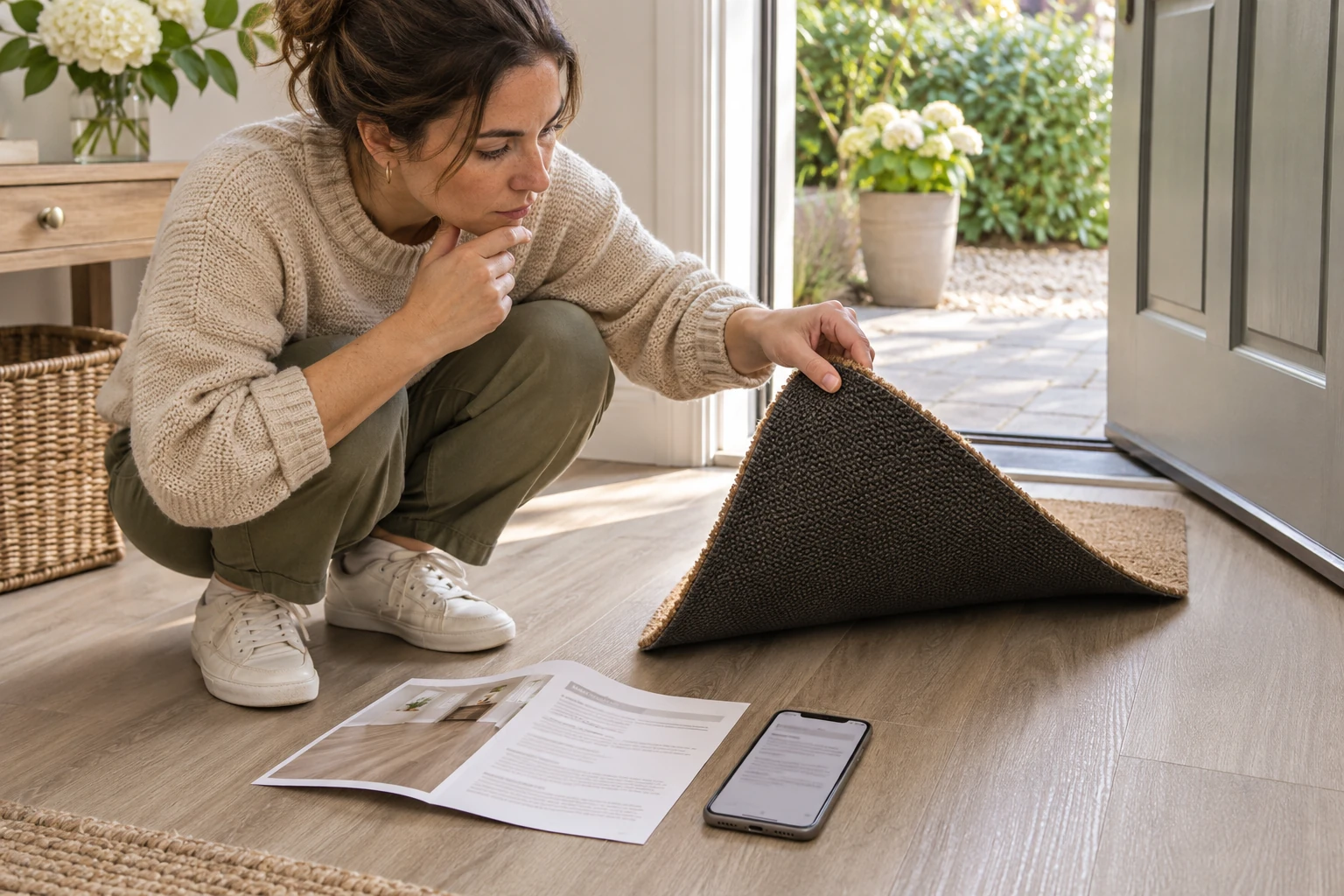
A doormat backing compatibility question needs the floor’s instructions as well as the mat’s material disclosure. Mannington’s ADURA Rigid care page calls for non-staining mats and says not to put rubber-backed, latex-backed or coco fiber mats on that floor because they will stain or damage the surface. Keep that named flooring context attached to the restriction. It does not identify the backing of a mat shown only from above.
Read vinyl floor mat restrictions for the named floor
For vinyl floor mat restrictions, Shaw’s resilient-vinyl care page recommends entry mats to intercept tracked material. For mats placed directly on its resilient floors, it specifies backings without latex or rubber to avoid possible discoloration. This is a contact-material restriction in that care account. A front design, an appealing color or a seller’s general non-slip wording does not answer whether the exact offered backing meets it.
Consider an original fictional enquiry. Nora likes an illustrated entry mat and wants to put it inside her home. She has not ordered it or placed any new material on the floor. Her first shopping note names the artwork she likes. Reading the floor-care information gives her a different question to answer before deciding whether this particular offer belongs in that location. The example reports no floor damage, material test or successful installation.
Nora looks for the identity of the flooring already in the entrance. A photograph of its color is not the same thing as the product record she needs. She finds a household folder and checks whether it identifies the actual installed floor. If the folder belongs to a different room, she leaves that uncertainty open. She does not choose a convenient care page simply because its photograph resembles her hallway.
Ask for entry mat backing details
The Yorkies Door Mat offer is cataloged as Betsy Drake model DM068G. Its sole gallery frame is signed terrier artwork, not a physical underside. The Buckeye Butterfly Door Mat, model DM763G, likewise shows butterfly artwork only. Its title and size field say 30x50 while another size attribute says 3 feet by 5 feet. That discrepancy remains unresolved. Neither artwork establishes entry mat backing details, exact delivered dimensions, construction or approval for a particular vinyl floor.
The two native offers can identify the kind of shopping question Nora has, while leaving the answer pending. She asks the seller to identify the backing for the exact selected item. Her message includes the offer reference so a reply about a different mat will be recognizable. She does not ask the front photograph to supply information it cannot show. An attractive illustration can remain a design preference without becoming a material disclosure.
In Nora’s imagined correspondence, the first reply says that the mat is suitable for an entrance. She appreciates the reply but sees that it has not answered her question. She asks again for the actual backing information for the offered selection. The example supplies no claim about how any real merchant responds. It shows why a relevant answer still needs to address the particular point that remains unresolved.
Keep the United States care context visible
Karndean’s United States cleaning-and-care page says to use mats with non-rubber backing at doorways. Keep that actual regional page with its advice. This statement does not certify every backing that lacks the word rubber, identify either illustrated retail mat or supply a stain-removal method. It is another named manufacturer’s care instruction to consult when that is the floor you actually own.
Nora keeps the floor reference beside the question she sent about the mat. When someone shares advice for another flooring brand, she can consider whether it answers anything about her own floor before relying on it. She does not need to declare the other advice wrong. It may simply belong to a different product or context. Her decision remains tied to the material that would actually contact her installed floor.
A second household member asks whether a generic reassuring description should be enough. Nora points to the unanswered material question. They can agree that the design is appealing while leaving the contact decision undecided. Neither person has to invent a reason that the mat will cause damage. Equally, neither needs to convert missing information into permission. They are deciding what they know before selecting what to buy.
An exclusion is different from an approval
An original fictional comparison makes the distinction clearer. Nora prepares two possible notes for a reply she might receive. One says that the disclosed backing conflicts with the applicable instruction. The other says that the material description is incomplete. She would ask a different follow-up in each case. The first calls for addressing the stated conflict; the second calls for the missing information. Neither note says that an unanswered question has been resolved.
She leaves room for another possibility: the response may identify the material clearly while the flooring account still leaves a relevant point uncertain. In that case, she can put the actual description to the appropriate flooring contact. She does not need to translate the material name into a chemical explanation she has not established. A straightforward enquiry can reproduce the question without making a promise about what the eventual answer will be.
If a reply discusses a similar mat rather than her exact selection, Nora retains the distinction. She asks which item the answer identifies before treating it as applicable. If she later changes the selection, the answer may need to be reconsidered. The point is not to collect reassuring messages until the purchase feels approved. It is to understand whether the information in hand actually concerns the proposed contact between these two identified products.
Leave sizing and movement with their own questions
The rug-on-carpet bunching guide considers which layer moves during use. The moving-doormat budget guide separates an earlier shared bill from a new order. Neither supplies the backing disclosure or named vinyl-floor permission needed for the decision here.
There may be other questions about the offer. Nora could still need its selected dimensions confirmed, or want a different illustration. She keeps those as separate questions rather than allowing an answer about one to stand in for another. This enquiry gives no measuring plan, placement trial or grip result. Even if she eventually settles the design preference, the backing question retains its own answer or its own unresolved status.
When Nora shares the proposed purchase with another adult, she explains what remains open. The other person can help obtain the missing information without assuming that the mat has already been selected for use. If a different offer appears, they bring it back for consideration. The fictional household has not agreed to substitute any similar-looking item, and this article states no merchant substitution, delivery or returns policy.
Nora can also decide not to pursue this particular offer. That decision does not require proving that the mat is defective or unsuitable everywhere. It can follow from the information available for her own intended use. Another shopper with a different identified floor has a different question to resolve. A bounded answer is useful precisely because it does not claim to settle every possible household installation.
She keeps the unanswered reply with the offer reference instead of rewriting it as a confirmation. If better information arrives later, she can compare it with the original question. The earlier uncertainty remains part of how she reached the decision, rather than a gap filled by memory. A simple note can show which backing was described, which floor was identified and which point still needed clarification.
Before closing her enquiry, Nora reads the response once more as another person might. Does it clearly name the item? Does it address the actual material question? Is there an unresolved qualification she has overlooked? Those are questions about this fictional conversation, not a certification checklist. If she cannot tell what the answer covers, she can ask for clarity while leaving the purchase undecided.
In an invented follow-up, Nora receives a description that lists the decorative face but leaves the underside unnamed. She copies that distinction into her question: the design description is present; the floor-facing material remains unspecified. She has not discovered a prohibited backing. She has discovered that this response cannot yet be compared with the instruction she is using. Her next request is for the missing underside information, not for somebody to repeat that the picture is attractive.
Imagine instead that a reply names a backing and also says that construction may vary between offered selections. Nora would ask which construction belongs to the exact item under consideration. The qualification matters to that conversation even if the general product name stays the same. The fictional example does not assert that either linked offer varies in this way. It illustrates why a conditional answer should keep its condition when passed from the seller to another household member. Leaving that condition out would make the answer sound more conclusive than the information actually received.
Keep a later order separate from material permission
If you later consider an entry mat through republeq.com, retain the exact offered selection and any unresolved backing question before choosing payment. Interest in crypto such as USDT does not establish that a method is available for your particular transaction. Read the payment options and instructions actually presented for the current order. This paragraph supplies no supported token, network, address, fee or exchange rate. Resolve conflicting product information with the responsible seller while you are still deciding what to buy. A payment instruction cannot answer a question about the material that would touch your floor. Read the delivery, cancellation and return terms applicable to the order rather than assuming that another purchase had the same conditions. If somebody orders on your behalf, give them the confirmed selection and explain any point that remains open. Ask them to bring a changed offer back for consideration. Review transaction details again if the selected item or basket changes. For any permitted payment, use the actual current instructions rather than a transfer sequence copied from this article. Retain the order reference and the payment response if you authorize a purchase. If the outcome is uncertain, reconcile that particular attempt before considering another payment; a missing confirmation does not establish that nothing occurred. After delivery, compare the received identity and product information with the order you actually authorized. A transaction record establishes no compatibility test, floor-care approval or grip result. You can leave the purchase unmade while the backing description or applicable flooring instruction remains unclear. The illustrated enquiry ends with the information needed for a decision, not a report that any new mat has been placed.
Conceptual backing enquiry before placement; no tested retail mat, flooring brand or compatibility approval is depicted.