Home & Living
Door draft stopper seam damage needs a precise report
A fictional report identifies a split outer seam on a fabric door barrier and records what remains unseen. Keep catalog construction claims attached to the exact product while asking about the next support step.
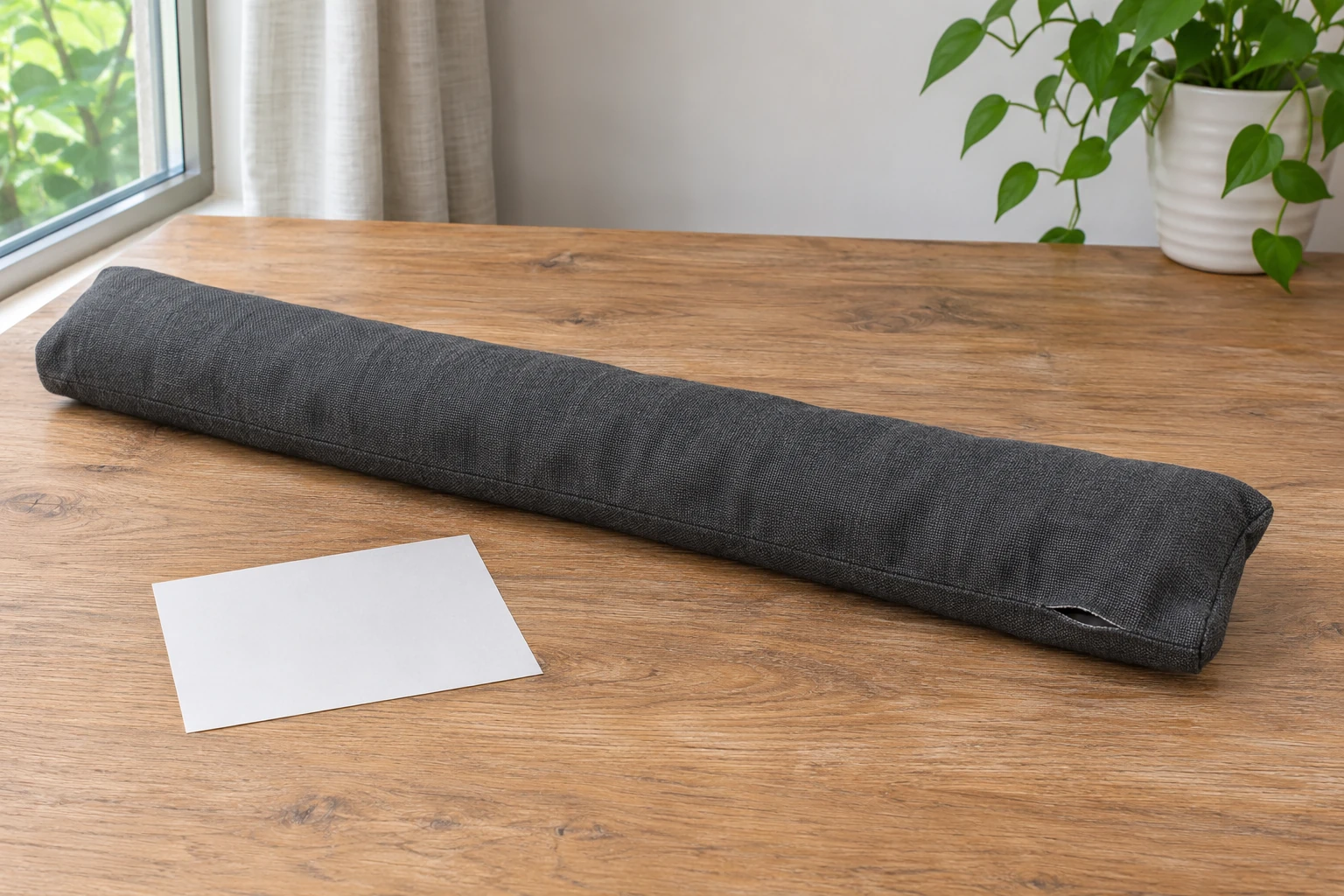
Start with the opening you can actually describe
Door draft stopper seam damage needs a report that stays close to the visible problem. In the fictional case followed here, Mara notices a small opening along a stitched edge of a fabric door barrier. Dev is helping her write a support message. Her first draft says, “The whole thing is leaking.” They pause over that sentence because it leaves several questions unanswered. The report has not said where the fabric is open, what can be seen through the opening, or whether Mara means escaping filling, moving air, or something else.
Mara begins again with the observation she can describe. “There is an opening along the stitched edge of the outside fabric near one end.” She has seen that opening while the barrier is resting on a table. She has not established what lies behind the outside fabric or whether another layer is intact. Her revised sentence gives the reader a place to look while keeping the unseen condition unresolved. The case concerns writing an accurate damage enquiry before deciding what support information is needed for the particular item.
A useful report can be incomplete in an explicit way. Mara does not have to supply a cause, a repair method, and a replacement specification in her first message. She can identify the item from her actual order information, describe the observed opening, and state what she has not confirmed. Dev reads the revised sentence back to her. It describes a fabric opening without saying that the entire assembly has failed. Their next task is to make the location and the unanswered construction question clear enough for a product-specific reply.
Locate the seam without adding a diagnosis
The phrase outer cover seam is useful only if it points to the edge Mara actually means. She looks at the barrier as a whole and decides whether the opening is near an end or along its long side. Her message can name that location in ordinary language. If she cannot tell whether a visible line is a seam, a fold, or a separate edge, she can describe the appearance and leave that identification open. A report becomes harder to follow when a guessed part name replaces the visible detail.
Dev suggests keeping an overall view with a closer view of the same location. In their fictional report, the overall view establishes which end is being discussed and the closer view shows the opening without changing its shape for the picture. The written sentence then refers to that same spot. A close view alone might leave the reader unsure which edge it belongs to. An overall view alone might hide the detail Mara is trying to describe. Their purpose is a coherent account of what she has observed, with no staged repair demonstration.
Two native accounts with different construction information
The Fuliko detachable-cover draft-blocker account describes an inner liner and a removable zippered cover. Its sole gallery image shows a black rectangular fabric barrier with a cord loop and a visible attachment tab beside a door. The photograph does not show the interior or a repair method. Keep the described construction attached to that exact account.
The Uxcell fabric draft-stopper account describes cloth and glass-bead filling. Its sole image shows a long dark cylinder with a seamed end and a hanging loop. The account does not describe a removable cover or an inner liner. The photograph cannot establish either feature or confirm the internal condition of an actual damaged item.
Give unseen layers an explicit unknown entry
Back in Mara's fictional message, Dev asks what she means by inner liner condition. Mara realizes she has used the phrase because she remembers seeing it in a different description. She checks the information for her own item before including it as an established part name. If that information does not identify a separate liner, her message can ask about the construction. She can describe the outside fabric opening without announcing that a second layer exists or that the opening has passed through it.
If the information for the actual item does identify a liner, its condition still needs its own evidence. Seeing an opening in the outside fabric does not supply that evidence by itself. Mara's draft can say, “I have not confirmed the condition of the layer behind this opening.” The sentence leaves room for a later answer. It also keeps the report from presenting two damaged components when she has only described one visible opening. The story gives no instructions to open, pull, press, or otherwise alter the item to fill that gap.
Dev asks whether “leaking” should remain anywhere in the draft. Mara decides that it is too broad for the observation she has recorded. She has described an opening, and she has not reported material coming out or completed an airflow check. She replaces the word with the location sentence. If she later observes something else under ordinary conditions, that would be a separate observation to record accurately. The message can develop as evidence changes without treating an earlier vague word as a confirmed diagnosis that must be defended.
Separate the observation from a guessed cause
Mara also has a sentence saying that the stitching “must have failed because the barrier moved.” She cannot point to an observation that establishes that cause. In the revised fictional message, she writes when she noticed the opening and what the item looked like at that moment. She leaves the cause unspecified. An accurate account of an earlier event can be included if she remembers it, but a guess does not become a history merely because it makes the message sound more complete. Dev keeps the observation and the proposed explanation on separate lines.
The same care applies to words about how long the damage has been present. Mara can say she first noticed it that afternoon. That does not establish that it formed that afternoon. Her wording can preserve the distinction without becoming elaborate. “I noticed this opening today” describes her discovery. The support reader can then ask for any additional information relevant to that exact product. The case makes no promise about a warranty outcome, a cause finding, or the availability of a replacement component after the message is sent.
The draft now has a practical sequence. Mara identifies her actual item, names the visible opening and its location, points to the corresponding views, and records the unanswered question about what lies behind it. She then asks what product-specific information is needed before a repair or replacement decision. Dev reads the whole message once to check that every part still concerns the same barrier and the same opening. No alternate product photograph is being used as evidence of the damage, and no general care instruction has been added as a presumed solution.
Suppose a later reply in the fictional exchange refers simply to “the cover.” That word would need enough context to connect it to the part under discussion. Mara could ask which component the reply means and which instructions belong to her exact item. The hypothetical reply is an example of an unanswered wording problem, with no real seller or support answer behind it. It does not establish that the outer fabric is removable, that a separate cover is available, or that exchanging one component would address an unseen problem elsewhere.
Mara's next note can carry the original observation forward. The outer cover seam location stays the same unless new evidence shows that she identified it incorrectly. The inner liner condition stays unconfirmed until there is an appropriate basis to describe it. She does not need to replace those entries with a more confident summary just because another message has arrived. If a requested detail is unavailable, she can state that directly and ask how to proceed with the information she actually has. The case leaves any technical repair instructions with the exact product's support route.
Keep cleaning and doorway tests in their own scopes
The published washable door draft stopper guide concerns identifying a washable part, following its care information, and reseating the dry barrier. Its damaged-seam boundary leads to product-specific support. This article develops the damage report at that boundary, with no laundering, drying, or reseating procedure.
The guide about the actual door draft gap follows a different problem involving the location of an air path and the fit of a barrier at a doorway. Mara's observed fabric opening does not establish that diagnosis. Her report stays with the damaged item and the condition she can describe.
Those separate scopes keep Mara's enquiry manageable. She is not trying to prove a draft path, select another barrier shape, or reconstruct a cleaning sequence in order to describe a visible fabric opening. If her actual concern later includes another observation, she can record it as such and seek the relevant product-specific guidance. For now, Dev checks that the report has not quietly expanded from one observed seam into several presumed failures. The support question can be narrow while still leaving room for the person answering it to request the next necessary detail.
Keep the report accurate through the next decision
Door draft stopper seam damage remains unresolved at the end of this fictional case. Mara has improved the account she can send, but the story has supplied no technical inspection, completed repair, replacement order, or support approval. Her final draft is useful because another reader can see which part of the account comes from observation and which part remains unknown. She keeps that version with the corresponding views so that a later exchange can refer to the same location. The next decision will depend on information for her actual item.
Dev's last check is a simple reading check. Does “this opening” still point to the place described earlier? Does a sentence about an unseen layer sound more certain than Mara's evidence allows? Has a suggested cause slipped back into the history as a fact? Mara corrects those wording problems before treating the report as finished. The enquiry can then carry a clear question forward without pretending to settle the physical fault. That is the outcome of this example, with the damaged seam described and the unanswered internal condition left visible in the record.
If a separate shopping visit to republeq.com offers a cryptocurrency payment option, examine the actual checkout details before choosing USDT or any other displayed asset. A fictional support enquiry does not establish that a particular item is available as a replacement, that an order has been accepted, or that a transfer route applies to your purchase. Keep the selected item and the current checkout information together while reviewing the proposed transaction. Check the displayed token, network, destination information, amount, and any instructions attached to that payment choice. A familiar token name does not supply a missing network or destination. If an essential detail is unclear, leave the payment unsubmitted while using the available support route to clarify it. Avoid substituting instructions copied from a previous order, another merchant, or an unrelated message. The details attached to one checkout need to be understood in their own context. After any actual payment submission, keep the transaction reference and the merchant's order information available for reconciliation. A transfer record and an order result describe separate parts of that process, and a pending screen does not establish dispatch. These payment considerations remain separate from the seam observation. They do not identify an internal liner, authenticate a catalog brand, confirm the condition of fabric, or supply a repair instruction. If the checkout being used does not offer a crypto option, the wording of a catalog account does not create that option. Decide whether to continue from the payment choices actually presented and the information you understand, while keeping the product-support question attached to its own evidence.