Office Supplies & Stationery
Write a donation pause notice while the shop stays open
An original shop-notice example distinguishes a pause in book donations from closure of the shop and leaves the restart date honestly unconfirmed.
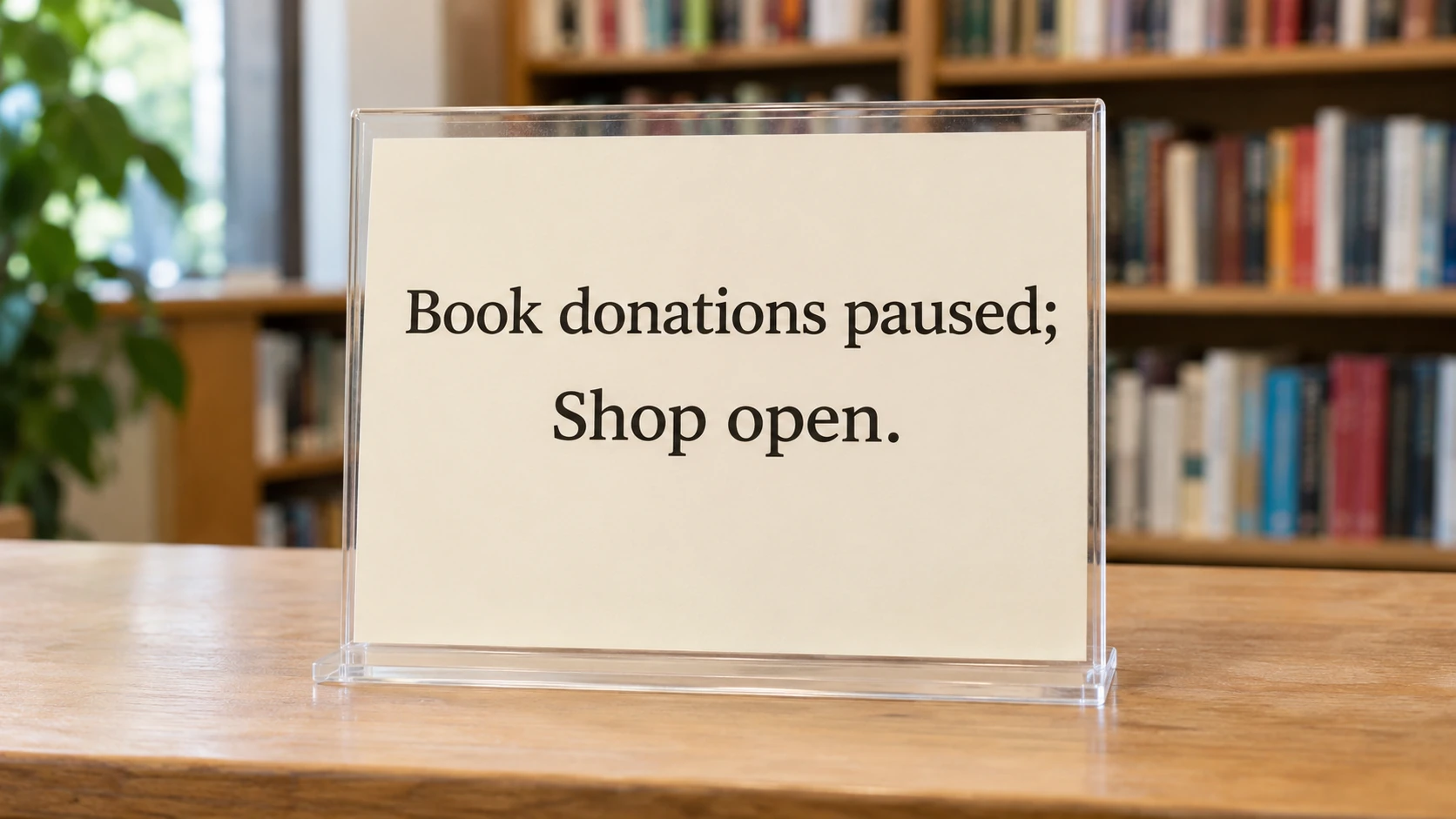
A small bookshop has paused book donations while keeping the shop open under its usual arrangements. Its draft counter card says, "Donations closed." Those words leave the shop itself unnamed. This tutorial works through an original fictional example: write a donation pause notice that identifies the paused activity and states what continues. The example supplies no opening hours and no confirmed date for restarting donations. Keep those limits in the copy instead of filling the gaps with a likely explanation or a hopeful date.
Start with the activity the shop has actually paused
Write the instruction for the person bringing books. In this example the paused activity is accepting book donations. That is the subject of the first sentence. "Book donations are paused" gives the pause a specific object. The shorter draft, "Donations closed," drops that object and uses a word also commonly applied to a shop. When editing your own version, spell out the actual intake you mean. Do not extend this example to money, clothing or another kind of donation unless the shop has separately established that those are paused too.
Keep a private working note beside the draft: "We know book donations are paused; the shop remains open; the restart date is not confirmed." This note is an authoring aid for the fictional exercise. It is not additional public policy. Each sentence you propose should be traceable to one of those supplied statements. If a line introduces a reason, an exception or a different destination for the books, set that line aside until there is authority for it. A polished sentence can still contain information the writer was never given.
For example, "We are full, so please try again next week" would add both a cause and a timetable. Neither belongs in this exercise. "Our volunteers need a break" would invent a staffing explanation. You do not need a substitute explanation to finish the notice. The paused service can be named directly. This leaves the shop free to publish a reason separately if it has a confirmed reason it wishes to share; the example does not supply one or suggest that a reason must always be disclosed.
Keep shop opening status beside the pause
The shop opening status is a separate statement: "The shop remains open." Put it immediately after the donation sentence in the working copy. This placement is an editorial choice for keeping the two supplied facts together. It does not certify that every visitor will read both lines or interpret them in the same way. Read the pair as a single message before deciding how to arrange the card: "Book donations are paused. The shop remains open." Neither sentence supplies hours or changes the shop's existing arrangements.
Avoid making the second sentence carry a promise you cannot support. "Come in any time" would imply an availability the example has not established. "Open as normal until late" would add hours without giving them. "The shop remains open" is enough for the narrow distinction here. If an actual shop needs to publish hours, take those from its own confirmed information and handle them as a separate writing task. Do not infer them from this fictional notice or from a sign-holder photograph showing an open storefront.
Try an omission check on your draft. Cover the donation sentence and read what remains: does it explicitly say the shop is open? Then uncover the whole draft and ask whether the word "open" has accidentally been attached to donations. "Open, donations paused" leaves the subject of the first word unstated. The full pair names both subjects. This is a desk exercise for the writer, not a test of public comprehension. It helps you locate the words you chose without claiming that the finished sign has been tested with customers.
Leave restart information honestly unconfirmed
For this example the restart information is: "We have no confirmed date for restarting donations." That sentence reports the limit of the supplied information. It does not say the pause is permanent, promise that a date will appear soon or ask visitors to return on a particular day. Keep the word "confirmed" if you mean the date has not been established. Replacing it with "announced" can imply that a date already exists privately. The fictional brief does not establish that distinction, so there is no reason to introduce it.
Check for an accidental deadline in the surrounding copy. "For now" is open ended, but "back shortly" adds an expectation about duration. "Check again tomorrow" supplies a next action and a time that were not given. Even a friendly closing such as "See you with your books soon" can sound like an invitation to bring them back before a restart has been confirmed. In this exercise, leave the sentence about the unknown date as it stands. You can be courteous without inventing a schedule or telling someone where to store unwanted books.
A writer may be tempted to offer a helpful alternative: another shop, a collection point or a named charity. Confirm each proposed alternative before adding it. This notice has none. Leave it out until the shop has confirmed it; another institution's donation policy does not supply that confirmation. The absence of a confirmed restart date does not establish that another organization accepts the same books, has room for them or consents to receiving referrals. The fictional shop's message can finish without sending anyone elsewhere.
Read the complete before and after
The original draft is "Donations closed." The proposed replacement is "Book donations are paused. The shop remains open. We have no confirmed date for restarting donations." Read that replacement without adding an explanation between its sentences. It names the paused intake, states the continuing shop activity and leaves the date unconfirmed. Those are the facts supplied for this exercise. It does not announce a permanent end to donations, a collection exception or a new opening schedule. Keep a copy of the full wording while you experiment with line breaks so a shorter layout does not silently lose one of the statements.
For a counter-card mock-up you could place "Book donations are paused" above "The shop remains open," with the unconfirmed-date sentence underneath. This is a proposed arrangement, not a claim that a particular paper size, font or holder will accommodate it. Work on the wording first. If a layout feels crowded, reconsider the available space using your actual materials before removing information. Cutting the shop sentence would remove the distinction this example was written to make. Cutting the date sentence would leave the question of timing unaddressed.
Now inspect pronouns and headings. A heading such as "Temporary closure" would conflict with the shop sentence even if the smaller copy were accurate. "Our closure" has the same problem. A heading that names the book-donation pause can stay within the supplied facts, although the complete sentence already does that work. If you add a logo, a decorative heading or another card beside this one, read the actual arrangement again. This tutorial cannot determine how neighboring material changes the meaning of a display it has not seen.
Use holder listings as bounded display context
The Raindrops sign-holder account describes a four-piece acrylic counter display product. Its gallery shows clear upright panels with separate thick black bases; a single view contains at most four complete assemblies. Repeated photographs do not establish additional inventory, and scenic inserts and household props are staging. The listing's quantity, material and dimensional statements remain attributed descriptions. They do not verify what a buyer receives or prove that this example notice fits, remains legible or stays stable in that holder. Use the account as display context while keeping the wording decision independent of those untested claims.
The Azar sign-holder account describes a landscape, top-loading acrylic holder and says it is sold in multiples of ten. Its gallery includes a clear holder with a folded foot, a dimensional drawing and an optional-pocket chart. That chart treats the pockets as other products and says online-ordered pockets will not be adhered or glued. It does not show pockets included with this holder. The photographs do not authenticate delivered quantity, dimensions, material or loading performance, and the chart does not establish factory equivalence between every maker name in its contact context.
Neither account approves the wording of the fictional shop's notice. A product picture containing a sample insert supplies no authority for a donation policy. Likewise, the existence of a display stand does not settle where a real shop should place it, whether it obstructs a counter or whether its message meets any accessibility standard. This tutorial makes no installation, safety or readability certification. After the copy is settled, any physical display decision belongs to the actual setting and the actual item, with its own information and constraints.
Keep this notice separate from other donation and opening guides
The holiday opening-hours counter-sign guide concerns dated opening information and the handling of closure and reopening messages. This exercise does not borrow its date or hours framework. The shop here continues operating while one intake is paused, and no restart date is supplied. Keep that simultaneous distinction in the wording instead of turning the example into a holiday timetable or a procedure for updating opening-hours signs.
The named-library zine-donation guide concerns an institution's selection and donation conditions, including consent, catalog treatment and delivery routes. None of those policies establishes the fictional bookshop's rules. This example does not recommend a receiving institution or decide whether particular books qualify. It ends at the wording of a pause notice, with the shop open and the donation restart date unconfirmed.
Keep a conditional purchase discussion outside the notice
If you later consider buying a display item through republeq.com, treat any crypto payment discussion as a separate, conditional purchasing task. The wording of the shop notice does not establish whether a seller accepts cryptocurrency, which checkout methods are available, or whether a transaction can be completed from your location. A mention of USDT in a conversation is not a confirmed offer to take payment in that asset. Before committing funds, inspect the actual checkout and the seller's current terms for the exact order you intend to place. If the information is missing or inconsistent, pause that purchase discussion until you can resolve it through an authorized channel. Do not put an unverified payment method into the public donation notice. Keep the order description, quoted amount and payment instructions together in your own records so you can compare them before proceeding. Confirm what any fees and refund terms mean for that particular transaction; do not infer them from an unrelated product page or a previous purchase. If a network or destination is specified for a transfer, compare it with the instructions for the intended transaction rather than choosing one from memory. This paragraph does not authenticate a wallet, promise a refund, recommend an asset or report an actual purchase. It also does not establish that the shop accepts financial donations. The exercise concerns donated books, and a possible purchase of display equipment would not change that scope. Leave all purchasing language off the example card so the public message continues to concern the paused intake, the open shop and the absence of a confirmed restart date.
Finish with the wording the shop can support
Before releasing your own version, compare each public sentence with the information the shop has actually authorized you to state. In this fictional exercise, retain the full replacement: "Book donations are paused. The shop remains open. We have no confirmed date for restarting donations." Save that exact copy with your working notes. If someone proposes "back next week" during layout, the saved text shows where a new claim has entered. Ask for confirmation of that new information before changing the sentence; the existing draft can remain complete with the date unconfirmed.