Crypto Commerce
DISHUP 3.5-cubic-foot portable dryer vs VINGLI portable dryers for a small laundry corner
Compare DISHUP 3.5-cubic-foot portable dryer by drum and load claims, dimensions, cycle controls, heat, mounting, venting, and laundry-room fit.
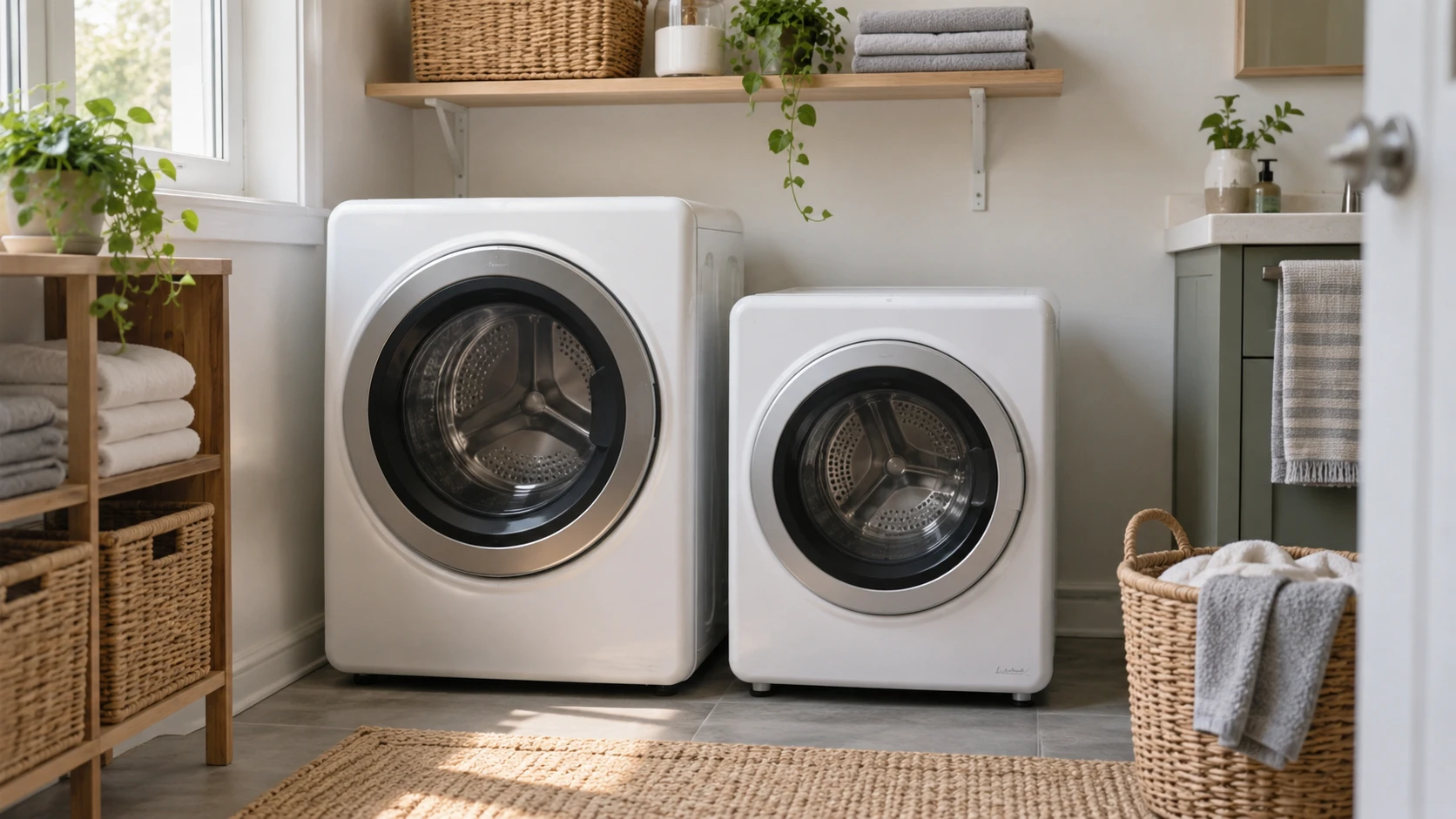
Portable dryers can make a laundry area possible where a full-size pair will not fit, but the word portable does not settle how the appliance is powered, vented, or supported. DISHUP lists a 3.5-cubic-foot front-load dryer with a 13-pound claim and a range of named drying modes. VINGLI lists a smaller 1.8-cubic-foot unit, identifies different limits for wet and dry clothes, and gives a weight and several placement options. Measure the available room and find the approved air path before trying to compare drying speed.
The DISHUP 3.5-cubic-foot portable dryer is described as white, front-loading, and fitted with a stainless-steel tub. It names Auto, Delicates Dry, Air Dry, and Timer Setting modes, and the source gives exterior dimensions of 23.6 by 18.9 by 26.8 inches. The VINGLI G46001150 has a stainless-steel tub, a 1020W power figure, a knob for drying modes, and a maximum stated temperature of 140°F. It weighs 57.3 pounds and measures 21.5 by 20.5 by 30.3 inches. Draw both cabinets in the intended corner and mark the space needed for the door and laundry basket.
Compare load claims before choosing a drum — VINGLI G46001150 portable dryer
DISHUP's listing calls the dryer 13 pounds but does not state whether that refers to wet or dry laundry. VINGLI is more specific: the source says 10.6 pounds of wet clothes or 6.6 pounds of dry clothes. The two weight limits use different conventions. A direct 13-versus-10.6 comparison would mislead. Ask DISHUP for the maximum dry-clothes weight and the manufacturer's guidance for bulky items. Find out whether the VINGLI wet limit assumes a particular spin cycle from the washer. A load that leaves the washer dripping will demand more time and energy than one spun thoroughly.
The 3.5- and 1.8-cubic-foot figures describe drum volume, not how a favorite blanket tumbles. Put a typical load in a basket and compare its dimensions with the door opening and drum of each dryer. Leave room for clothes to lift and fall rather than packing the drum tight. Towels, sheets, and denim need different space and time; a small dryer can handle a few items well while struggling with a bulky mixed load. Neither saved excerpt offers a tested cycle duration for the same fabric weight, so ask for a model-specific load chart.
VINGLI's smaller capacity may suit a person who dries a few garments at a time and has little floor space. DISHUP's larger stated drum may reduce the need to split a weekly load, if the actual weight rating and tumbling room support it. The washer feeding the dryer changes how useful either drum size will be. A small portable washer may produce several short loads that fit a compact dryer naturally, while a large washer may leave you waiting through multiple drying sessions. Count the loads you run in a week and how many could fit under each maker's recommended limit.
Draw the appliance in the room — compact dryer power planning
The published guide on compact dryer power planning examines another small dryer and the electrical questions that come with it. Start here with a sketch of the outlet, available floor or counter, vent route, and path from the washer. The DISHUP dimensions are 23.6 by 18.9 by 26.8 inches, but the saved excerpt does not specify which measurement is width, depth, or height. Request a labeled drawing. VINGLI labels its 21.5 by 20.5 by 30.3 inches as length, width, and height. Check the orientation of the door and controls in the current manual.
Leave space beyond the cabinet footprint. The door needs space to swing, laundry needs room in front for loading, and the manufacturer may require rear or side clearances for heat and airflow. Neither saved description states those clearances or the vent outlet location. If the dryer would sit below a shelf, measure the full height including any stand or wall bracket. Check that a person can remove the lint filter without moving the machine. A dryer that is difficult to access for cleaning will be frustrating even if its drum capacity suits the load.
VINGLI says it may stand on a counter, on a firm and level floor, or on a wall with an included mounting kit. That does not establish whether any particular wall can carry it safely. The unit weighs 57.3 pounds before laundry, and the bracket must support operating loads according to the manufacturer's instructions. Have the mounting points and wall structure checked for the exact installation. The DISHUP excerpt calls its unit portable but does not say it is approved for wall mounting. Do not transfer VINGLI's mounting option to DISHUP merely because both are compact front-load dryers.
The DISHUP listing describes use in an RV, home, or apartment. The RV claim still needs model-specific power, ventilation, vibration, and securing instructions, particularly if the vehicle will move. VINGLI's saved description does not mention RV use. If travel is part of the plan, ask the manufacturer for the approved installation environment rather than relying on a portable label. A counter placement during travel needs different restraint from a stationary laundry-room shelf, and neither source gives a vehicle-specific mounting diagram.
Confirm the outlet and airflow path — VINGLI G46001150 portable dryer
VINGLI's source states 1020W but does not provide a voltage or plug specification in the saved excerpt. DISHUP's excerpt gives no wattage or voltage. Obtain the rating labels and manuals for both, then match the required electrical supply to the available circuit. The guide's 120V topic should not be copied onto these two models without their own evidence. Avoid assuming that a nearby convenience outlet, extension cord, or shared circuit is suitable for a heater. A qualified installer can verify the circuit and the maker's location requirements.
Drying also moves moisture and lint. The saved excerpts do not state whether either dryer is vented outdoors, recirculating, or supplied with a duct or filter kit. Request the air-path diagram and approved venting instructions. If an outside vent is required, measure the route and count bends before buying. If a unit permits indoor recirculation, ask how it manages humidity and lint in a small room. The exhaust arrangement determines whether either dryer can work in that room. Do not operate it in a way the manufacturer has not approved.
VINGLI names a filtration system that catches cotton wool. Ask where that filter sits, how it is removed, and how often the manual says to clean it. The DISHUP description does not mention a lint filter, which is a gap in the excerpt rather than evidence of its absence. Inspect the current manual for filter access and replacement parts. A lint-packed filter can reduce airflow and change drying behavior. Plan an easy cleaning routine before deciding where the dryer will be mounted or tucked away.
Check what the controls actually do — VINGLI G46001150 portable dryer
DISHUP's named modes suggest distinct choices for routine and delicate garments: Auto, Delicates Dry, Air Dry, and a timer setting. The listing does not define the temperature range, dryness sensing, or time limit for each mode. VINGLI names a knob and control-panel settings, but the excerpt does not list the mode names. Ask for both operating manuals. Compare one familiar cotton load and one delicate item under the recommended settings, noting total time, heat, and how damp the clothes feel when the machine stops.
VINGLI's maximum temperature is stated as 140°F. The 140°F maximum does not describe the temperature of every setting or garment. Use garment-care labels and the manufacturer's cycle guidance. The VINGLI source also recommends an hour of rest after long use, without defining a long cycle in the saved excerpt. Clarify the duty-cycle instruction if you expect to dry several loads in a row. DISHUP's source provides no equivalent cooldown guidance, so its manual needs the same review before a busy laundry day.
Opening the VINGLI door during operation stops the machine according to its listing. That is useful to know when checking a load, though it does not describe restart behavior or a child lock. The DISHUP excerpt gives no door-interlock detail. Inspect the controls and safety instructions for both. A dryer placed within reach of children or pets needs a clear plan for supervision, door closure, and storage. The location of the power switch and the ability to pause a cycle can affect day-to-day use as much as the number of programs.
Use the installation facts to decide — VINGLI G46001150 portable dryer
DISHUP's larger stated drum and named modes may fit a household that wants fewer small batches, provided its load rating, circuit, and vent route check out. VINGLI gives a more precise wet-versus-dry load limit, electrical power figure, weight, temperature ceiling, and mounting options. Its smaller drum and cooldown instruction deserve attention if laundry arrives in several loads. The listings leave the drying-time and installation comparison unresolved.
Before ordering, compare the exact model labels, dimensioned installation drawings, rating plates, airflow instructions, load charts, and warranty or parts support. Measure the intended space with the door open and a basket in front. The VINGLI G46001150 portable dryer and DISHUP model will make more sense once the room, circuit, and laundry pattern are known. The installation documents and load chart should answer whether either model can finish your usual laundry in that space.