Office Supplies & Stationery
Dish packing kit budget: count cartons, dividers and padding
A component-first budget check for two Highcool dish and glassware packing kits, without assuming every compartment fits a fragile item.
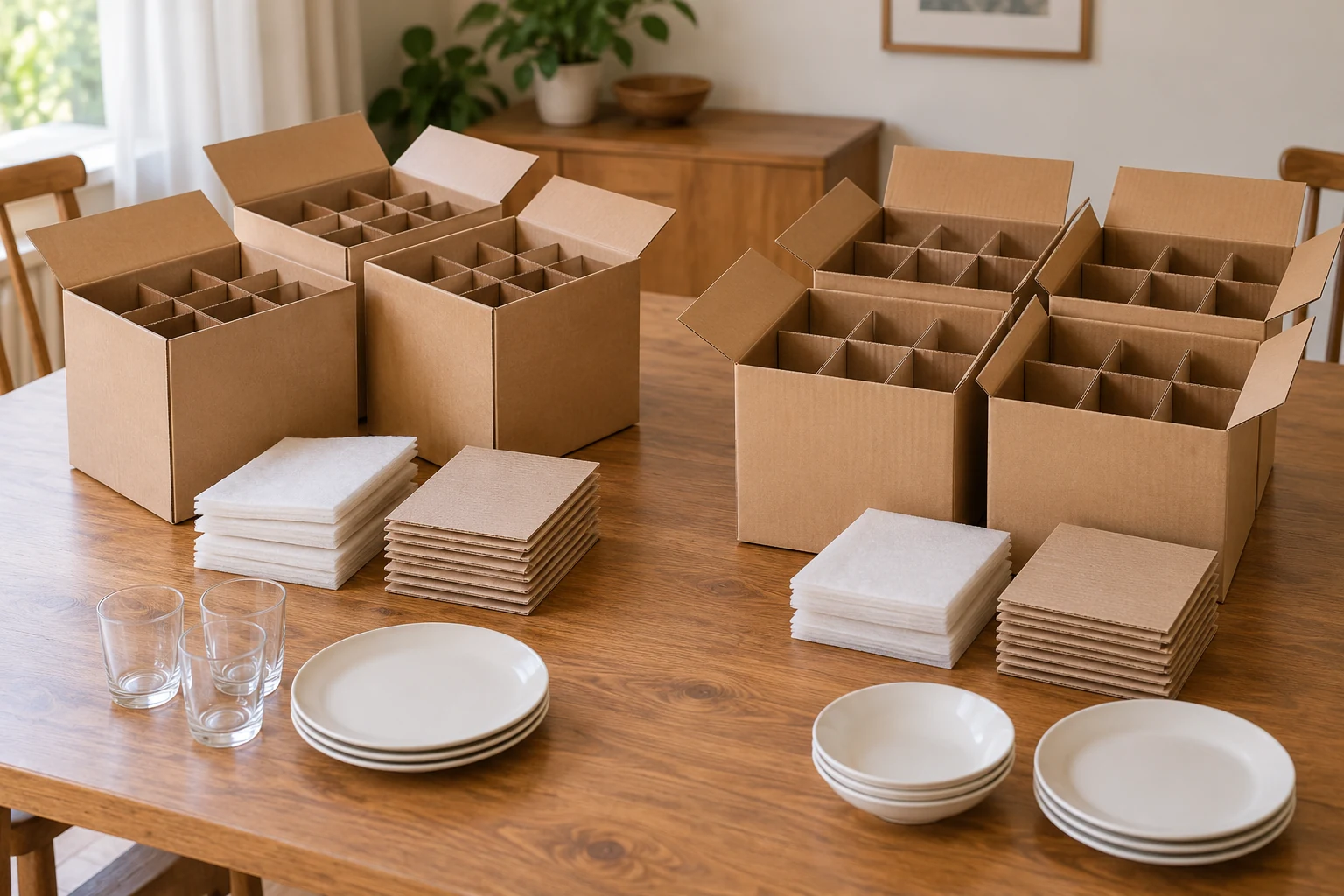
A dish packing kit budget starts with the dishes and glassware you need to move. A carton count on its own cannot tell you how many pieces will fit inside the supplied dividers, and a bundle photograph cannot tell you whether the padding covers your particular collection. Make a short inventory, match it against each kit's listed parts, and price only the supplies still missing. That keeps an attractive bundle from becoming a second shopping trip.
The two current Highcool three-carton dish packing kit and Highcool four-carton glassware kit give useful but different component lists. Both supply cartons, dividers and a tape item. Their descriptions do not establish that either bundle will fit every object, prevent breakage, or meet a carrier's shipping requirements. The worksheet below leaves those questions open until you check the actual objects and the current offer.
Count useful kit components against the fragile items you actually need to pack.
Count the pieces that need their own place
Start with a household inventory rather than the number printed on a kit. List plates, bowls, cups, stemmed glasses and awkward pieces separately. If several items can safely share a compartment under your own packing method, record that as a planned group. If an item needs its own separated space, count one space for it. This is a planning count, not a tested protection specification for either Highcool kit.
Measure the widest point of each awkward item and its height in the orientation you intend to pack. A plate's diameter, a glass's rim and a handle can create different fit problems. Keep the measurements beside the item names. A box that is large enough overall may still have divider cells too narrow for one item. Likewise, an item fitting a cell on paper may need additional room for a sleeve or wrap. Do not treat the bare compartment measurement as a usable clearance after padding.
For a practical example, suppose you have twelve ordinary glasses, six larger mugs and a few plates. Make three rows. The glasses may use one cell each if their protected dimensions allow it. The mugs may need a different orientation or a larger cell because of their handles. Plates may follow the three-carton listing's stated dish use, but that statement alone does not show how many of your plates fit in one box. The counts in this example describe a hypothetical packing list, not the contents of either bundle.
Read the three-carton kit as a set of parts
The three-set Highcool account lists three cartons, three sets of cardboard dividers, thirty additional pieces and a roll of tape with a dispenser. It gives carton dimensions of 16 by 12 by 13 inches and describes a section measuring 11.5 by 3.9 by 12.5 inches. The description also says the kit is suitable for dinner plates of 11 inches and under. That is the listing's fit claim; it does not substitute for measuring your own plate with the protection you plan to use.
The same description says to assemble a complete box from carton boards and describes divider pieces. Keep those assembly details attached to this listing. It does not give a dependable, plain-language count of ready-to-use compartments across all three cartons in the captured account. The photograph shows carton and divider groups, but a photograph is not an assembly manual. Ask for the exact assembled layout before assigning a fixed number of pieces to the kit.
Do not silently label the thirty additional pieces as a specific kind of padding in your budget. The current account does not identify them clearly enough for that. Ask the seller what they are and whether their size suits your glassware or plates. If you need foam sleeves or wrap regardless, put those on the missing-supplies line until the contents are confirmed. This keeps an unclear count from turning into an assumed saving.
Read the four-carton kit on its own terms
The four-set Highcool account lists four cartons, four divider sets with twenty-four dividers in total, sixty-four padding pieces, and one roll of tape with a dispenser. It says the assembled layout provides sixty-four compartments: sixteen in each carton. The specified compartment is 3.9 by 3.9 by 12.75 inches, and each carton is listed as 16 by 16 by 13 inches. These numbers describe the listed layout and supply quantities. They do not tell you that sixty-four of your particular items can be safely packed.
Test the 3.9-inch cell width against the protected width of an actual item. A slim glass might fit while a mug handle might not. A tall piece could challenge the listed height even if its base fits. If you intend to trim a divider as the description permits, count the resulting layout after the trim rather than continuing to use the sixty-four-compartment figure. Changing a divider changes the number and shape of spaces you can use.
The sixty-four padding pieces are a component count, not a promise of one appropriate piece per compartment. Check what each piece is, its dimensions, and how you plan to use it. You may need more, less, or a different material for specific objects. The current listing also calls the kit intended for glassware and kitchenware. It supplies no verified transit test for your route or carrier, so avoid treating the product language as an insurance or breakage guarantee.
Try the intended layout without treating a drawing as proof
Before assigning a kit to an inventory row, sketch the divider arrangement from the current product instructions. Put the measured width and height of each item beside its proposed cell. Add the thickness of any sleeve or wrap you intend to use. Where the listed compartment size is not stated as clear inside space, mark the fit as unconfirmed. This paper exercise can identify obvious conflicts; it does not test the strength of a carton or the protection of a packed object.
Keep the quantities separate from the shapes. A kit can have enough nominal cells and still be wrong for a few large items. If a glass has a wider bowl than base, use the widest measured point. If a plate goes in a different orientation, check that orientation against the carton and divider description. Do not turn “up to” or “suitable for” language into a claim that every item will fit. Ask the seller for a clear assembled image or measurement when a cell is close to your object's protected size.
Make a small test group on the worksheet: items confidently matched, items that need a different cell, and items awaiting an answer. Count only the first group as covered. The unanswered group becomes a question or a separate material line, not an invisible assumption in the savings calculation. If trimming a divider changes the arrangement, redraw the cell count for that carton and check whether the remaining pieces still cover the other items.
Build a component gap list before comparing checkout totals
Write two columns, one for each kit. Put cartons, divider sets, padding pieces and tape in separate rows. For the three-carton kit, enter three cartons, three divider sets, “thirty pieces, type to confirm,” and the listed tape roll and dispenser. For the four-carton kit, enter four cartons, four divider sets, sixty-four padding pieces, and its listed tape roll and dispenser. Keep ambiguous labels in quotation marks on the worksheet instead of improving them from memory.
Then add a row for each thing the packing job still requires. You may need a larger cell for a handled item, more protective wrap, labels, or another carton. Those are examples of possible needs, not claims that either kit lacks a standard component. Mark a need only after comparing your own inventory with the current kit contents. A bundle earns value when the included items actually replace something you otherwise would have bought.
Suppose your inventory needs four cartons and the divider layout of the four-set kit fits each planned group. That kit could avoid a separate fourth-box purchase. If your inventory fits into three cartons and the fourth would remain unused, its inclusion has no immediate packing job. The calculation should record both the pieces you use now and the extras you have a credible later use for. An imaginary future move should not be treated as an automatic credit against today's checkout cost.
The tape line deserves a similar check. Both current kit descriptions mention a roll and dispenser, but neither captured account gives enough detail here to calculate the number of cartons one roll will seal. If you need a seam-by-seam tape estimate, the separate packing tape bulk-pack guide works through measured box seams, roll lengths and likely surplus. This kit budget needs only a yes-or-no answer about whether its included tape covers your plan; do not invent a roll-length figure for either Highcool bundle.
Price the missing components as part of the same purchase
Once your fit and component questions have answers, get a current delivered checkout total for each exact kit. Add the current delivered cost of any missing cartons, dividers, padding or tape you would need with that kit. The resulting number is a planned purchase total for the packing job. Product-page prices can change, and a captured listing is not a current checkout quote. Leave a total blank when a required part or its price is still unknown.
Keep the arithmetic simple: kit checkout total plus required extra-supply checkout totals. If you already own usable materials, record them as on-hand rather than assigning a made-up zero price to a new item. If one bundle leaves surplus components, note what will remain. The surplus is still part of the cash outlay today. Whether you later use it is a separate judgment supported by an actual future packing plan.
A four-carton bundle can be the better fit even if its checkout figure is higher, when the fourth carton and enough appropriate padding remove real extra purchases. A three-carton bundle can cover the job with less surplus when the inventory and dividers fit. Neither conclusion follows from carton count alone. Write the item fit, component gaps and delivered totals beside one another before choosing.
The magazine-holder cost guide asks whether each holder has a real reading location. Dish packing needs a different check: each fragile item must fit the planned divider layout, and the kit must include the materials that layout requires. There is little value in dividing a kit price by its advertised compartment count when many of those cells may be too narrow or remain empty for this job.
Resolve the fit questions before ordering
Ask for an assembly diagram or clear instructions for the three-carton kit's divider layout and its thirty additional pieces. For the four-carton kit, ask whether the stated 3.9 by 3.9 by 12.75-inch compartment size represents the clear opening after assembly and how the padding changes usable space. These are precise questions tied to the current offers. The present sources do not answer them for every item you own.
Check the current offer again before checkout. Confirm the exact SKU and that the photo, description, carton count and included accessories still refer to the same package. If the offer changes, update the worksheet rather than carrying forward the older kit count. Keep the item inventory too; a decision for twelve glasses and a few plates need not work for a different collection next month.
If the packed cartons will enter a carrier network, consult that carrier's current packaging requirements and any instructions supplied with the kit. The listings describe intended glassware or dish use, but do not certify a packing method for a shipment. If you are moving boxes yourself, check the assembled carton and the actual item's protection before relying on the listed dimensions. Any unresolved fit or protection question is a reason to verify, not a reason to fill the budget with an assumed saving.
Keep taxes, shipping and any separately bought protection in the same dated comparison. If one option requires a second order, its delivered cost belongs with that option. A seller's offer of a bundled dispenser may matter when you do not own one; it does not create a benefit when the included dispenser would sit unused. Write the reason for each added or omitted item beside the figure so another household member can repeat the comparison.
Keep the final purchase note specific
Record the date, item inventory, measured exceptions, proposed divider layout, kit SKU, included component counts, missing purchases and current checkout totals. Put “unconfirmed” beside the thirty-piece identity or any fit measurement you have not verified. That note makes the decision reviewable if a seller answers a question, the bundle changes, or you discover another fragile item before packing.
The useful comparison is the complete set of materials needed for your actual dish and glassware inventory. Choose the kit that fits the items and leaves a manageable gap list at the current delivered total. If neither current source resolves a critical fit or component question, postpone the cost conclusion until the exact offer supplies that answer.