Crypto Commerce
Dimedeal vs EastVita mini fridges: compartment checks
The Dimedeal HA601B-DM-01 and the EastVita mini fridge have the same listed capacity split: 2.9 cubic feet for fresh food and 0.3 cubic feet for the freezer, within a stated 3.2-cubic-foot total. Those figures give neither model a capacity advantage on paper. The useful comparison is how each description explains the compartments, temperature controls and physical cabinet, and which unanswered details matter to your purchase.
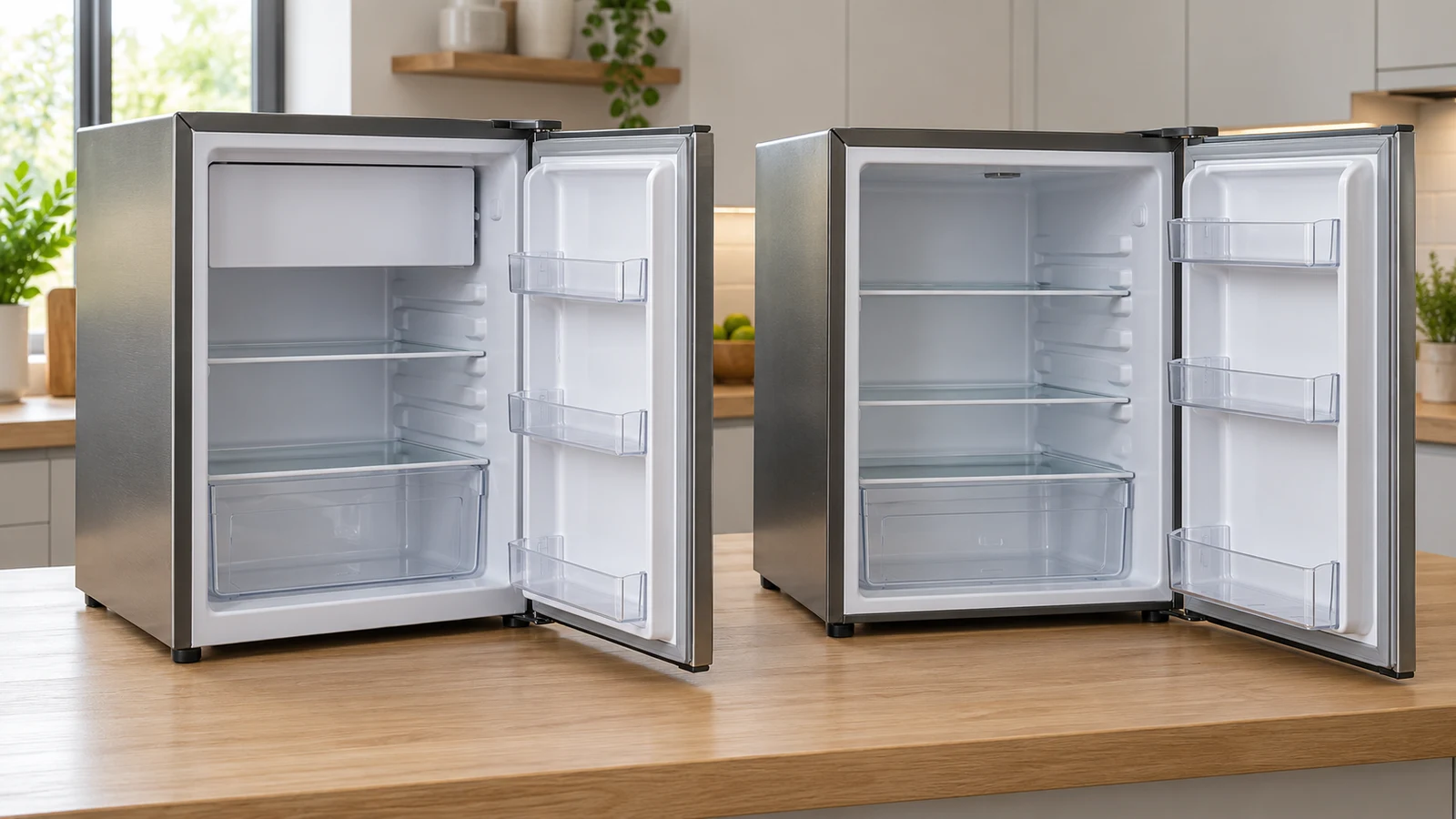
The Dimedeal HA601B-DM-01 and the EastVita mini fridge have the same listed capacity split: 2.9 cubic feet for fresh food and 0.3 cubic feet for the freezer, within a stated 3.2-cubic-foot total. Those figures give neither model a capacity advantage on paper. The useful comparison is how each description explains the compartments, temperature controls and physical cabinet, and which unanswered details matter to your purchase.
The descriptions differ in important ways. The HA601B-DM-01 is described as a two-door refrigerator with separate temperature ranges for its upper freezer and lower fresh-food section. EastVita describes a reversible single-door design and gives one temperature range without clearly assigning it to a particular compartment. EastVita also supplies exterior dimensions; the HA601B-DM-01 description supplied for this comparison does not. These are differences in documented information, not proof that either appliance performs better.
Compare Refrigerator Compartment Capacity Beyond The Total: What Matches Here
Start with the Dimedeal product description. It identifies model HA601B-DM-01, SKU sku-17136317060, and an upper 0.3-cubic-foot freezer above a lower 2.9-cubic-foot refrigerator. The EastVita description assigns those same capacities to its freezer and fresh section. Neither description provides usable internal dimensions for those spaces, so the matching volume figures do not establish that the same container will fit equally well in both.
For this pair, the capacity split can be treated as a shared starting point. If you have already decided that these stated compartment sizes meet your needs, there is no listed volume difference to settle between them. If you are still deciding what those numbers mean for your shopping habits, the guide Compare refrigerator compartment capacity beyond the total addresses that broader question. Here, the next step is to compare the details that the two descriptions actually distinguish.
A comparison note can keep the evidence clear. Record the total and compartment capacities as matching stated specifications. Beside them, record the door arrangement, temperature wording and supplied dimensions separately for each model. Leave a blank where a description is silent. This prevents a detail from the more expansive EastVita description from accidentally becoming an assumed feature of the other refrigerator.
That distinction matters because missing information is not a negative specification. The HA601B-DM-01 description does not identify a crisper drawer or a can rack, for example. That omission supports asking about those fittings if you need them; it does not support declaring that the appliance lacks them. Likewise, the shared capacity figures do not establish common manufacturing, identical interiors or interchangeable parts.
Compare Refrigerator Compartment Capacity Beyond The Total: Read The Temperature Labels Separately
The HA601B-DM-01 description states a freezer range of -4°F to 32°F and a refrigerator range of 34°F to 50°F. It also lists a seven-level adjustable thermostat. Those statements identify the described range for each compartment, but they do not explain what temperature corresponds to each numbered setting. They also do not establish that the two compartments have independently adjustable controls.
EastVita lists seven adjustable temperature levels and a range of 21°F to 46.4°F. Its description does not clearly say whether that range applies to the fresh section, freezer section or another measurement point. Keep that uncertainty attached to the range. Assigning the lower endpoint to the freezer and the upper endpoint to the refrigerator would add an explanation that the description itself does not provide.
The shared phrase “seven levels” therefore leaves a substantial comparison question open. A numbered adjustment is not a documented temperature chart, and matching numbers on two controls do not establish equivalent settings. Ask for the model-specific instructions showing what the dial controls and how the compartment temperatures are described. You need that explanation before treating the two thermostat arrangements as equivalent.
A focused seller question would be: “For this exact model, which compartment does the stated temperature range describe, and does one thermostat adjust both sections?” For EastVita, request separate fresh-section and freezer specifications if available. For the HA601B-DM-01, ask how the single described thermostat relates to the two stated ranges. These questions address the gap without presuming either product has an undocumented control.
Suppose your purchase depends on using the freezer every day, while someone else mainly wants space for drinks. The first shopper needs a clear explanation of the freezer specification before selecting either model. The second may give more attention to shelf layout, while still checking that the appliance suits the intended contents. The listing language alone cannot establish temperature stability, freezing speed or performance with a particular load.
Eastvita Refrigerator Alternative: Compare The Documented Cabinet And Fittings
The Eastvita refrigerator alternative is described with dimensions of 17.52 x 19.29 x 32.72 inches. The supplied description does not label the axes in that sequence. Before assigning the figures to width, depth and height on your room sketch, confirm their order. Also establish whether they describe the appliance itself and what installation space the model requires.
The supplied HA601B-DM-01 description has no exterior dimensions. Do not borrow EastVita's measurements because the capacity totals match. Request the dimensions for HA601B-DM-01 specifically, along with its installation instructions. Until those are known, the available descriptions cannot tell you which cabinet occupies less space or whether both suit the same proposed location.
Keep this fit comparison narrow. You are checking whether each exact cabinet can be considered for your available space, using its own measurements and placement requirements. There is no basis here for calling either model suitable for a tight enclosure or a built-in installation. Descriptions aimed at small rooms do not supply the missing installation specifications.
The door information is more explicit. The HA601B-DM-01 is described as a two-door model with a separate upper freezer. EastVita's description says it has a reversible single-door design. This establishes a stated difference in the exterior arrangement. It does not establish a cooling-efficiency advantage for either design, and the EastVita description does not fully explain the freezer's internal closure.
Ask for a model-matched interior image or diagram if the relationship between the freezer opening and main door affects your choice. For EastVita, that can clarify what the single exterior door exposes. For the HA601B-DM-01, use the same request to confirm the described upper and lower arrangement. A general product-family image should not settle a question about the exact unit you intend to order.
EastVita also explicitly describes adjustable feet and a reversible door. Reversibility is not stated in the supplied HA601B-DM-01 description. If changing the opening direction is a purchase requirement, EastVita has affirmative description support for that feature, while the other model needs clarification. Even for EastVita, ask what the reversal procedure involves and whether any necessary hardware comes with the selected unit.
The shelving descriptions offer another concrete distinction. The HA601B-DM-01 lists removable glass shelves that make room for taller items. EastVita lists two adjustable tempered-glass shelves, a crisper drawer and a can rack, as well as door storage for beverages and sauces. This gives EastVita a more detailed inventory of stated fittings. It does not establish that its shelves are larger or that its usable storage is greater.
Consider one tall container you already own. For the HA601B-DM-01, the stated removable shelves make a height-adjustment question relevant, but the description does not give the resulting clearance. For EastVita, ask which shelf positions would accommodate it and whether the drawer remains usable in that arrangement. Measuring the container gives the seller a concrete question; neither nominal capacity nor an adjustable-shelf claim answers it alone.
Compare Refrigerator Compartment Capacity Beyond The Total: Resolve The Remaining Purchase Questions
Package contents deserve a separate check from the feature list. EastVita's description names its drawer, shelves and can rack, while the HA601B-DM-01 description names removable glass shelves without a count. Confirm the fittings supplied with the selected variant. Do not assume that either package includes an ice tray, spare fittings or tools merely because those items would be useful with a compact refrigerator.
For maintenance, EastVita describes a defrosting switch at the center of the thermostat knob. That wording does not establish frost-free operation or explain the complete defrost procedure. Request the instructions if maintenance effort affects your choice. The supplied HA601B-DM-01 description does not specify its defrost method, so there is no supported basis for ranking the pair by maintenance convenience.
The noise wording also needs restraint. The HA601B-DM-01 description gives a compressor rating below 38 dB; EastVita states 38 dB. These are catalog claims, with no common measurement conditions supplied here. They do not support a conclusion that one will sound quieter in your room. If noise matters strongly, seek comparable information about how the ratings were established before using them to choose.
Energy language is similarly incomplete for a numerical comparison. The HA601B-DM-01 is described as energy saving, without a consumption figure in the supplied description. EastVita states “0.73 per day” but omits the unit in that phrase. Do not turn that number into kilowatt-hours or a running-cost estimate. A model-specific energy label or a consumption specification with units would be needed for that comparison.
Electrical compatibility is another unresolved item. Neither supplied description gives enough information to establish the required voltage and plug configuration. Confirm those details for the actual unit offered, particularly if the listing has multiple variants. This is a separate check from cabinet size or thermostat levels; none of those specifications establishes compatibility with your intended power supply.
At this point, a conditional preference is reasonable. The Dimedeal description gives you a stated two-door layout and compartment-specific temperature ranges to investigate. EastVita gives you explicit reversible-door wording, exterior measurements and a more detailed list of interior fittings. Choose which set of documented details addresses your needs, then resolve the remaining questions that could change that preference.
Before ordering, compare the current product page and selected variant with the details you used. For HA601B-DM-01, the supplied SKU provides an additional identity check. For EastVita, confirm that the offered version matches the single-door description and stated fittings. If current text or images conflict, ask which specification applies to the unit being sold; do not silently combine the most appealing details from different versions.
Finish by checking current availability, the complete checkout total and the delivery and return terms that apply to your order. Those transaction details do not resolve a missing freezer specification or cabinet measurement. Keep your purchase decision attached to the exact model: matching capacity figures, understood compartment controls, confirmed dimensions and the fittings you expect to receive.