Computer Accessories
Diamante poem from Night to Day
An original poem bridges two imagined landscapes.
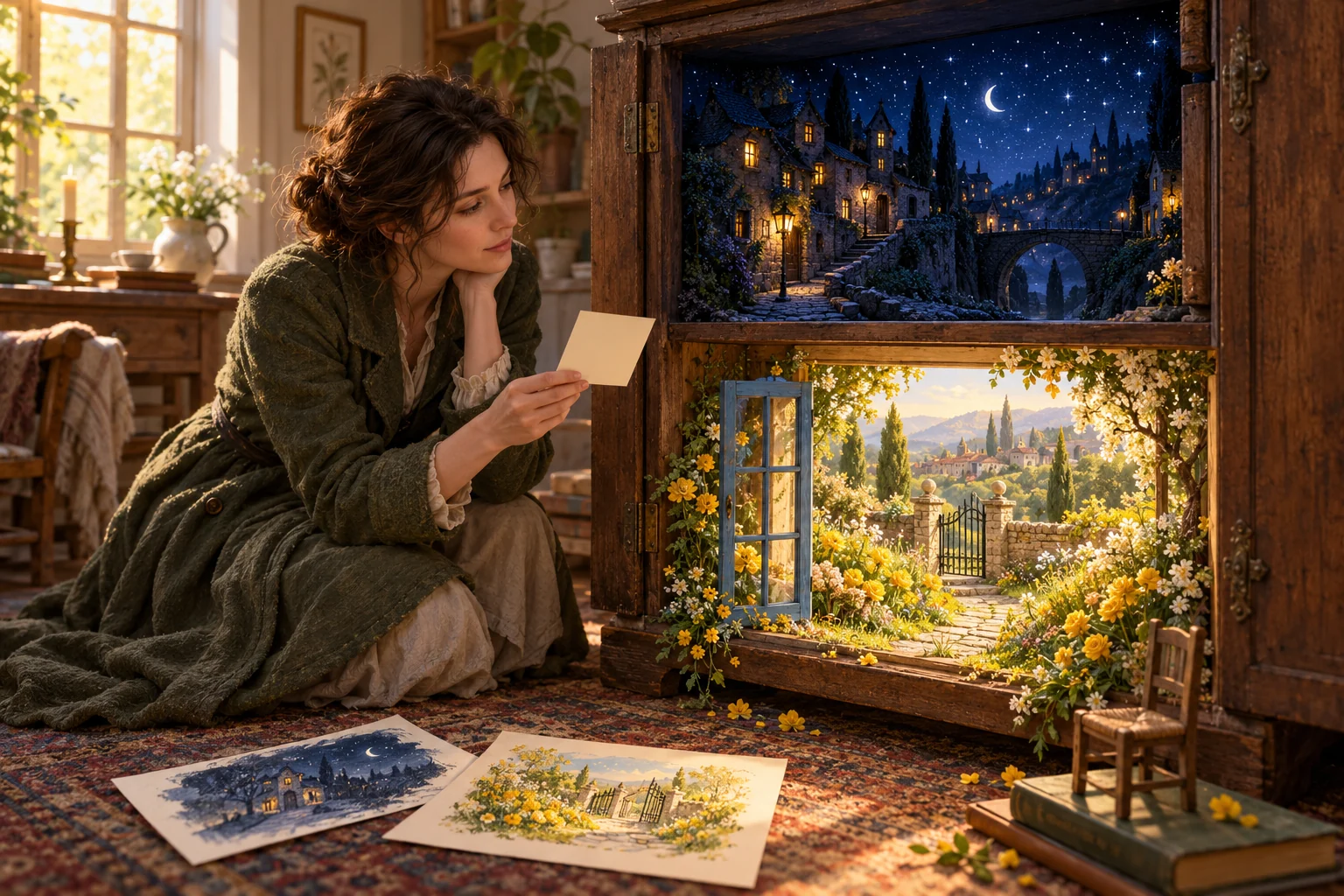
Write one complete original Diamante poem from Night to Day. Vale and the landscapes surrounding the poem below are fictional.
The chosen form
ReadWriteThink describes a seven-line diamond form with opposite end nouns. Here, Night and Day frame two adjectives, three -ing words, four central nouns, three -ing words and two adjectives. Our chosen line lengths are 1/2/3/4/3/2/1 words.
Vale's cabinet
Vale kept the two landscapes in a cabinet with a missing handle. The upper shelf held Night, with a paper sky folded against its back wall. The lower shelf held Day, though most of Day was hidden beneath a cloth. Every evening in this invented place, Vale opened the cabinet to see which small things had moved. A staircase might have changed sides. A window might have acquired a second pane. Once, a tree appeared where she had left a chair. She had kept the chair in a drawer afterward, in case the tree decided to leave.
On this occasion, Night contained a narrow path between two rows of sleeping houses. Their roofs were blue enough to disappear into the sky until Vale leaned closer. A white star hung above the nearest chimney. Behind it was another, smaller star, so pale that she could see it only after she had stopped looking directly at the first. She counted neither. The sky extended beyond the back of the cabinet, somewhere the wooden shelves could not contain. Vale put her hand on the empty place where the handle should have been and listened.
The houses made no sound. At the end of the path, a figure stood beneath a porch roof, holding something square. Vale could not see whether it was a parcel or a book. She imagined the figure waiting for a visitor, then imagined it returning from a visit, then left both possibilities alone. The square object stayed at the figure's side. A long shadow crossed the path from a house she could not see. Its roof belonged somewhere beyond the cabinet's left wall, in the part of Night that remained out of reach.
Vale found an old card in the drawer with the chair. She had written two words on it earlier and could no longer remember why. She turned it over rather than crossing them out. The other side was empty. On that side she began the little poem she wanted to leave beside the cabinet. The imagined star, path and porch were already there for her to look at. The poem did not have to identify the square thing in the figure's hand. She could let that detail remain beyond what the card said.
The complete poem
Night
Dark, hushed
Waiting, dimming, resting
Stars, shadows, windows, gardens
Waking, climbing, shining
Bright, open
Day
Along the path
A second figure emerged from one of the houses after Vale had put down her pencil. It stood in the doorway for a moment, then stepped into the path. The shadow reached its shoes. Vale expected the two figures to meet, but the newcomer turned away from the porch and walked toward the darker end of the street. She could follow the pale shape of its coat for a little while. Then the coat passed behind the corner of a house. The person under the porch had not moved. The square object remained impossible to name.
She considered adding a little lamp above the porch. There was one in the drawer, beside the chair: a drawn lamp she had cut from another invented room. Its paper edge curled upward. Vale held it near the opening of the cabinet and tried to imagine the porch with that extra light. She could see the figure's hand more clearly in the imagined version, but the square thing became a different question. A label appeared on it, with no writing she could read. She returned the lamp to the drawer without putting it into Night.
Farther down the path, the houses leaned close enough for their upper windows almost to touch. A piece of cloth hung between two of them. It might have been drying, or it might have been left there as a signal. Vale had supplied neither reason in this scene. She watched one corner lift. The corner lowered again before she could see what lay beyond it. She wrote a small note on a separate scrap: cloth between windows. The scrap would remind her of the detail without giving it a history she had not invented.
Night grew darker near the cabinet's back wall. The roofs became a single uneven line, while the nearest star stayed white. Vale found that she could still locate the porch from the figure's pale sleeve. She looked away to find the card, then back into the cabinet. The sleeve was still there. No one had handed over the square object. She left the upper landscape at that point, with its path continuing behind the houses and its two people no closer to a meeting than the events already written allowed.
Under the cloth
Day began with a window. Vale lifted the cloth from the lower shelf and found the window standing by itself, upright on a little strip of grass. Its frame had no surrounding wall. Through the opening she could see a garden that did not appear on either side of it. She moved her head to the left and saw only the cabinet's wooden corner. When she looked through the window again, the garden returned. A narrow bed of yellow flowers ran toward a gate at the far end. The gate stood open, with nobody passing through it.
She had left a small ladder in Day on an earlier occasion. It was now leaning against the freestanding window, although she had placed it beside a tree. Vale could see the tree beyond the glass. One of its branches reached over the yellow flowers, holding the shadow of a bird. The bird itself was absent. She drew that arrangement on another scrap, stopping her line before it became a wing. The shadow could remain a mark in the garden without requiring a bird to arrive simply because she had noticed its outline.
A person in a white coat crossed the garden behind the flowers. They carried an empty watering can, swinging it close to one knee. Vale knew it was empty because she had written that detail into this fictional scene, not because an actual photograph had established it. The person set the can beside the open gate and continued out of view. Nothing was watered in the passage she had chosen. The flowers kept their yellow heads above the path, and the window remained standing in the grass with the little ladder against its frame.
Vale put the two scraps beside the poem card. One held the cloth between windows; the other held the garden's branch and its absent bird. She had not tried to make the scraps describe the whole cabinet. They recorded the particular things she wanted to keep from this visit. Beneath the card she placed another blank piece of paper, leaving room for a landscape she had not yet imagined. She could close the cabinet without deciding what would go there. The missing handle had not prevented the doors from meeting when she brought them together.
One of the older words on the card was shelter. Vale remembered writing it after finding the drawn chair in a different landscape, beneath a sky crowded with yellow shapes. She had never decided what those shapes were. The chair had given her somewhere to imagine sitting while she looked at them. The second word remained harder to account for. It was almost hidden beneath a faint thumb mark, and she left it unread. She turned the card back to the new poem without making the earlier writing part of either landscape. The card could retain an older use on its other side while this visit remained the one she was keeping.
The keeper's shelf
Before closing them, she noticed that the little chair in her drawer had acquired a dark mark on its seat. It had not had that mark when she put it away. Vale held it beside the lower shelf, where the window's light could reach it. The mark looked like the outline of a leaf. She searched the drawn chair for a second mark and found none. She could have called the mark a leaf's shadow, but there was no leaf above the drawer. She put the chair back with the mark still unexplained.
The card fitted into a shallow space beneath the cabinet. Vale slid it partway in and left the upper edge visible. She wanted to be able to take it out again without searching through the drawer. The scraps went beside it, each with its drawing facing upward. From across the room she could see only three pale edges. Up close, the angled corner of the window sketch distinguished one from the others. Vale touched that corner once before leaving it in place. The card's other side still held the two older words she had chosen not to erase.
She kept the cabinet closed while she went to the table for a cup. When she returned, she did not open it. The imagined person under the porch could remain with the square object, and the empty watering can could remain beside the garden gate. She had no further event to add to either landscape that evening. Vale sat on the floor near the cabinet and read the card once more. Afterward she returned it to the same shallow space, keeping its edge visible. The room around the cabinet belonged to this fiction too.
Optional mouse accounts
The CadMouse Compact account names 3DX-700081. Its sole image shows a complete wired mouse with separate top panels, wheel and front cable. The published rating display was ★ 4.0/5 · 1 rating when checked. No CAD compatibility, button function or performance test is established here. The mouse does not supply Vale's cabinet or poem.
The Kensington Pro Fit account names a full-size wired mouse bundle. Its sole image shows one complete mouse with a thumb ledge, central wheel and front cable; delivered count is not verified. Its published rating display was ★ 4.1/5 · 8 ratings when checked. No hand-fit, driver or tracking result is adopted.
Other poetry questions
The rhopalic sentence guide keeps one sentence whose successive words have lengths one through seven. Tavi's fictional scene remains with that sentence; it supplies neither Vale nor her cabinet.
The original triolet guide keeps eight lines, two rhymes and exact returning lines in a paper-moon poem. The cup, moon and spoon belong to that separate piece.
Leave the card
In the morning of the surrounding story, Vale found the card where she had left it. She did not learn what the person under the porch had been holding. The garden's gate had acquired no visitor on the page. She took out the window sketch and added a small rectangle beneath the frame, then put the sketch back. It was another invented detail she might return to later. For now, the poem card and both landscapes could stay complete at the point where she had chosen to stop looking.
Night and Day remain inside an imagined poem.
A separate purchase
If you plan to purchase an item on republeq.com, check the particular offer and current checkout before ordering. This guide does not establish that any cryptocurrency payment option is available. If USDT is offered for the intended order, verify the requested asset, network, amount, receiving destination and order reference with the responsible service before authorizing a transfer. Review the actual product identity, selected variant, quantity, delivery details, total charge and applicable terms. Use the confirmed order details when checking the payment instructions. Confirm any fee, conversion term or exchange rate from the current transaction information. Determine the applicable cancellation, return and refund process, including how a refund would be handled for the selected payment method. Keep the relevant instructions and transaction records, with dates and confirmed references. If essential instructions change, ask the responsible service to confirm the change against the exact order. An acknowledgement should identify the order and the agreed details; it does not replace checking whether the selected product is the one you intended to buy. If payment or order status remains uncertain, reconcile that status before considering another transfer. Do not treat an unresolved transaction as evidence that nothing happened. This article supplies no wallet address, transfer guarantee, recovery procedure or assessment of a counterparty. A product enquiry does not authorize a payment or resolve an uncertain order. If support provides an answer, retain the exact question and response so a later reviewer can understand what was confirmed. Decide whether to proceed only when the conditions of the particular transaction are clear, and retain the confirmed transaction information with the exact order.