Networking
DHCP lease renewal: replies, deadlines and restart rules
Trace IPv4 DHCP renewal, rebinding, acknowledgment timing, rejection, expiration, and conditional reuse of a remembered unexpired lease.
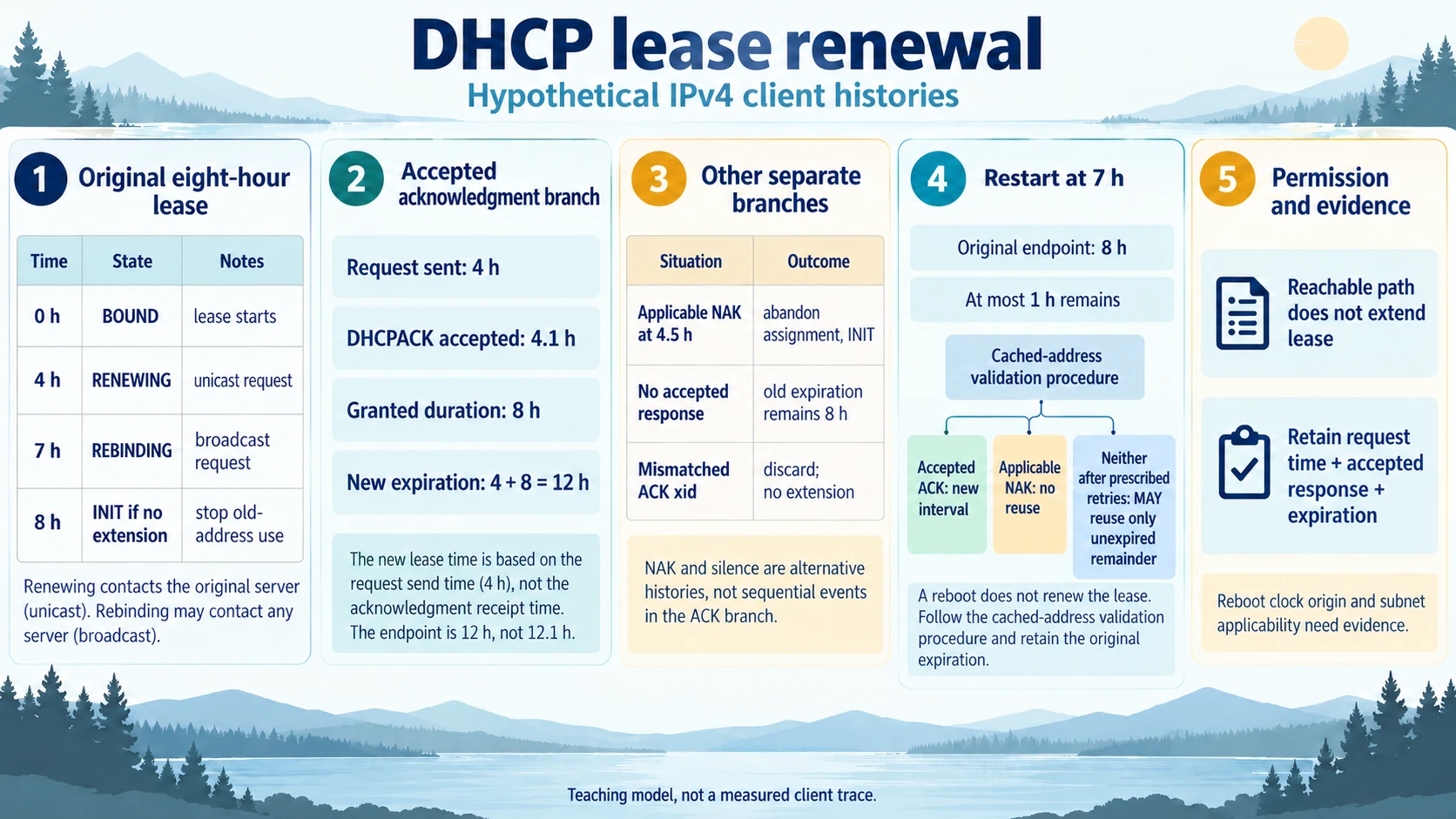
A laptop can keep communicating after its DHCP server becomes unreachable. Its existing address has an unexpired lease, and ordinary traffic may follow a route that does not need the DHCP server. The client nevertheless has a deadline. Sending requests, retaining a configuration file, or successfully exchanging application traffic does not extend that deadline. DHCP lease renewal changes the permission interval only when the client accepts an applicable acknowledgment.
The lease and the forwarding path can fail at different times. A server outage starts a recovery problem; expiration ends the old permission to use the address. RFC 2131 describes the IPv4 client states and message outcomes used here. The examples assume a finite lease, a working client time record, and no earlier release or applicable rejection. They are calculations of those states, not measurements from a particular operating system.
Set the renewal and expiration timeline
Suppose an accepted lease has a time basis of hour zero and a duration of eight hours. The client has renewal time T1 at hour four, rebinding time T2 at hour seven, and expiration at hour eight. These choices make the ordering visible: T1 precedes T2, and T2 precedes expiration. The protocol specifies default fractions for T1 and T2, but a server can supply those values. The example is not a promise that every client uses exactly these hours.
Before T1, the configured client is in BOUND state. At T1 it enters RENEWING and sends a unicast DHCPREQUEST to the server that issued the address. The request identifies its currently used address through the client-address field. This is an attempt to extend an existing assignment. It does not mean the client has surrendered the current lease or received another one.
If no accepted acknowledgment arrives before T2, the client enters REBINDING. It broadcasts a DHCPREQUEST so that a server beyond the original issuing server can respond. The address still has one hour left in this example. The broader request changes whom the client tries to contact; it does not move expiration from hour eight to some later time.
At hour eight, if no acknowledgment has extended the lease, the client returns to initialization and stops using the expired assignment for ordinary network processing. A remembered address value may remain available as historical information. Its presence in memory does not authorize continued transmission. The deadline belongs to the lease interval, not to how long the interface has displayed an address.
DHCP rebinding changes contact scope
A missing response during RENEWING says little about the cause. The original server might be down, a path might have failed, or a reply might have been lost. Application traffic can still work because its forwarding path and remote endpoint are separate from that renewal exchange. An application success at hour five therefore proves some communication worked at hour five; it does not prove the address remains leased through hour nine.
REBINDING gives the client a broader opportunity to obtain a valid response. It does not guarantee that another server has the necessary assignment information or will grant an extension. The server's knowledge and policy still matter. A broadcast request is an action by the client, while an accepted acknowledgment is the event that establishes the new interval.
The QUIC-anti-amplification guide offers a permission comparison for DHCP rebinding. A prepared QUIC response still needs sufficient unvalidated-address allowance or the applicable validation evidence before it can depart. A broadcast renewal request likewise leaves the old lease endpoint in place until an accepted response grants a new interval. The QUIC byte budget and the DHCP time-limited assignment have different rules; each requires the event that changes its own permission.
For a diagnostic record, keep the current lease's time basis, its duration, the resulting expiration, and the observed state transitions. Add the destination of each request and the arrival or absence of the corresponding response. Without the old expiration, repeated requests can look like progress even while the client approaches its unchanged deadline.
Acknowledgment, rejection, and silence produce different outcomes
Take a renewal request sent at hour four. Suppose a valid DHCPACK arrives at hour 4.1 and grants an eight-hour lease. Under RFC 2131's renewal calculation, the new expiration is the request's recorded send time plus the acknowledged duration. It is hour twelve, not hour 12.1. Starting the whole interval when the delayed response arrives would credit the client with time the calculation does not grant.
The word valid matters. A packet labelled DHCPACK is not enough by itself. For example, an acknowledgment whose transaction identifier does not match the request is discarded. The client must associate the response with the exchange and process its applicable lease information. A stray or mismatched packet cannot be used as evidence that the old deadline moved.
An applicable DHCPNAK is a different result from a timeout. It tells the client that the requested or remembered configuration is invalid and sends it back toward initialization. In a branch where such a rejection is accepted at hour 4.5, the client cannot simply continue using the old address until hour eight. The previously drawn interval was conditional on no earlier event invalidating it.
Silence grants nothing new. If the request at hour four receives no answer, the lease still expires at hour eight. If later rebinding also receives no answer, the same endpoint remains. The client can retransmit according to the protocol's timing rules, but each transmission is an attempt rather than an extension. Counting attempts or logging a successful send does not substitute for an accepted response.
These are separate branches of the example. One client history receives an acknowledgment and extends to hour twelve. Another receives rejection at hour 4.5 and abandons the assignment. A third hears nothing and reaches expiration at hour eight. Combining those events into one timeline would hide which message actually changed the client's permission.
IP address lease expiration is a permission boundary
The expired client must stop ordinary use of its old leased address even if a nearby host still answers or a router retains a usable route. Reachability and permission answer different questions. The route can continue to exist after the client's lease has ended. Conversely, an unexpired lease cannot make a broken physical link or failed router deliver traffic.
A client can obtain configuration again after expiration. If the newly accepted assignment gives it the same address, it can resume network processing under that assignment. If the address changes, it must not keep using the previous address. Applications may have their own response to the interruption or address change; the lease state alone does not establish that a session survived.
The monotonic-clock guide supplies timing context for IP address lease expiration. Calendar corrections can alter timestamp subtraction, and interval-clock readings need a valid domain and lifecycle. A persisted counter from before a reboot cannot automatically be compared with a new origin. The DHCP example assumes a usable client time record; an actual restart needs evidence for how the remaining interval is reconstructed. Changing a stored timestamp supplies no server acknowledgment.
Expiration should therefore be visible in any evidence used to explain an outage. A record containing only the last configured address misses the decisive fact. A record containing the address, lease basis, duration, and accepted message history can show whether the client stopped because permission ended, because a rejection arrived, or because connectivity failed while the lease was still valid.
A restart does not create a fresh lease
Suppose the laptop shuts down and restarts at hour seven. Its saved eight-hour lease began at hour zero, so it has at most one hour remaining on the original basis. Restarting does not give it eight new hours. The saved record must preserve enough time information to determine whether any part of the old interval remains, rather than treating the duration as an instruction to restart a countdown.
RFC 2131 provides a remembered-address initialization path. The client requests validation of its cached address. A matching acknowledgment supplies configuration and a lease interval; an applicable rejection means the remembered address cannot be reused. The protocol also permits a client, after the specified request and retransmission procedure yields neither acknowledgment nor rejection, to choose the old configuration for the remainder of an unexpired lease.
A client can sometimes reuse an unexpired lease without a fresh acknowledgment after following the restart procedure. Silence cannot preserve an expired lease. The remaining interval and the restart procedure are part of the case. An already expired record has no remaining lease to support that reuse.
A network change adds a question about applicability. A saved address from one subnet is not proof that the same assignment fits another subnet. In the remembered-address exchange, a server with the relevant knowledge can reject an incorrect address or wrong-network request. Silence must not be promoted into confirmation that the client is on the old network, and an ordinary renewal history must not be assumed to describe a move to a different network.
Build an address-use record that can be checked
A useful example record starts with the accepted address and original lease basis. It records T1, T2, expiration, each request's send time and transaction identifier, and any response actually accepted. For an acknowledgment, it stores the granted duration and calculated new endpoint. For rejection, it records the transition back to initialization. For silence, it leaves the old endpoint intact.
The Lenovo IdeaPad laptop lists a 15.6-inch FHD touchscreen for viewing the renewal trace. The hypothetical table needs separate timing columns, so keep the hour-four send, hour-4.1 acknowledgment and hour-twelve endpoint visible together. Its processor entry names Intel Core i5-1334U; the memory entry specifies 16GB DDR4. Storage is described as a 512GB PCIe SSD. Those fields identify the workspace, while a real diagnosis still needs the packet capture and client state log.
Restart evidence needs the old expiration as well as the remembered address. The ASUS Vivobook 14 FHD laptop listing identifies a 14-inch FHD display, Core 5 120U processor and 16GB DDR4 memory. On a record displayed for the stipulated hour-seven restart, the original hour-eight endpoint leaves at most one hour. Preserve the cached-address validation outcome beside that endpoint. The laptop specifications supply no client lease state or evidence that a restart renewed it.