Crypto Commerce
Dessiz 1.7 cu ft compact dryer vs EUHOMY 2.6 cu ft compact dryers: which fits your laundry?
Compare Dessiz 1.7 cu ft compact dryer by wet-load claims, controls, space, power, exhaust questions, and saved prices.
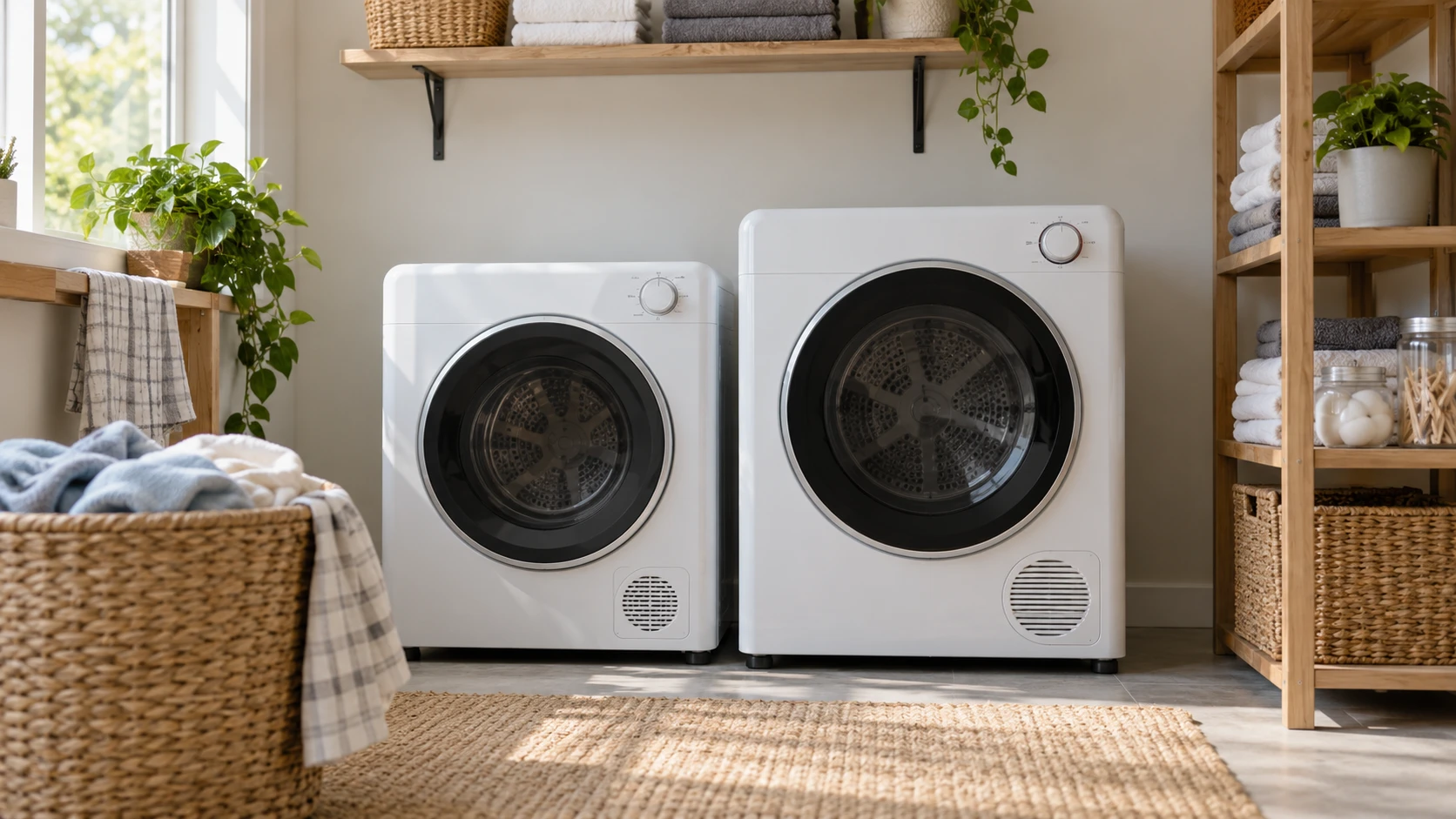
A compact dryer is easiest to choose after you picture a normal wash day. Where will it stand? How much laundry comes out of your washer at once? Where will its exhaust go? Those questions matter more than the difference between a 1.7- and a 2.6-cubic-foot label if either machine cannot be installed and used in your space.
The Dessiz and EUHOMY listings offer different levels of detail. Dessiz gives a 12-pound wet-clothes capacity and recommends a lighter load for faster drying. EUHOMY describes a larger drum, a 14.5-pound wet-laundry claim, and four named modes. Both are presented for small homes, but the saved product descriptions do not supply a complete installation plan or a controlled, same-load drying test. Treat the numbers as shopping information to check against your room, your clothing, and the current manuals.
Start with the place the dryer will occupy — compact dryer 120V setup guide
The Dessiz 1.7 cu ft compact dryer listing measures it at 16.5 by 19.7 by 23.4 inches and lists a weight of 34.17 pounds. The saved description calls it portable and suggests apartments, dorm rooms, and RVs. Those suggestions say little about whether a particular shelf, wall, or room is suitable. Measure the actual dryer location, the path through the doorway, and the room needed to open the door and remove the lint filter. Then check the manufacturer's required clearances; the cabinet dimensions alone do not include working space.
EUHOMY lists its 2.6-cubic-foot dryer at 17.6 inches deep, 23.6 inches wide, and 27 inches high. It describes a wall-mount option and a kit, though the saved text does not establish the load rating of your wall or the fasteners needed for your construction. A larger body can make placement harder even when it reduces the number of loads. If wall mounting is the plan, use the exact model's instructions and confirm that the structure and installation method meet them. A listing's mention of a kit is not an installation approval.
Neither product page resolves the rules of a particular lease, dorm, or building. Ask about dryer use, electrical supply, and exhaust before buying. Think about the finished setup rather than where the carton can temporarily fit. You will need access to the controls, door, lint filter, and plug during ordinary use. A dryer squeezed into a cabinet can be awkward to clean and may conflict with its clearance or exhaust requirements.
Drum volume is only one capacity number — EUHOMY 2.6 cu ft compact dryer
Dessiz lists a 1.7-cubic-foot drum and a 12-pound capacity for wet clothes. In the same description it recommends putting in no more than 5 kilograms, about 11 pounds, when quick drying is the goal. The recommendation is slightly below the stated wet-load capacity. It is useful because wet garments are heavy and need room to tumble; a drum filled to its geometric volume will not necessarily dry well. The listing does not say that every 11-pound load will dry in a given time.
EUHOMY's 2.6-cubic-foot listing claims it can handle 14.5 pounds of wet laundry per cycle. That figure also describes wet weight, not a promise about the dry weight of a basket or how long a particular fabric will take. The larger drum may offer more room for towels or a split washer load, but the saved descriptions give no matched test using the same fabric, washer spin, starting moisture, and dryness target. You cannot turn the drum-volume difference into a reliable cycle-time or load-count saving from this evidence alone.
Weighing a typical wet load once can make these figures more useful. If your washer regularly produces more than either suggested amount, plan on splitting loads. If you mostly wash a few shirts, socks, and towels at a time, the extra drum space may be less valuable than a dryer that fits and is simple to reach. Bedding deserves a separate check: the product descriptions mention ordinary clothing and towels but do not establish that your particular comforter is permitted or will tumble freely. Look up the item guidance in the current manual before counting on a compact machine for large pieces.
A two-load laundry routine has costs beyond a second timer setting. You need space to hold the waiting wet load and time to unload and clean the filter between cycles. If the dryer is far from the washer, include carrying space and a safe place for a basket. Those small details decide whether a compact dryer is pleasant to use several times a week.
Compare controls by the loads you actually dry — EUHOMY 2.6 cu ft compact dryer
Dessiz describes a knob and an LED display. Its saved listing names Fresh at zero to 20 minutes for cooling, Iron Dry at 30 to 50 minutes for drying and cooling, Regular at 110 minutes, and Heavy at more than 110 minutes. The description also recommends removing water in the washer first for a better result. These labels tell you what Republeq's catalog says the controls do; they do not establish a moisture-sensing system or a guaranteed result at the end of a cycle. Check the panel on the exact model sold today and use the garment care labels when choosing heat and time.
EUHOMY names Powerful, Smart, Environmental, and General modes. The saved description says they suit different fabrics, but it does not provide the temperatures or timer ranges for each. “Smart” on a mode label is not enough evidence to assume the dryer senses remaining moisture. If you regularly dry delicate items, request the current manual's mode table before deciding which panel gives you the control you need. An easy-to-read control that does not offer the setting you use most is not much of an advantage.
Dessiz mentions a see-through door and a display for checking progress. EUHOMY describes a transparent door with a 105-degree opening, an automatic shut-off feature, and a removable lint filter. The latter description does not explain every condition that triggers the shut-off. Confirm door behavior and filter access on the exact machine, especially if the dryer will sit under a counter or near a wall. Both filters need cleaning according to their manuals; accessible maintenance matters more over a year than it does in a product photo.
The published compact dryer 120V setup guide discusses a different machine. Its checklist is useful for thinking through outlet, space, load size, and exhaust, but it does not replace either Dessiz or EUHOMY instructions. Keep the model-specific manual beside your measurements when you decide where to put the appliance.
Check the power and exhaust plan before price — EUHOMY 2.6 cu ft compact dryer
Dessiz's listing calls it a 120V, 1000W dryer and includes an exhaust pipe, an outlet filter cover, a filter, and filter cotton in the package. An included pipe is a component, not proof that a particular room has a safe route for warm, moist exhaust. The saved text does not show the entire installed path or a rule for your building. Check the current manual for the permitted outlet, exhaust arrangement, and clearances, then ask the building owner or manager where needed. Avoid assuming that simply pointing a pipe into a closet solves ventilation.
EUHOMY's product title says it is for a standard wall outlet; the saved description identifies a 1400W motor. That wording does not verify the condition, capacity, or suitability of the outlet you intend to use. Nor does a wall-mount kit settle the exhaust question. Confirm the electrical requirements and venting instructions for the exact model, including any applicable building restrictions. Do not plan around an extension cord or improvised adapter based on a listing's broad “portable” language.
A wattage label gives an instantaneous power rating, not the energy required to finish one basket. Drying energy depends on how long the heating element runs, how much water the clothes retain, and the cycle chosen. The 1000W and 1400W figures therefore do not establish which dryer costs less per completed load. Dessiz also describes a roughly 58-decibel operating level, with an acknowledgment that perceived loudness varies by room. There is no same-method noise result for the EUHOMY model in the saved evidence. If evening noise matters, look for a trustworthy test under comparable conditions or hear the exact model in use.
EUHOMY's listing makes ETL and DOE claims and mentions a one-year warranty. Confirm the marks, coverage, Republeq's catalog, and service process for the unit currently offered. Those claims do not remove the need to install it as instructed. The Dessiz snapshot does not provide comparable certification or warranty terms, so ask for those details directly instead of treating their absence from one saved description as proof they do not exist.
Put the saved prices in context — EUHOMY 2.6 cu ft compact dryer
The September 30 catalog snapshot marked both products available. It listed a minimum price of $237.49 for Dessiz and $349.99 for EUHOMY, a difference of $112.50 at that moment. The lower saved price may be attractive if your normal loads fit the Dessiz recommendation and its controls suit you. EUHOMY's larger listed drum and higher wet-load claim may be useful if you would otherwise split many loads. Neither possibility proves better value until you know the installed cost and the routine each machine can handle.
Check today's offer for shipping, returns, warranty service, and what is included. If one setup requires a proper exhaust route, suitable mounting support, or a different location, that work belongs in the comparison. A low appliance price can be offset by a setup that is difficult to use or cannot be approved for the space. Likewise, paying more for drum volume has little value if the machine will be too large for the only workable spot.
Before ordering, walk through a real basket. Measure the proposed spot, weigh or estimate the wet load, identify the settings you would use, and confirm the power and exhaust requirements in the current manual. Decide where the next wet batch waits while the first dries. Then compare the current Dessiz offer with the EUHOMY 2.6 cu ft compact dryer offer. The better choice is the one whose verified setup and practical load size work in your home week after week.