Office Supplies & Stationery
Understand dedication and acknowledgments in a booklet
Two original fictional booklet notes distinguish honoring Ada from thanking Mina for the specific task of checking illustration order.
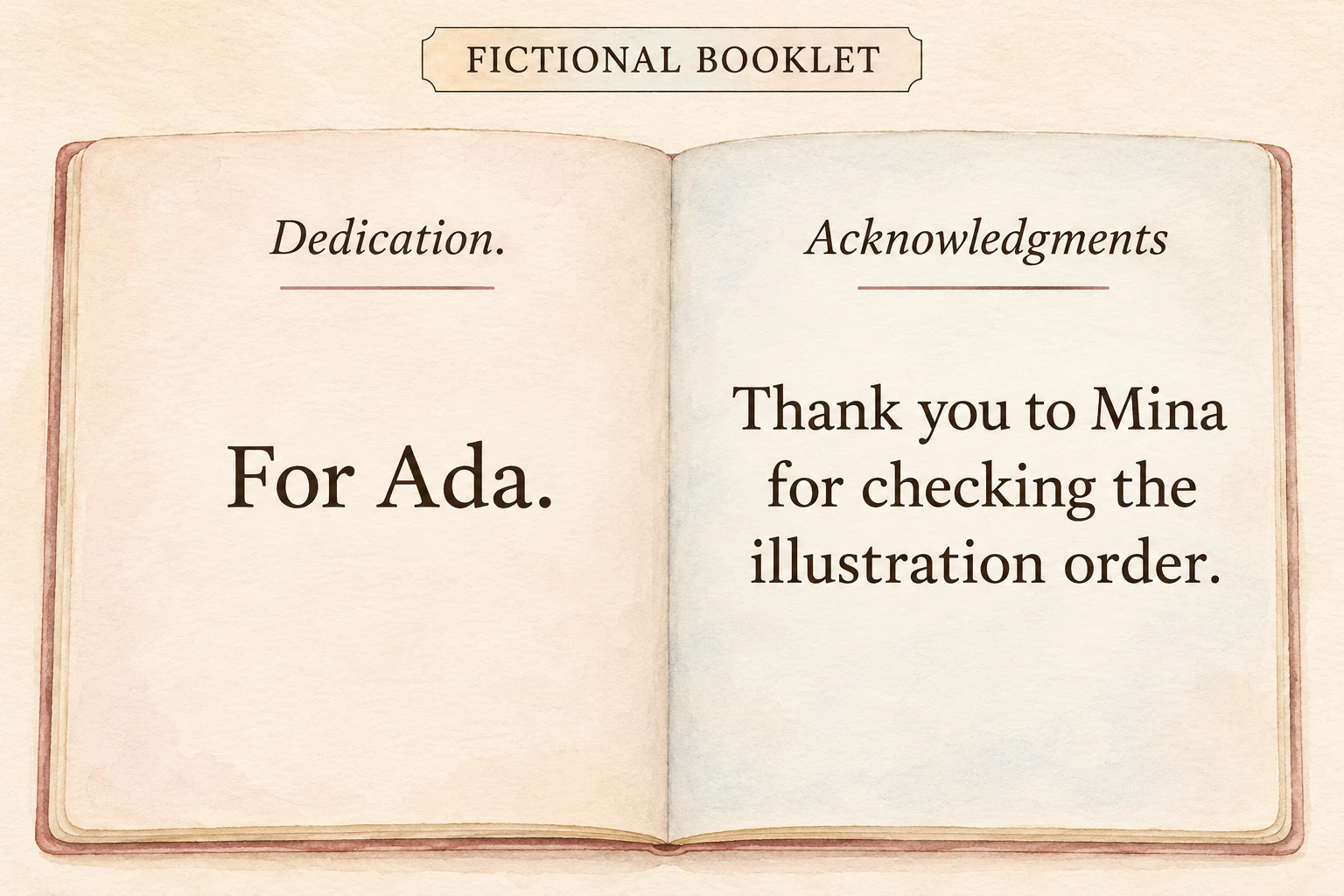
The dedication and acknowledgments in this fictional booklet name different relationships. “For Ada.” honors the person the author chose. “Thank you to Mina for checking the illustration order.” names a particular contribution to the work. The notes can sit within the same project without turning Ada into a contributor or Mina into its author. Looking at the wording beside the project brief explains why each person appears in this example.
The brief is entirely invented: one author wrote the booklet’s text and made its room drawings. Ada is the chosen honoree, with no help or family relationship specified. Mina checked the illustration order. No actual booklet, person or contribution is reported. The example lets us discuss what the two notes say without borrowing an occasion from somebody’s life or claiming a universal publisher’s preferred arrangement.
Read the dedication page as an act of honoring
The short line “For Ada.” carries the author’s chosen dedication. It does not describe a task Ada performed. The brief gives no reason to expand it into a sentence about years of advice, financial support or help with the drawings. Those additions would introduce a different account of the relationship. This version can honor Ada while leaving the author’s wider reasons unstated.
Brevity is a choice for this particular dedication page. The example does not require every dedication to be equally short. A writer may have something more to say in another project. Here, the supplied intention is simply to honor Ada, so the plain line is enough to express that choice. A longer sentence would need a reason that belongs to the work being prepared.
Imagine placing “For Ada, who checked the illustrations.” on this page instead. That wording would attribute a contribution the brief gives to Mina. Its warmth would not settle the factual difference. Keep the short original line while reading what the acknowledgment actually credits. The problem with the invented expansion lies in its claim about a task, rather than in how generous or polished the sentence sounds.
Keep contribution credit attached to the named task
Mina’s acknowledgment reads, “Thank you to Mina for checking the illustration order.” The phrase after Mina’s name identifies the help the fictional brief assigns to her. It does not say she made the drawings, wrote the text or selected every part of the booklet. The thanks can remain specific without supplying a complete account of her relationship with the author.
Compare that line with “Thank you to Mina for the illustrations.” The shorter wording could suggest a different contribution from the one supplied. The original phrase keeps the checking task visible. If the author wants a shorter note, the revision still needs to identify the help they mean to thank. Cutting words should leave the intended account understandable, rather than replacing it with a broader claim about the work.
“Checking the illustration order” also leaves some things unspecified. The brief does not tell us whether Mina suggested a change or confirmed an arrangement already chosen. It supplies no number of revisions, dates or discussion transcript. The selected acknowledgment need not complete those details. Its wording can stop at the contribution the author has actually included in this fictional account.
Leave authorship with the role the brief supplies
The fictional author made the drawings and wrote the text. Thanking Mina for an order check does not change that supplied account. If we replaced her credit with “coauthor” or “illustrator,” we would be assigning work the brief has not given her. Those labels would require their own supporting account in a real project.
Likewise, the acknowledgment does not say Mina endorses every sentence or agrees with the author’s choices. The line thanks her for a task. Adding a statement such as “Mina approved the whole booklet” would bring a new assertion into the note. Leave it out when the project information does not establish it. Specific thanks can retain its meaning without becoming a claim of complete approval.
I keep the contribution credit close to Mina’s name. A reader can encounter the person and the task in the same short sentence. The sentence does not need a second paragraph praising every aspect of the work. For this invented booklet, I want the acknowledgment to record the order check plainly, while the author remains responsible for the text and drawings named in the brief.
A person can be honored and thanked
The distinction between the notes does not require two mutually exclusive groups of people. In a different authored version, the writer could choose to honor Mina as well as thank her. That would be another dedication choice. The contribution statement would still need its own wording if the writer wanted to identify the illustration-order check. A person’s appearance in a dedication alone would not describe that particular task.
Our selected version keeps Ada as its honoree and Mina in its acknowledgment. There is no need to move a name merely to make the two pages look balanced. Nor does the brief require an equal number of names or a matching amount of text. The author has chosen different things to say about the two people. Keep those intentions visible when comparing the notes.
If someone has both relationships to your own work, you can decide what you want each note to express. Use the project’s actual account of the contribution when naming it. This fictional arrangement is available as an example of a distinction, rather than a rule assigning every helpful person to one page and every loved person to another. The words need to fit the relationship you mean to describe.
A name alone cannot explain the contribution
“Thank you, Mina” would express appreciation while leaving the task unstated. That may be the wording a writer wants in another context. Here, the aim is to name the illustration-order check, so the selected sentence includes it. Compare the alternatives against that aim. You can prefer the more specific sentence for this booklet without declaring every brief thank-you incomplete.
The dedication makes a different choice about what to leave open. “For Ada.” does not explain the author’s reason for honoring her, and the brief does not ask it to do so. Adding a detailed account of Ada’s supposed help would change the note’s content. Read the actual words alongside the intention assigned to them before treating a missing explanation as an omission that must be filled.
Keep any working role notes separate from the words you intend to include in the booklet. A private line saying “Mina checked illustration order only” helps the author avoid expanding the credit while drafting. It need not appear as a restrictive aside in the finished thank-you. The selected sentence can describe what Mina did without surrounding that contribution with a list of things she did not do.
Read both notes beside the same project brief
Return to the complete pair: “For Ada.” and “Thank you to Mina for checking the illustration order.” The first retains the honor choice. The second retains the named check. Neither note needs to borrow the other’s wording to be complete within this exercise. Keep the short brief nearby while considering a later revision, so an attractive new phrase does not quietly change who did the work.
A different contribution would need different words. If a real collaborator checked captions, translated a passage or made an illustration, identify the work you actually mean to credit. Do not transplant Mina’s task merely because this sentence is ready to use. The fictional names and roles belong to this example. Your own draft needs the people, contributions and sharing arrangements relevant to its actual project.
Keep the notebook accounts within their visible limits
The Cambridge planner account describes a gray guided action planner with eighty sheets and a ten-notebook bundle. Its sole photograph shows one closed dark cover with CAMBRIDGE lettering and wire binding. The interior planning format is not shown. The image does not verify the bundle, paper performance or stated dimensions. The offer can remain a separate reference for working notes while this explanation supplies its own fictional booklet text.
The Oxford notebook account describes an Earthwise narrow-ruled notebook and a ten-book bundle. Its sole photograph shows one green wire-bound cover with subject, sheet and ruling information, plus a low-contrast barcode. That view does not inspect the interior or delivered quantity, authenticate the maker or test recycled composition. Neither notebook account establishes a publisher’s front-matter arrangement or proves that someone contributed to a particular manuscript.
Separate a gift message from a project acknowledgment
The bookend gift-note guide develops a message from the giver’s attributed reading recollection and a personal connection with a motif. Its memory limits belong to that task. The booklet here has a fixed invented contribution brief, so it has no uncertain reading occasion to reconstruct. A note of affection and a specific work credit can each be personal, while the claim about who checked the illustration order still needs its own basis.
The library zine-donation guide follows institution-specific intake, consent, catalog access and delivery information. Those arrangements concern offering a copy to a collection. The dedication and acknowledgment drafted here supply no submission form or institutional answer. Keep an intended donation attached to the collection’s actual route. Naming a person in a prefatory note cannot establish that a library accepted the booklet or that an intake agreement has been completed.
Leave a notebook order with the purchasing record
A booklet note can be finished while a possible stationery order remains undecided. If buying a notebook through republeq.com becomes a separate decision, start from the precise offer and variant you are considering. Keep unanswered package questions with that selection, including what the seller means by a bundle when the photograph shows one book. A payment preference will not inspect the goods. If you would like to use crypto such as USDT, see which choices the actual checkout presents before proceeding. The examples in this article do not establish an available asset, network or payment service. Read the amount requested and any charges disclosed for that order. Use only the receiving details and other requirements supplied for the intended transaction, resolving an unclear instruction through the merchant or payment provider. Preserve the answer with the order reference so it remains attached to the question it addresses. Review applicable delivery, cancellation, return and refund terms, including conditions specific to a cryptocurrency option if one is offered. This explanation supplies no receiving address, wallet selection, transfer sequence, exchange rate or assurance of recovery. Keep any resulting confirmation alongside the selected goods and the merchant’s order status. If a payment attempt has an uncertain result, reconcile that result before initiating another attempt. A confirmation about a transaction does not establish a notebook’s page count, paper quality or suitability for your writing tool. It also gives no information about the people named in a dedication. Keep private purchasing records outside the booklet notes you intend to share, and continue the editorial work using the project information that actually concerns it.
Keep the two intended relationships clear
For this fictional version, I retain “For Ada.” as the dedication and the specific thanks to Mina for checking the illustration order. The dedication and acknowledgments can remain different lengths because they say different things. The author’s text and drawings stay attributed to the author in the brief.