Office Supplies & Stationery
Dated payment comparison: state the assumed rate
Compare fictional payments now and later at one common date. Keep the assumed conversion rule beside any conditional cost ranking.
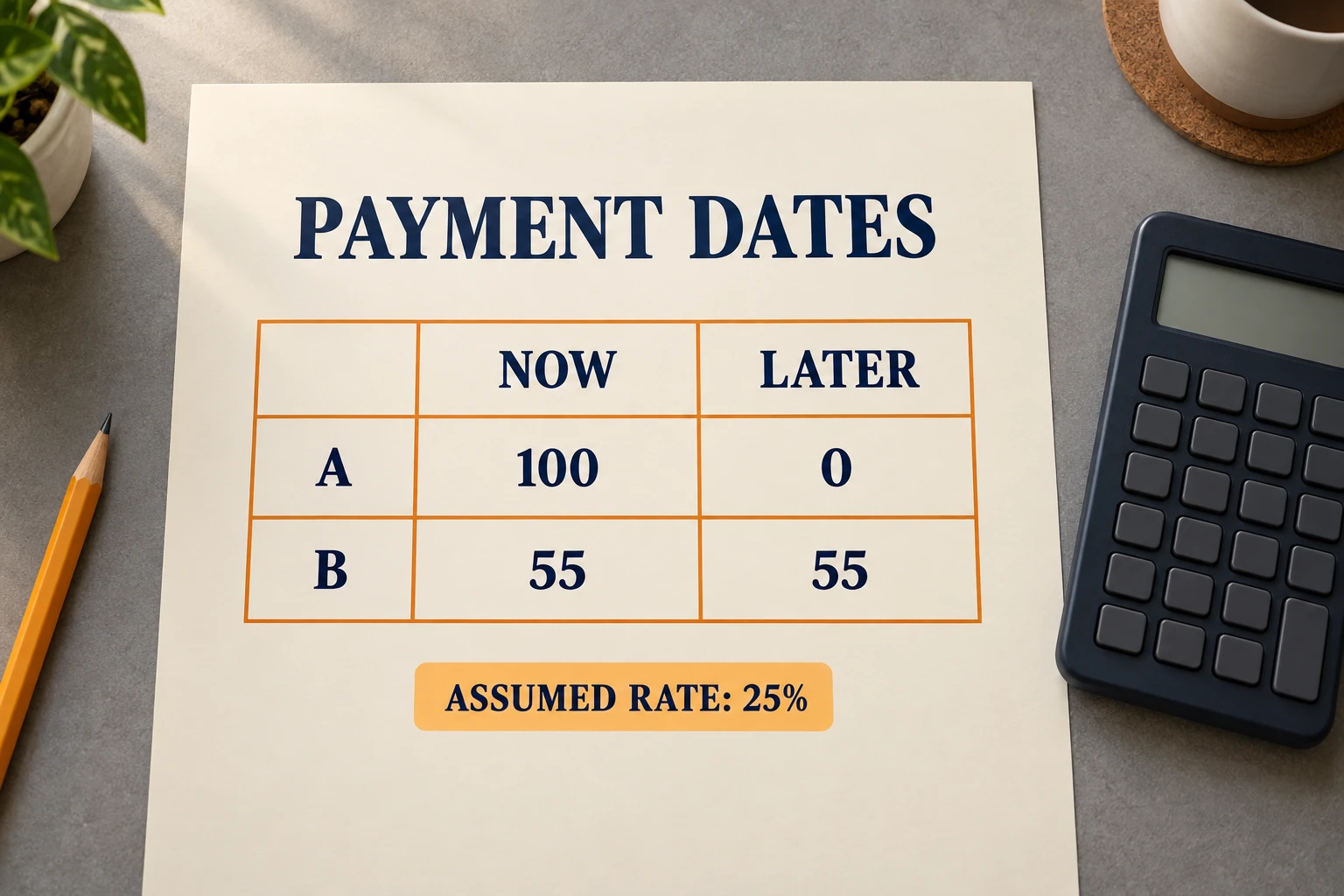
A Dated payment comparison needs both amounts and dates. In the fictional schedules below, A pays 100 tokens now. B pays 55 now and 55 one period later. A has the lower nominal total: 100 against 110. Comparing their equivalents at one date asks a separate question and requires an expressly stated conversion rule.
All tokens, schedules and rates in this exercise are invented. They describe no product price, installment offer, loan, deposit, investment or available return. The same notional purchase is assumed for both schedules solely to isolate the arithmetic. No actual seller has agreed to either schedule, and no benefit or suitability comparison is established.
Keep the two schedules intact
Write two columns, now and one period later. A contains 100 in the now column and zero in the later column. B contains 55 in each column. The period is one defined interval shared by the worksheet; it is not silently a month for one entry and a year for another.
Adding the printed payments gives A's nominal total of 100 and B's nominal total of 110. On that measure, B requires ten more tokens. Nothing in the later conversion will change those specified payment amounts. Keep this addition on the page instead of replacing it with a date-equivalent figure carrying the same heading.
The exercise assumes no fees, tax, missed payment, uncertainty, penalties or extra receipts. It also assumes that the notional purchase and its timing are otherwise identical. These narrow boundaries let us inspect the effect of the declared conversion rule without treating it as a complete real purchase decision.
State a rule before moving an amount between dates
Let r be a nonnegative assumed rate for one period. Declare that one token now corresponds to one plus r tokens at the later date. This is a mathematical rule for the worksheet. It supplies no evidence that anyone can earn the rate, borrow at it or move actual funds between dates on those terms.
Under this rule, an amount x now corresponds to x times one plus r later. To find the now-equivalent of a stated later payment, reverse that multiplication: divide the later amount by one plus r. Keeping the direction visible prevents the rate from being subtracted from a payment merely because its date is later.
A's entire payment already falls at the common date now, so its now-equivalent remains 100. B's first 55 also remains unchanged. Its later 55 becomes 55 divided by one plus r. B's total now-equivalent is therefore 55 plus 55 divided by one plus r.
The denominator is positive for every rate allowed here, including zero. This matters when comparing or rearranging the expressions. The worksheet excludes negative rates; a different permitted range would need its own conditions and analysis. No selected calculator or payment provider supplies the assumed r.
Work a ten-percent assumption completely
First assume r equals 0.1, or ten percent for the one defined period. One token now corresponds to 1.1 later under this rule. B's later 55 therefore has a now-equivalent of 55 divided by 1.1, which is 50. Its first 55 remains due now.
B's combined now-equivalent is 55 plus 50, or 105. A's is 100. Under this particular assumption, A is lower by five tokens at the common date. The nominal comparison remains 100 against 110, so the two measures have different gaps even though they give the same ordering in this case.
Check the reversed operation: 50 multiplied by 1.1 equals 55. That recovers the specified later amount. By contrast, simply removing ten percent from 55 would give 49.5. Multiplying 49.5 by 1.1 gives 54.45, which fails to recover 55 under the declared rule.
Change the assumption without changing the payments
Now make a separate worksheet with an assumed rate of 25 percent. The conversion factor is 1.25. B's later 55 divided by 1.25 equals 44, and its now-equivalent total becomes 55 plus 44, or 99. A still pays 100 now.
At this assumed factor, B has a lower now-equivalent by one token. It still has the larger nominal payment total of 110. Reporting B as an unconditional ten-token saving would therefore be wrong. The result is a one-token difference in the common-date measure under the expressly assumed 25-percent conversion rule.
Nothing about changing r changes B's two printed payments. Nor does the worksheet establish a way to fund the later payment. A real decision would require its own evidence about available arrangements, obligations and risks. The arithmetic here can remain correct while those practical questions remain unanswered.
At an assumed rate of zero, the factor is one and no date conversion changes an amount. B's now-equivalent is then 55 plus 55, or 110. A remains 100. This control shows why the rate belongs beside the result: the same two schedules do not have one rate-independent common-date ranking.
Find the exact tie
Set the two now-equivalents equal: 100 equals 55 plus 55 divided by one plus r. Subtracting 55 leaves 45 equal to 55 divided by one plus r. Multiplying by the positive denominator gives 45 times one plus r equal to 55.
Divide by 45 to obtain one plus r equal to 55 over 45, or eleven ninths. The tie rate is therefore two ninths. As a percentage it is twenty-two and two ninths percent. Retain the exact fraction when checking the tie rather than replacing it with a rounded percentage and expecting exact equality.
At r equal to two ninths, dividing 55 by eleven ninths gives 45. B's now-equivalent is 55 plus 45, exactly 100. This direct substitution checks the boundary against the original expression. It also shows that the tie is not inferred from a few rounded trial rates.
For nonnegative r below two ninths, the positive denominator is smaller than eleven ninths, so 55 divided by it exceeds 45. B's total then exceeds 100. Above two ninths, that divided amount is below 45, making B's total below 100. The equality case sits between the two conditional orderings.
Cross-check at the later common date
You can compare the same schedules at the later date if the rule is applied to every entry consistently. A's now payment becomes 100 times one plus r. B's now payment becomes 55 times one plus r, and its later 55 stays 55. Add those two contributions for B's later-date equivalent.
At ten percent, A's equivalent is 110. B's is 60.5 plus 55, or 115.5. A remains lower. The gap is 5.5 at the later date, consistent with multiplying the earlier common-date gap of five by 1.1. The positive factor scales the gap while preserving its direction.
At 25 percent, A's equivalent is 125. B's is 68.75 plus 55, or 123.75. B remains lower, now by 1.25. That matches the earlier one-token gap multiplied by 1.25. Comparing A at now with B at later would lose this consistency by mixing dates within one subtraction.
Do not count two periods as one
For a separate timing check, place a payment of 55 two periods later. Suppose the ten-percent conversion rule applies separately in each period. One now token corresponds to 1.1 times 1.1, or 1.21, after two periods. Its now-equivalent is therefore 55 divided by 1.21, exactly 5500 over 121.
You can reach the same fraction in two steps. Moving 55 back one period gives 50. Moving that 50 back another period gives 50 divided by 1.1. That is 500 over eleven, equal to 5500 over 121. Dividing once by 1.1 would move the payment only one of its two periods.
Dividing by 1.2 would use another rule, adding two ten-percent increments to the original amount instead of applying the stated factor each period. Keep the full date and conversion convention with the amount. Neither a familiar percentage nor a calculator's display can decide which convention the worksheet has defined.
Read the native calculator accounts separately
The Big Numbers Talking Desktop Calculator offer retains an Unbranded account. Its sole image shows a complete black desktop calculator with TALKING wording, digit keys and display. Audio, usability and calculation performance were not tested. The screen is illustrative and supplies no result for these schedules.
The Detectamet 202S-P01 calculator offer retains its Multicolor label. Its sole image shows a complete blue calculator with Detectamet branding, display and keypad. Detectability, dimensions, automatic shutdown and operated digit behavior are not independently verified here. Neither photograph establishes the complete contents of a delivered parcel.
Neither selected account supplies a payment schedule or a conversion rate for this exercise. The native observations concern actual catalog accounts; the dated token arithmetic remains an original paper model. No purchase or particular calculator is required to inspect it.
Keep other checking questions distinct
The Fibonacci parity-pattern guide examines consecutive states in a recurrence. Here a period is a stipulated payment interval, not a position in that recurrence. The recurrence supplies neither the assumed factor nor the dated amounts.
The last digit power-sum guide checks an exponent's position in a repeating digit cycle. That cycle cannot establish the rate or payment dates needed here. Use the payment schedule and assumed conversion factor to check this worksheet.
Separate an actual checkout enquiry
If you separately consider a calculator order on republeq.com and want to ask about USDT, begin with the exact offer and intended quantity. The fictional tokens, payment dates and assumed conversion rates in this worksheet are not prices, cryptocurrency amounts or payment instructions. Correct arithmetic establishes no checkout method or actual order status. Read the payment options and conditions presented for the intended transaction, and ask the responsible support contact to clarify essential missing information before deciding whether to proceed. If a cryptocurrency option is offered, establish the specified asset and network, requested amount, any stated validity period and the reference associating payment with the order. Do not infer a transfer destination from a product image, worksheet heading or calculator display. Resolve material product questions separately, including actual supplied contents and any intended use you need the item to support. Ask about applicable delivery, cancellation, return and refund conditions, including the denomination of any approved refund and relevant deductions. Keep each answer with the offer it concerns. Information about one account does not automatically describe another quantity or purchase, and a changed order may require reviewing the resulting terms again. This article promises no present USDT availability, fee level, conversion result, confirmation time, refund amount or delivery outcome. You can inspect every fictional payment schedule without purchasing anything. Preserve any eventual order acknowledgement and transaction record separately from the worksheet. Those records concern an actual transaction under its documented conditions; the calculations compare expressly stated schedules. A preferred payment asset or a plausible result cannot fill a gap in actual order information.
Save the assumption beside the result
A Dated payment comparison is inspectable when the payment dates, nominal totals, common comparison date and assumed factor remain together. A totals 100 and B totals 110. B's now-equivalent is 105 at ten percent, 99 at 25 percent, and exactly 100 at two ninths. Those are conditional arithmetic results, with no demonstrated real saving beyond the model.