Crypto Commerce
Danolapsi dual-zone wine fridge or Lanbo: what will the wine cabinet actually hold?
Compare Danolapsi dual-zone wine fridge by footprint, bottle-count evidence, zone ranges, door access, shelves, and beverage-drawer use.
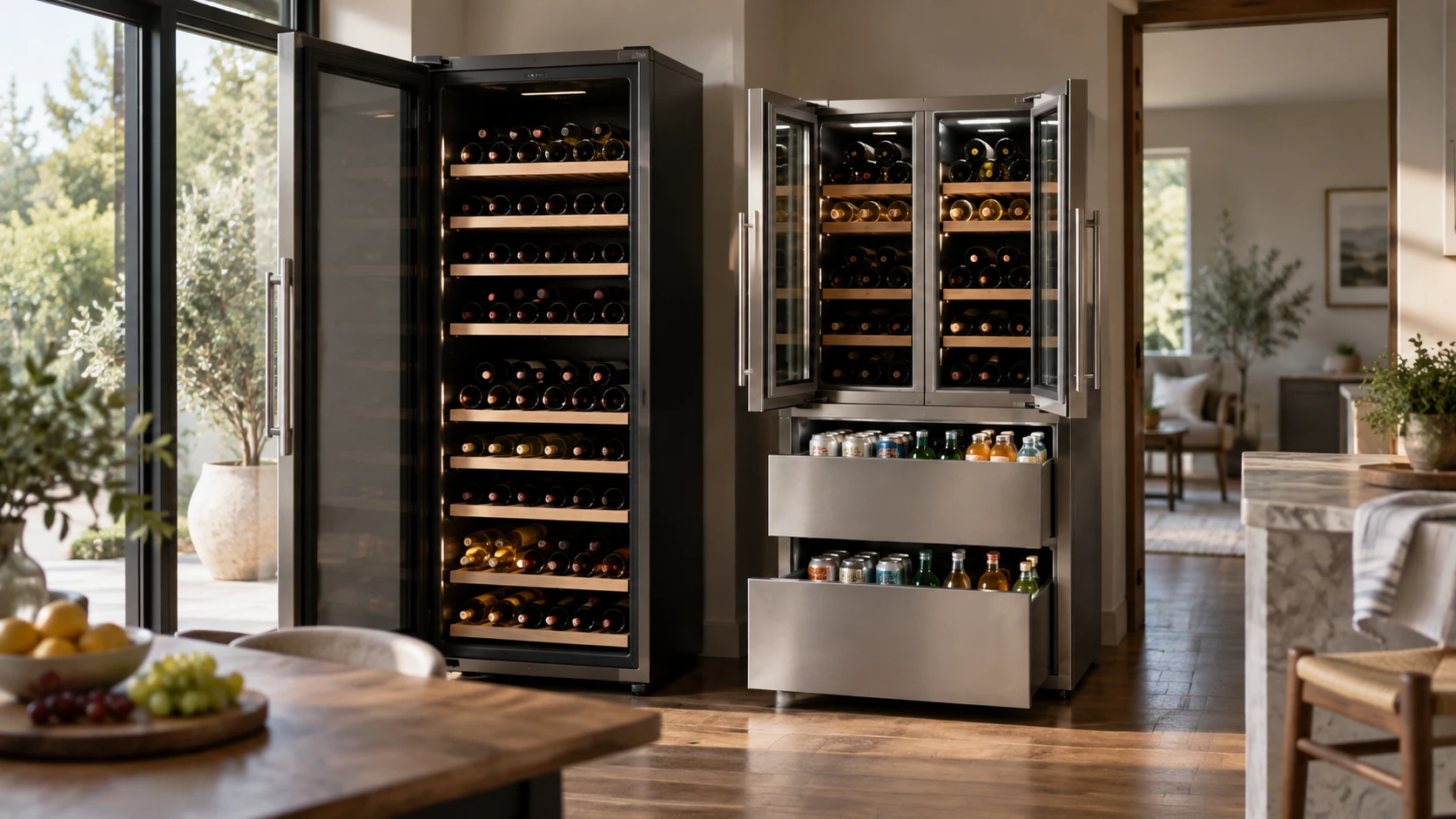
The Danolapsi dual-zone wine fridge is presented as a tall cabinet with two temperature areas and removable wooden shelves. The published guide on wine fridge bottle-capacity checks uses a smaller pair, but the same bottle-measurement question applies here. The Lanbo wine and beverage refrigerator combines an upper wine section behind French doors with two lower beverage drawers. The two layouts invite different uses, yet the advertised counts need close scrutiny before either unit gets a place in the kitchen plan.
Start by listing what you want to store: ordinary wine bottles, wider sparkling bottles, cans, or short mixers. Write down the normal count and note the holiday peak separately. A dedicated wine cabinet can be easier to organize when most of the space is for bottles. A divided wine-and-drink cabinet may be more useful when guests regularly reach for cans. Neither saved row supplies a dependable loading diagram for a mixed collection. The plan should come from interior measurements and shelf positions, not a headline maximum.
Resolve the bottle-count conflict first — wine fridge bottle-capacity checks
Danolapsi's title promotes a 160-bottle model, while its description says the 15.9-cubic-foot unit accommodates up to 46 bottles at one time. That is a material contradiction, not a small rounding difference. The same row calls the appliance 24 inches wide, with stated exterior dimensions of 23.5 inches wide, 69.7 inches high, and 26.8 inches deep. Check Republeq's product page for the exact model number, a manufacturer capacity drawing, and a photograph of the interior with shelves installed. Do not reserve space or budget for 160 bottles until the conflicting 46-bottle statement is explained.
Lanbo's title says 168 bottles and 300 cans. It is unclear whether those are separate maximum configurations, a combined total, or figures for different sections. The saved text says some larger wine bottles require one or two shelves to be removed, reducing capacity. That is a useful admission: bottle shape changes the count. Ask for the manufacturer's shelf map showing standard bottles, wider bottles, and cans in the lower drawers. If the cabinet can be loaded in more than one way, request the usable count for the actual mix you plan to store.
A bottle count can change sharply when a shelf must leave room for Champagne or a tall closure. Measure a few representative bottles from your own collection, including diameter and overall height. Do the same for the cans and small bottles intended for Lanbo's drawers. Compare them with usable shelf and drawer dimensions, allowing enough clearance to remove an item without scraping its label. A cabinet that technically contains a maximum number of bottles may be unpleasant to use if every removal requires shifting several others.
Check the cabinet opening and delivery route — Lanbo wine and beverage refrigerator
Danolapsi's row describes front vents and says the unit can be used built in or freestanding. Yet it also calls a cabinet nearly 70 inches tall suitable for under-counter mounting. A typical under-counter opening cannot accommodate that height. Treat the under-counter phrase as unreliable for this exact listed unit until a current installation sheet explains it. Measure the full height, width, depth, door swing, ventilation clearances, and electrical outlet location before ordering. Front venting does not mean every side and rear clearance can be ignored.
Lanbo's description calls it a 32-inch wine-and-beverage fridge but does not provide a complete height and depth table in the saved excerpt. It has French doors above two drawers, so its operating footprint includes the space to open both doors and pull each drawer out. Ask for the manufacturer's dimensioned installation drawing. Mark those open positions on the floor with tape. A cabinet can fit between counters and still block a walkway when someone reaches the lower drawer during a gathering.
Measure the route from delivery entrance to final location. A tall Danolapsi cabinet may need careful clearance through doors and around turns. Lanbo's wider front may present a different problem. The listings do not provide matching packaged dimensions or weights. Verify whether any door removal is permitted and who would perform it, rather than expecting the delivery crew to improvise. Confirm that the floor is level and can support a fully loaded cabinet. Bottle and can weight can be significant even when the empty appliance seems manageable.
Match each zone to what belongs inside — Lanbo wine and beverage refrigerator
Danolapsi lists an upper compartment adjustable from 40 to 50 degrees Fahrenheit and a lower compartment from 50 to 66 degrees Fahrenheit. Its description frames the two areas around different wine types. Those are settings in a saved Republeq catalog record, not a measured guarantee that every shelf will hold an exact temperature. Ask how the controls display set point versus actual cabinet temperature. Use independent thermometers in both zones during setup and follow the manual's stabilization time before loading a valuable collection.
Lanbo says its upper wine section can be set from 41 to 64 degrees Fahrenheit and its lower two-drawer beverage section from 39 to 50 degrees Fahrenheit. That arrangement makes the drawers the colder stated area. Check whether both drawers share one control and what temperatures are permitted when the upper section is set near either extreme. The Republeq's product-page text describes food storage as an option, but a beverage-drawer range in a product description is not enough to establish safe storage for perishable food. Follow current food-safety guidance and the manufacturer's approved uses if food is part of the plan.
Location and loading affect both cabinets. A sunlit glass door, a crowded shelf, and frequent openings can change what an independent thermometer reports. Danolapsi describes a compressor with air cooling; Lanbo describes fan-forced circulation. Those words do not provide a matched recovery test after a door has been open. Try the intended load, note how long each zone takes to return to its normal reading, and adjust the routine if a cabinet is opened often during parties. No saved source measures that performance for your room.
Examine doors, shelves, and controls — Lanbo wine and beverage refrigerator
Danolapsi lists removable wooden shelves, a double-layer tempered-glass door, an LED control screen, a lock, and a blue light. Its row makes broad claims about light protecting wine and wooden shelves contributing aroma without changing flavor. Those claims are not established by a controlled storage test. Concentrate on whether shelves slide smoothly under the weight of your bottles, whether they can be rearranged for wide shapes, and how the lock operates. A lock may discourage casual opening, but it is not a substitute for keeping alcohol safely away from children where required.
Lanbo lists upper stainless-trimmed French doors with tinted double-pane glass and lower drawers with stainless fronts. That format may keep a guest's can search separate from the wine shelves. Check whether both upper doors can open fully beside nearby walls or cabinet handles. Pull the lower drawers out as far as the manufacturer allows and inspect how cans or bottles are kept from rolling. The saved description does not specify drawer dividers or the load each drawer can support. Ask for those details if the lower section will be packed densely.
Danolapsi claims noise under 45 decibels and calls its compressor energy efficient. Lanbo's row does not give a matched noise or annual energy figure. The presence of fans in both descriptions does not settle how either cabinet will sound in an open-plan room. Request current model-specific energy information if the unit will run continuously, and check the installation manual for leveling and ventilation. A cabinet that is wedged tightly against another surface may rattle even when its compressor is operating normally.
Plan how the collection will be inventoried. If bottles are stacked deep or labels face a wall, the theoretical capacity becomes harder to use. Group wines by when they are likely to be opened and keep a written count outside the cooler if the collection is large. For Lanbo, place the cans people reach for most often where a drawer can open without crossing the cook's work area. For Danolapsi, consider whether the lock key needs a regular storage spot. The product descriptions do not specify an inventory system; these are simple ways to test whether the physical layout fits the household. Try removing a bottle from the back of a full shelf before deciding that an impressive capacity figure represents convenient storage.
Choose with measurements, then inspect on arrival — Lanbo wine and beverage refrigerator
Danolapsi could suit a mostly wine collection if its two zone ranges and tall shelf layout fit the intended room. Its conflicting 160 and 46 bottle figures and implausible under-counter wording must be resolved before buying. Lanbo offers separate upper wine access and lower beverage drawers, but its 168-bottle and 300-can claims need a real loading plan and full cabinet dimensions. Neither listing warrants treating the maximum count as a promise for mixed bottles.
Keep the exact model specification, approved installation clearances, and order contents with your measurements. Once the unit is installed, confirm the doors and drawers move freely, the seals close, and both zones reach stable readings before filling every shelf. Load a representative set of bottles and cans first. That early trial gives you time to correct a fit or control problem while the unit is still easy to inspect.