Crypto Commerce
Danby DWM065A1WDB-6 compact washer vs Urban Living top-load washers for a small laundry routine
Compare Danby DWM065A1WDB-6 compact washer by tub size, wash settings, water-level choices, faucet setup, imbalance handling, and installation checks.
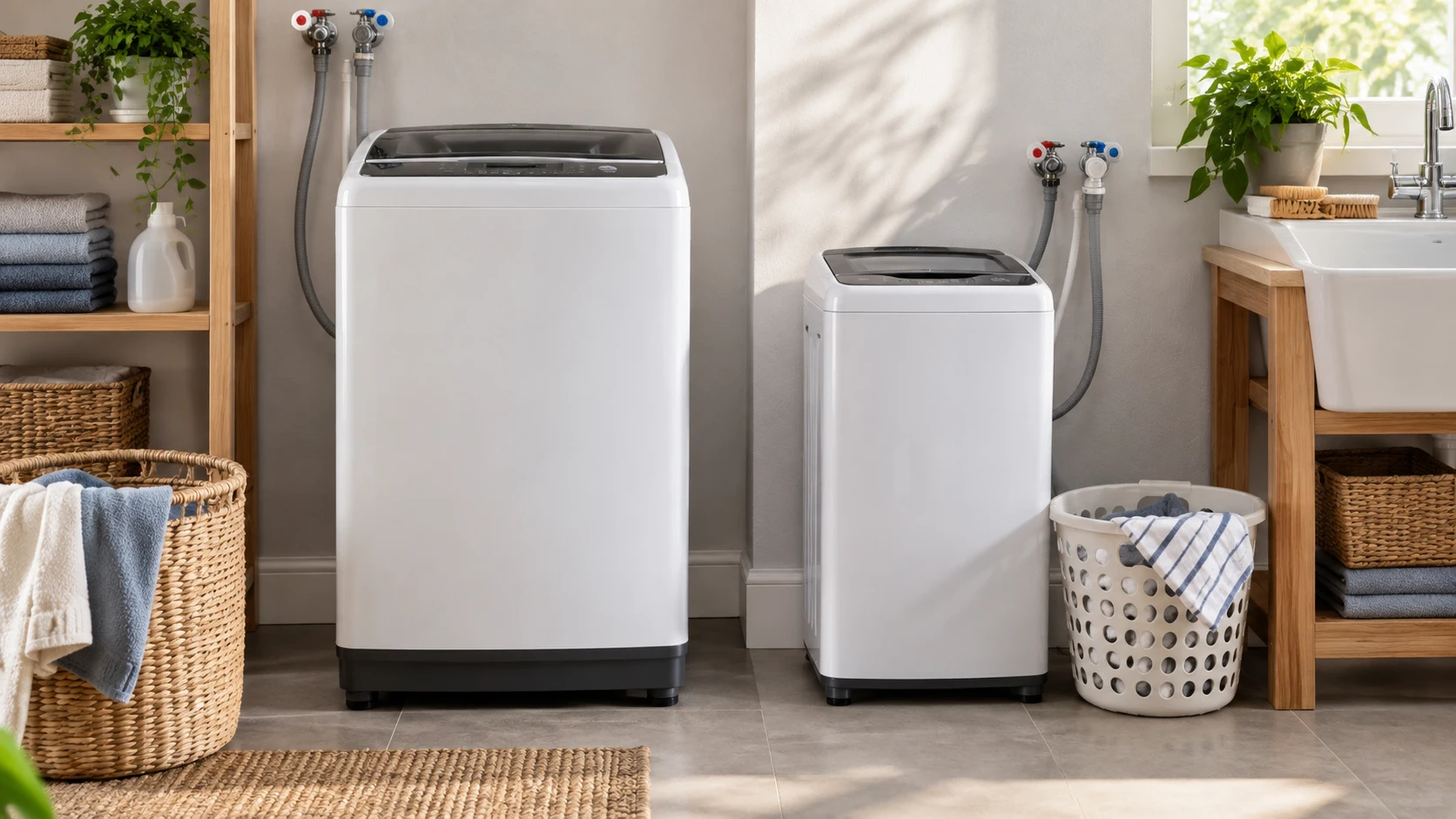
A compact washing machine can help when a full laundry room is unavailable, but its drum has to match the loads you wash and its hoses have to work in the place you can give it. The Danby DWM065A1WDB-6 is listed as a portable 1.8-cubic-foot top-load washer with four cycles and ten water levels. The Urban Living model is listed at 0.9 cubic feet with five automatic cycles, three water levels, and a quick-connect faucet kit. The larger drum may reduce how often you split a load, while the smaller unit may better fit a routine built around frequent, light washing. The saved listings do not give enough dimensions or hookup detail to make that decision alone.
The Danby DWM065A1WDB-6 compact washer has a digital panel, LED display, delay start, stainless steel drum, and a child lock according to its catalog entry. Urban Living describes an accessible control panel, clear lid, end-of-cycle signal, built-in filter, and automatic shutoff. Both list ways to respond to an unbalanced load, though they describe different actions. These are Republeq's product specifications, not side-by-side cleaning results. Start with one ordinary laundry basket and ask which machine can process it within the time and space you have.
Let your usual load set the capacity question — compact top-load washer cycle choices
Danby's stated 1.8 cubic feet is twice Urban Living's stated 0.9 cubic feet of tub volume. That ratio does not mean one machine can safely wash exactly twice the clothing weight. Garment bulk, fabric type, water level, and the manufacturer's load limit all matter. A few towels occupy space differently from several thin shirts. Check each exact model's current manual for weight and item guidance. A compact washer is easier to live with when it accepts the load sizes you actually produce rather than the ones in a product photo.
Count the loads you generate over a week. A person washing work clothes every other day may be comfortable with a small tub and short, frequent sessions. A household that saves laundry for the weekend may want more room to avoid a long sequence of batches. Consider sheets and towels separately from clothes. If the machine cannot handle those bulky items according to its manual, you will need another washing plan even if the tub handles daily garments well.
Urban Living's listing warns that overloading can reduce cleaning efficiency and cause wrinkling. That is a useful caution for both machines. Clothes need room to move through water, and a packed top-loader can leave detergent or soil in folded fabric. Do not use the cubic-foot figure as permission to push down a mound of dry clothes. Follow the load markers or instructions for the exact model, and note whether your usual hamper needs more than one cycle.
The published guide on compact top-load washer cycle choices compares a different pair of top-loaders. Its useful lesson here is to connect wash programs and water choices to real fabric loads. A longer list of cycles is not automatically more useful. Ask which setting handles your most common load and what you would choose for a small delicate load, then compare the steps required on each control panel.
Compare water levels and programs — Urban Living 0.9 cu ft top-load washer
Danby lists four wash cycles and ten selectable water levels. Urban Living lists five fully automatic cycles and three water levels. The saved descriptions do not name every cycle or explain how each machine pairs a water level with a load. Read the current cycle charts before ranking the control panels. Ten levels might let you match water more closely to a range of load sizes, but that benefit depends on how the machine fills and what the maker recommends for each program.
Urban Living's three water levels may be sufficient if your loads fall into a few familiar sizes. A simple choice can be easier for several household members to repeat. Its clear lid lets you see clothes moving, but that view does not prove the machine is using the right amount of detergent or cleaning evenly. Check the manual for detergent type and dose, water supply requirements, and whether a program allows changes after it starts. A shorter menu helps only when it covers the fabrics you wash.
Danby describes a pulsator that moves water and detergent through clothes and claims both stronger action for heavier items and gentler action for delicates. That is a mechanism and claim in Republeq's catalog, not a controlled comparison with Urban Living's wash system. If you care about a particular delicate garment, follow its care label and the machine's fabric guidance. Try to find independent tests using similar fabrics rather than assume one marketing phrase predicts wear over time.
Danby's delay start may be convenient if you want a cycle to finish near the time you get home. Its saved excerpt does not give the allowed delay interval or explain how long wet clothes may remain in the tub after a cycle. Urban Living mentions an end-of-cycle signal and automatic shutoff, but no delay feature in the short description. Check current manuals for notifications and pause behavior. A delayed cycle is useful only if the supply hoses, drain, and installation can safely be left ready for it.
Plan the water and drain path — Urban Living 0.9 cu ft top-load washer
Urban Living says a quick-connect kit is included for connection to a faucet. That is a starting point, not a guarantee that it fits your faucet. Check thread type, adapter contents, water pressure requirements, and where the used water must go. A faucet-fed washer can occupy the sink for much of a cycle, and a hose must be secured so it cannot spray or slip out of the drain. Follow the manufacturer's instructions rather than relying on a generic portable-washer setup video.
Danby's saved description calls it portable but does not specify an included faucet adapter or hose arrangement. Ask the current Republeq's catalog for the exact package contents and installation manual. A wheeled or moveable-looking washer still needs a stable location, suitable water supply, electrical outlet, and safe drainage. Do not order based on the word portable if the machine cannot connect to the fittings in your apartment or reach a proper drain. Check landlord or building rules where they apply.
Look at the route you would take on laundry day. If the washer must move from storage to the sink, measure the doorway and any narrow turn. Leave room above the lid to load and remove clothes. The saved listings omit complete external dimensions for both models, so obtain current drawings before claiming either will fit under a shelf or beside a toilet. The water and drain hoses need room too. A machine that fits its corner only when disconnected may make every load a setup chore.
Keep the floor and outlet in the plan. Check the exact model's electrical requirements and installation instructions before use, especially in a bathroom or another damp area. Neither saved entry establishes the needed outlet configuration or permits an extension cord. A stable, level surface can also help with spinning. Small machines can still move when a heavy item collects on one side. Follow the manufacturer's leveling and load-balancing instructions rather than restraining a moving cabinet with nearby furniture.
Understand how each handles an unbalanced spin — Urban Living 0.9 cu ft top-load washer
Danby lists automatic spin balancing that corrects an out-of-balance load. Urban Living says its detection adds water to help redistribute clothing. The saved text does not explain the limits of either system or how the machine reports a load it cannot balance. A single heavy towel or sheet may still need you to pause and rearrange it. Consult the troubleshooting section for the exact model. If the machine uses more water to address imbalance, that may affect cycle time and consumption for some loads.
Danby also lists overflow protection and a child-proof lid lock. These features address different concerns. Overflow protection is not a substitute for a secure water connection, and a lock does not mean children can be left around a running appliance without supervision. Urban Living's excerpt does not list corresponding protections, which leaves their presence unverified rather than disproved. Look up the current safety features and instructions for both models if children or shared-space use matter in your home.
The built-in filter on Urban Living is described as easy to clean. Find its location and cleaning interval in the current manual. Danby's saved entry does not describe a comparable filter. Both machines still need routine care to prevent residue and odors. Ask how to clean the tub, hoses, detergent area, and any accessible filter, particularly if the washer is stored between uses. A portable connection can collect drips when disconnected, so plan where the hoses will drain and dry.
The September 30 saved catalog marked both models available. Danby was listed at $627 and Urban Living at $374.78. These are historical prices and stock labels. Confirm today's offer, shipping, warranty, included connection parts, and return policy. Danby's listing mentions 12 months of parts-and-labor coverage; confirm current terms and who performs service in your area. A lower purchase price can be offset by adapters or a separate place to wash bulky items, so compare the complete routine.
Danby is worth a closer look if you need the larger stated tub, many water levels, delay start, and a stainless steel drum. Verify its current connection kit, outside dimensions, and safe load limits. The Urban Living 0.9 cu ft top-load washer may suit smaller, frequent loads where a faucet connection can be arranged and its three water levels cover your needs. Verify the adapter and drain setup first. The useful machine is the one that fits both your laundry basket and the place where a cycle can run safely.