Furniture & Home Organization
What a curtain fabric sample can help you decide
Use the stated purpose of a fabric sample to organise a curtain decision while keeping actual finished-product details unresolved where necessary.
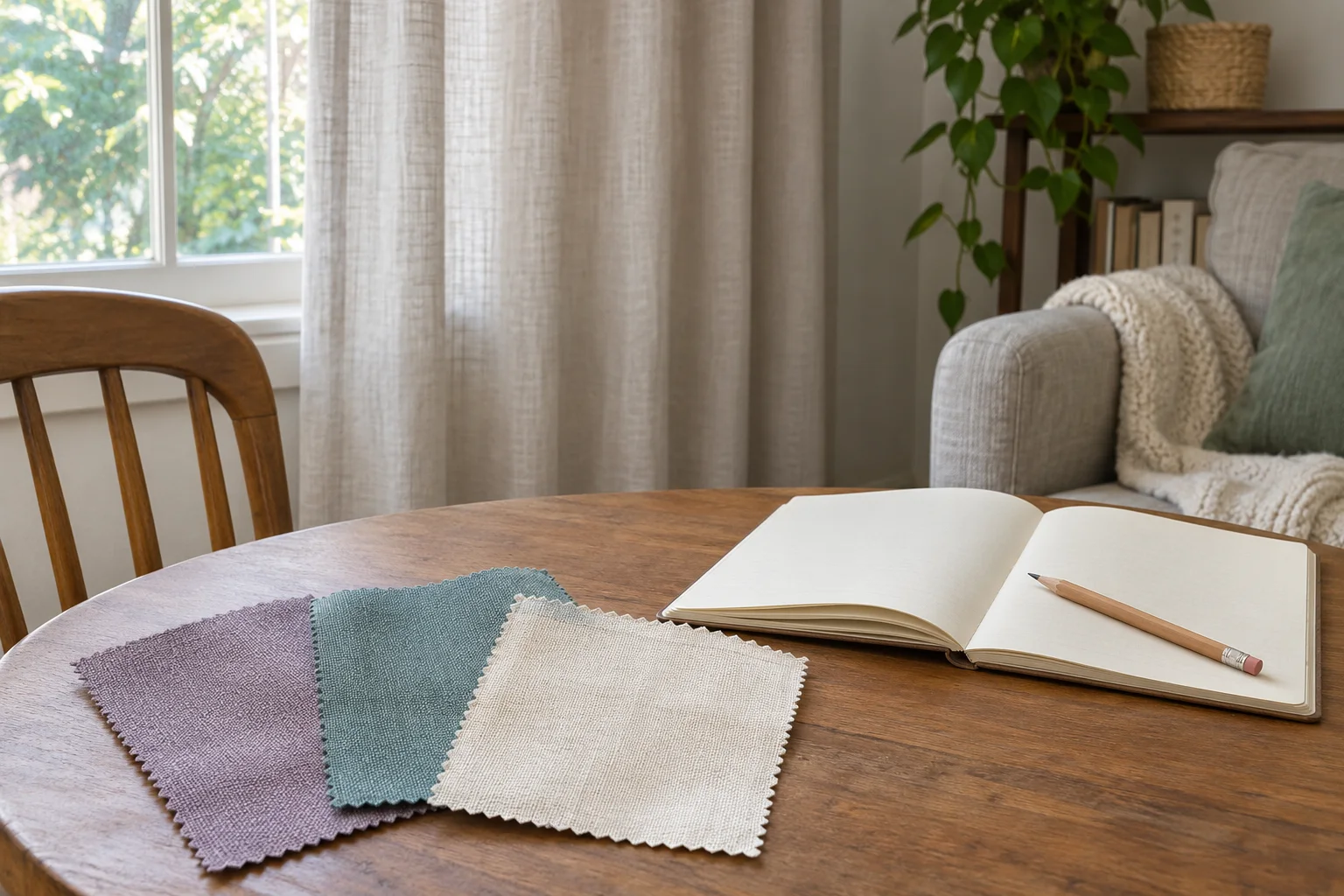
Conceptual fabric-choice scene; generic swatches, no authenticated retailer sample or performance test.
A curtain fabric sample gives you something specific to consider before committing to a fabric choice. Harlequin's FAQ recommends an actual sample for seeing colour, texture and weight in your own home before ordering its made-to-measure curtains or blinds. That recommendation belongs to its stated service. It does not establish that a sample is offered for every curtain you find elsewhere, or that a small piece settles the details of a finished item.
The useful household decision is how much you are ready to choose. You may like a fabric enough to investigate the finished curtain, while still needing an answer about the order itself. Keep those two decisions separate in your notes. A preference can be clear even when the information needed to place an order remains incomplete. There is no need to turn a favourable impression into a purchase commitment on the same afternoon.
Give the sample a specific job
Before seeking a sample, write down the uncertainty that prompted you to want one. Perhaps the fabric interests you but the description leaves you unable to imagine its feel. Perhaps you and another person agree on a general colour direction and disagree about the particular fabric. Those are different reasons to continue looking. Naming the reason keeps the next conversation about the fabric you are considering, instead of reopening the entire room every time someone expresses a preference.
A useful note can be quite ordinary: “I want to decide whether I like this fabric here.” That leaves room for an honest response, including indifference. You are allowed to receive a sample and decide that the fabric no longer appeals. You are also allowed to like it without knowing whether you want curtains made from it. The sample has helped if it gives you a clearer preference; it does not owe you a complete room scheme or a reason to buy.
Harlequin's stated purpose helps set the boundary of this enquiry. Its recommendation concerns experiencing the actual fabric in the home, within a made-to-measure buying process. Use that context when reading the advice. A generic loose swatch, an unrelated fabric left over from another project and an actual sample of a proposed fabric carry different identities. If you cannot connect the piece to the fabric under consideration, preserve that uncertainty instead of treating a similar-looking piece as an equivalent.
Record a preference in words you can use later
Notes are most useful when they express your response rather than claim a test result. “I prefer this beside the furniture we are keeping” records a choice. “This fabric is guaranteed to look the same in the finished room” claims much more. The first sentence can guide a discussion with the person sharing the purchase. The second needs evidence that your preference note cannot supply. You do not need technical language to make a personal choice legible.
Try to preserve the reason for a hesitation, too. If you like the colour direction but have not decided how you feel about the fabric itself, say that. If another person has not yet considered it, leave their response open. A written objection should remain recognisable to the person who raised it. Replacing “I do not like this” with “we just need to see it again” quietly changes the decision and can prolong a choice that someone has already made.
For example, imagine a household choosing curtains while keeping its existing chair. One person likes a proposed fabric with that chair; the other would prefer a different fabric. The next useful action may be to compare their reasons, or to set that fabric aside. This is an invented planning example, not an observation of either offer below. It illustrates how a sample conversation can end with a clear decision to continue or stop, without a claim that either taste is objectively correct.
Move from the fabric enquiry to the finished offer
Once a preference becomes clear, open a separate note for the actual curtain being considered. Identify the offer precisely enough that you can return to it. Keep the product name and its identifying details with any unanswered product question. This prevents a useful fabric conversation from acquiring facts about another curtain simply because both were open in the same browsing session. A retailer's sampling advice and a different retailer's product description should remain attached to their own contexts.
The Ambesonne p_17931_108x90 floral curtain listing describes a two-panel set with an ornamental floral design. Its image shows a turquoise and white appearance. Those details identify the example being discussed here; they do not establish that a sample can be ordered for it. A reader interested in this particular offer still needs product-specific confirmation for any question the listing leaves unanswered.
The Ambesonne p_2268_108x90_mc floral curtain listing is another two-panel offer, pictured with purple flowers and green stems. It also contains an unresolved length discrepancy: its description records a 90-inch source length while the catalog size field gives 84 inches. The observed catalog item has one default variant. These measurements are not treated as equivalent here, and neither is confirmed as the delivered length. Someone considering that offer needs the discrepancy resolved before relying on a length.
This example gives the household two different kinds of unfinished business. A reader may be confident about a preferred floral appearance and still lack a dependable answer about the item they would order. Repeating the aesthetic discussion will not answer the measurement question. Conversely, receiving a clear product answer would not oblige someone to like the fabric. Give each question its own place so that progress on one does not conceal the other.
Keep the enquiry attached to the item
When asking about a sample, name the proposed fabric or curtain and ask whether a sample is available for that exact selection. Do not write the question as though availability has already been promised. If you receive an answer, keep it with the relevant item rather than treating it as a rule for every listing from the same retailer. This is a way to organise correspondence; it is not a claim about any seller's sampling service, charges or fulfilment terms.
There is also a useful stopping point when the answer remains incomplete. You can retain an item as an idea without recording it as ready to order. State the missing answer plainly, such as “sample availability unconfirmed” or “finished length unresolved.” Those notes let you resume the enquiry later without rebuilding it from memory. They also help someone else understand why an attractive item is still on a consideration list rather than an agreed purchase.
A household with several possible fabrics can close decisions as well as accumulate them. Keep a brief reason when you set a choice aside, particularly if more than one person is involved. That reduces the chance that the same dismissed option returns under a slightly different description. You need not rank every fabric or invent a scoring system. A short explanation of what you prefer and what remains unanswered is enough to make the decision understandable.
Agree who is making the remaining decision before gathering more possibilities. In a shared purchase, one person may be collecting information while the other expects to choose together. Writing down that arrangement prevents an enquiry from being mistaken for consent to order. It also gives the person doing the research a stopping point: bring back the answer that was requested, then discuss the choice. More browsing does not necessarily address a disagreement about who has agreed to what.
If you change your mind, update the note rather than leaving an earlier preference as the apparent final decision. A useful record might say that you liked a fabric initially, then decided against pursuing it after discussing the room. That history needs no justification beyond an honest account of the choice. Keep factual product questions intact when changing a preference; an unresolved answer does not become true because the item has moved down your list.
Leave other curtain questions in their own scope
A sample preference does not provide evidence about an existing curtain that appears to have changed colour. The separate guide on curtain colour fading before cleaning addresses that enquiry. If your concern starts with a curtain already in use, keep its history and the observed problem attached to that item. Buying a new fabric and understanding an existing curtain's condition are different decisions, even if both begin with a conversation about colour.
Likewise, the guide on curtain energy savings claims deals with the evidence needed for those claims. Liking the feel or appearance of a sample supplies no household energy result. If energy performance is part of your intended purchase, it remains a separate question with its own evidence. Do not let a pleasant fabric impression become an unsupported reason for expecting a change in household bills.
You can finish this enquiry with a modest written decision: pursue the exact fabric further, decline it, or leave it undecided for a stated reason. Then carry only the relevant unresolved questions into the product enquiry. That approach respects a useful sample without making it responsible for the entire purchase. For the second example above, the length discrepancy remains open regardless of how appealing its pictured flowers may be.
If crypto appears at checkout
Keep payment planning separate from the fabric decision. If you later consider buying on republeq.com, inspect the actual checkout for the selected item and destination at that time. This article does not confirm which payment methods will appear for a future order. A sample preference, a product description and an earlier browsing session do not establish the payment options for the transaction you are about to make. If checkout offers a cryptocurrency method such as USDT, read the payment instructions shown there before deciding whether to use it. Do not assume that the name of a token identifies every detail required by that checkout. Keep the actual order information beside the payment instructions so that you can identify what you are being asked to pay for. This paragraph provides no wallet address or transfer instruction and makes no claim that a particular network is supported. Any unresolved product question should remain visible while you consider payment. In the curtain example with conflicting lengths, reaching checkout would not settle which length would arrive. Nor would a payment option establish that samples are available, that a sample corresponds to a finished product, or that the seller has answered your enquiry. Resolve the questions on which your purchase depends before treating an order as ready. Read the actual terms and final order details presented to you. If something differs from the item or terms you intended, pause and obtain a clear answer through the available channel before proceeding. No refund timing, crypto conversion rate, fee, delivery date or transaction outcome is promised here. Payment becomes relevant after you have decided what you want to order and have sufficient information about that specific order; it should not supply the missing reason to choose a fabric.