Crypto Commerce
CQAOE 9.9 lb portable twin-tub washer vs GFNXYI twin tubs: separate the wash load from the spin load
Compare CQAOE 9.9 lb portable twin-tub washer by separate wash and spin ratings, water and drain setup, manual timers, load handling, and floor space.
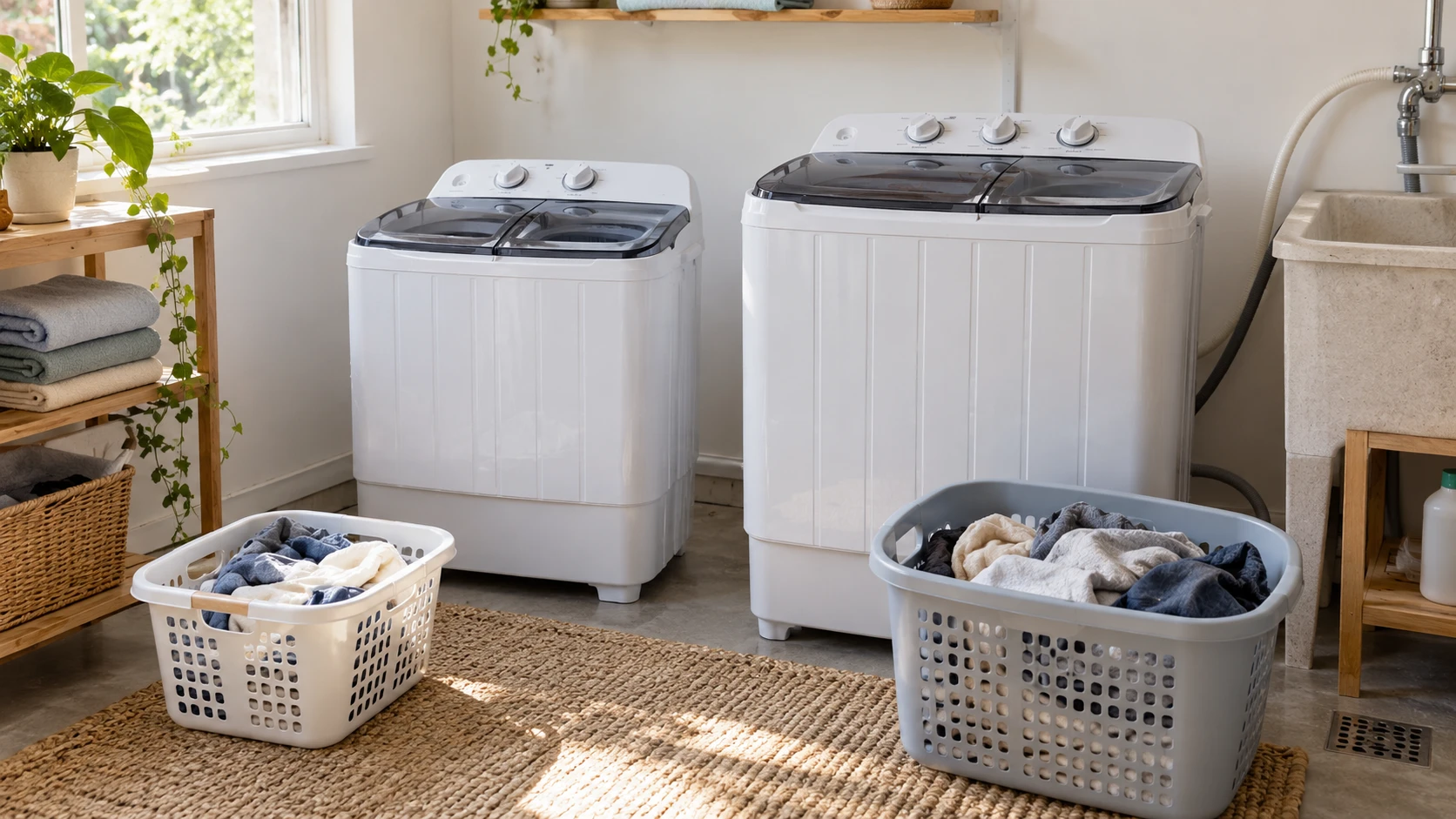
The CQAOE 9.9 lb portable twin-tub washer and this guide to checking a washing-machine pause before choosing raise a practical point about compact laundry: know what each stage needs from the person operating it. The GFNXYI 17.6 lb twin-tub washer offers a larger listed load, but it still has separate washing and spinning sections. The guide discusses other machines and should be used for the general workflow question, not as instructions for either model here.
Both product titles combine capacities that belong to two tubs. CQAOE's saved description divides 9.9 lb into a 5.5-lb wash tub and a 4.4-lb spin tub. GFNXYI divides 17.6 lb into an 11-lb wash tub and a 6.6-lb spin tub. The number on either title is not the amount of clothing that can be washed in one tub at once. That distinction should drive the comparison before any claim about saving laundry trips.
Work out the number of batches — GFNXYI 17.6 lb twin-tub washer
Start with a real load: a week's everyday shirts, towels, or light bedding, separated as you normally wash it. CQAOE's washer can take a listed 5.5 lb, then its spinner can take 4.4 lb. A wash load near the washer's rating will need to be split for spinning. GFNXYI's washer is rated at 11 lb and its spinner at 6.6 lb, so a full wash tub also exceeds one spin load. The larger GFNXYI tubs may reduce the number of wash cycles, but the spinner still creates a second handling step.
Weight is only one limit. A bulky blanket may occupy the tub before it reaches the listed pounds. The saved descriptions do not supply tub dimensions or an approved bedding list. Measure the items you most want to wash, then request current manuals with load examples and the maximum safe amount for each tub. Do not assume a twin tub can handle an item simply because its dry weight is below a printed capacity. The shape and water-soaked bulk can matter as the load moves.
For a rough workflow sketch, divide your normal dry laundry weight by the listed wash capacity and then by the smaller spin capacity. Round up each time, but treat the calculation as a planning aid rather than a promise of cycle count. The manuals may require lower loads for particular fabrics or settings. If you often wash just a few garments, the smaller CQAOE tub may suit that pattern. If several people share one laundry day, GFNXYI's higher wash and spin ratings could be more useful, provided the space and water setup work.
Twin tubs allow washing and spinning to overlap according to both saved descriptions. That does not remove the need to transfer clothing between tubs. Set up a clean surface or basket where wet clothing can wait briefly while the spinner is occupied. Think about who will lift and transfer a full wet load. A larger tub can reduce the number of batches while making each transfer heavier. The two ratings therefore describe a human workload as well as machine size.
Manual timers change the routine — guide to checking a washing-machine pause before choosing
CQAOE lists separate controls for washing and spinning, with a maximum of 15 minutes for the washer timer and five minutes for the spinner. GFNXYI also describes a 15-minute wash timer and a five-minute spin timer. These are control limits in the saved entries, not a verified total time for a finished load. Filling, any rinse step, transferring clothing, draining, and hanging or machine-drying clothes take additional time. Ask what each manual says about rinse cycles and whether the timer needs to be reset for another stage.
CQAOE says the two tubs can run at the same time. GFNXYI presents its twin-tub design as a way to manage washing and spinning separately. Check the exact operating instructions for simultaneous use, particularly how loads should be balanced and where the water goes. If your laundry routine involves frequent interruptions, find out what happens when a timer ends while you are away. The linked guide's broader pause-check idea can help you ask this question, but its controls and failure modes belong to different machines.
The CQAOE description says to put clothing in, fill with water, set a timer, and begin washing or spinning. That is a semi-manual sequence rather than an automatic one-button wash-to-spin cycle. GFNXYI's description likewise emphasizes selecting a time instead of relying on a preprogrammed machine. If you need laundry to finish with little attention while you work elsewhere, consider how often you will need to return for filling, rinsing, transferring, and draining. The product descriptions do not provide a complete unattended cycle.
Do not turn the timer figures into fabric-care instructions. A delicate item may need a different load, water level, or cleaning time from sturdy towels. Check each manual's permitted fabrics, detergent guidance, and treatment of heavy items. The saved GFNXYI description calls the unit suitable for small and delicate loads despite its larger numeric capacity. The current instructions, not a timer maximum, should govern how you use it.
Water supply, drainage, and the floor — GFNXYI 17.6 lb twin-tub washer
CQAOE lists a water-inlet hose 78.8 inches long, about 6.57 feet. That helps plan the distance to a filling point, but the listing does not identify every faucet connection or its drain arrangement. Check the hose ends against the actual tap and ask where used water must discharge. GFNXYI's title names gravity drainage, while its saved description focuses on the tubs and a filter net. Confirm the drain hose length, required drop, and allowed outlet position from the current manual before choosing a spot for the machine.
Gravity draining is especially sensitive to placement. A hose routed uphill to a high sink may not behave like one directed to a suitable lower drain. Do not improvise a drain path from the product title; get the manufacturer's routing instructions for the exact GFNXYI unit. CQAOE also needs a verified outlet for used water even though its short excerpt does not define one. A portable washer that fits in a bathroom but cannot drain safely there is not a workable choice for that room.
Draw the path from supply to washer to drain, and include an electrical outlet in the drawing. Check whether a hose crosses a doorway or walkway during use. Measure the space needed to open both tub lids, transfer clothing, and reach the controls. Neither saved entry supplies complete exterior dimensions, so request them before planning storage in a closet or a narrow gap. The machine must be practical during a wet load, not merely fit where it is stored after laundry day.
The proposed surface should be stable and allowed by the manual. Spinning wet clothes can create movement when a load is uneven. GFNXYI's saved description mentions a cover plate for the spin tub and a filter net on the wash side; read its placement and cleaning directions. CQAOE describes a plastic body and transparent blue design, which may make the contents visible. Neither feature replaces the manufacturer's instructions for leveling, loading, and keeping water away from inappropriate surfaces.
Motors, accessories, and maintenance — GFNXYI 17.6 lb twin-tub washer
CQAOE's entry advertises a 1300-rpm motor and a 60-Hz maximum-frequency figure. GFNXYI lists 240 W washing power and 120 W spinning power. These are different kinds of numbers, so they do not support a direct ranking of cleaning strength or spin dryness. Ask what the 1300-rpm figure refers to and seek comparable spin-performance information if that matters to you. A wattage figure alone does not tell you how clean a garment comes out or how damp it remains afterward.
GFNXYI's description says a filter net on the wash barrel can be removed for cleaning. Its spin cover plate is intended to help keep clothing in place during spinning. Confirm whether those parts are supplied with the exact listing and read the instructions for installing, washing, and replacing them. CQAOE's short entry does not describe a comparable filter or cover. Verify its included parts and maintenance routine rather than assuming it has or lacks the same accessories.
Both machines require attention to water residue and fabric lint. Ask how each tub is drained completely, whether hoses should be dried between uses, and how the inside is cleaned. If the washer will be stored in a closet after use, the drying procedure and weight of the empty unit matter. CQAOE calls itself compact and lightweight; GFNXYI says it is light and movable. Neither excerpt gives a measured empty weight. A buyer who will lift the machine frequently should request that figure and check how the handles or body may be carried.
The product pages suggest dorms, apartments, and RVs. Those are examples of use, not approval from a building owner or proof that every RV outlet and drain is suitable. Review property rules, electrical instructions, and the exact model's water-handling requirements. The larger GFNXYI rating may be valuable, but it cannot compensate for an unsafe or impractical hookup. The smaller CQAOE may be easier to place only if its real dimensions and hose route support that conclusion.
Choose the load size you can operate — GFNXYI 17.6 lb twin-tub washer
CQAOE suits a short list built around small, frequent loads if its 5.5-lb wash and 4.4-lb spin ratings match the clothing you handle. Verify its fill and drain route, included hose fittings, outer dimensions, and exact timer instructions. GFNXYI deserves consideration when an 11-lb wash tub and 6.6-lb spinner would reduce batches and the larger unit can be supplied and drained as instructed. Verify gravity-drain placement, tub dimensions, and the spin cover procedure before buying.
The exact saved identities are CQAOE product ID prod_a1f4f098af35346e2118b1e9 and GFNXYI product ID prod_9ea5e05b152301f8b91a4a7d. Use those IDs to obtain current manuals and included-parts lists. Count the wash batches and spin batches separately for your typical laundry, then check the floor plan for filling, draining, transferring, and storage. That gives the combined capacity labels a practical meaning.