Crypto Commerce
Costway ES10166US-WH compact dryer and HOMCOM for a small laundry space
Compare Costway ES10166US-WH compact dryer by load wording, power, controls, venting, floor space, and care requirements.
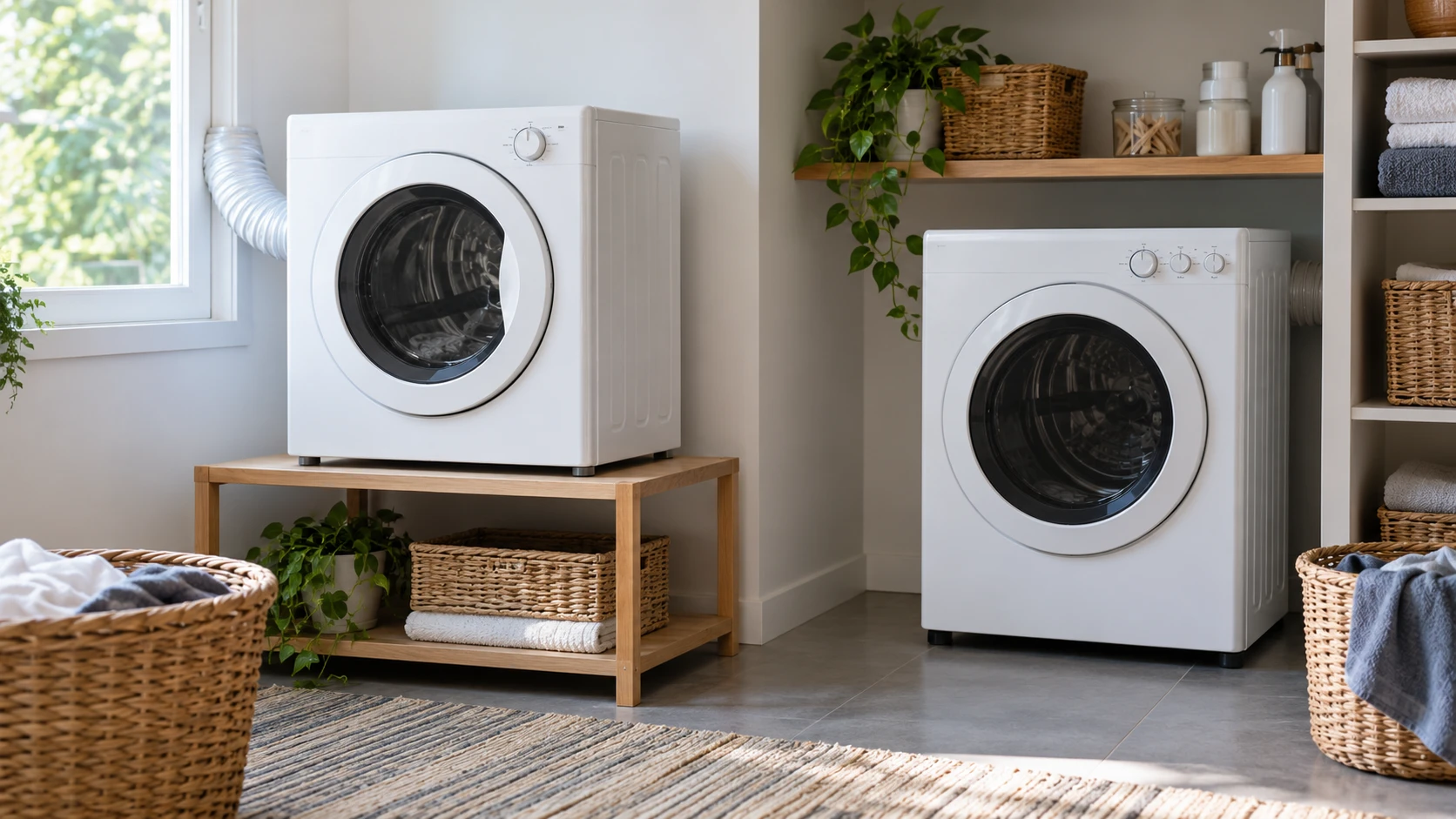
Compact dryers can make laundry easier where a full-size machine will not fit, but the word "portable" does not settle power, venting, or mounting. Costway's saved listing describes a white ES10166US-WH dryer with an 8.8-pound capacity, 1,400-watt heating system, two named operating modes, and an included exhaust pipe. HOMCOM's saved entry describes a white 9-pound, 120-volt dryer with 850 watts of power, a 1.5-cubic-foot drum, and four drying modes. Their capacity figures sound almost equal, yet the listings do not describe the same load condition.
The Costway ES10166US-WH compact dryer says to load only spin-dried clothes and gives exterior dimensions of 23.6 by 17.1 by 27.5 inches, labeled length, width, and height. HOMCOM's saved description calls its nine-pound limit a load of wet clothes but does not define how wet, or supply full exterior dimensions. Before comparing them by pounds or ordering either one, check the model manuals for load definitions, electrical requirements, exhaust routing, and the space needed to open the door.
Make room for the dryer you can actually install — HOMCOM 9 lb electric dryer
Costway's listed body dimensions provide a starting point for a floor plan. Mark a rectangle on the floor or shelf and leave room for the rear exhaust, door swing, access to the lint filter, and the manufacturer's required ventilation clearance. The saved excerpt says the machine can stand on its own or be mounted on a wall, but it does not state which bracket is included, the supporting-wall requirements, or the safe mounting procedure. Do not turn a catalog phrase into a mounting plan. Use the exact manual and qualified installation help where required.
HOMCOM's saved listing calls the dryer portable and suitable for apartments, but gives only the 1.5-cubic-foot drum volume, not the exterior footprint. A 1.5-cubic-foot drum cannot tell you whether the cabinet fits under a counter or through a closet door. Request width, depth, height, weight, door clearance, and any stacking or wall-mount approval for the exact model. If you need to move it between uses, ask how it is lifted and where the exhaust connection goes when it is stored.
The related published guide on compact dryer power and venting checks covers another model, but the installation questions carry over. A smaller body still needs an acceptable outlet and a safe route for exhaust if it is a vented dryer. Costway explicitly lists an exhaust pipe. HOMCOM's short excerpt does not explain its exhaust arrangement. Get both installation pages before assuming that a small dryer can run in a closed closet, vent into a room, or share a circuit with other appliances.
Think through a complete load, not just the appliance footprint. Where will damp laundry wait? Can the door open far enough to move clothes without dropping them onto the floor? Is there a stable space for a basket when the cycle ends? A dryer in a tight corner may fit the measured rectangle but be frustrating every week. If wall mounting is allowed, consider the reach height for loading, removing lint, and cleaning the exhaust path. The saved descriptions do not settle those ergonomic details.
The load numbers use different language — HOMCOM 9 lb electric dryer
Costway lists an 8.8-pound capacity and specifically tells users to put only spin-dried clothes in the machine. HOMCOM says it can dry up to nine pounds of wet clothes. Those two numbers are not a controlled capacity comparison. Water adds weight, and the descriptions do not define the test fabric or moisture level. Find the recommended dry-clothes weight and the maker's loading diagram for each model before deciding which can handle a full wash load. A small drum also needs room for clothes to tumble rather than packing to its stated weight limit.
If your washing machine holds more than the dryer, plan to split loads. Measure a typical batch after it leaves the washer, and note whether a heavy towel load uses much more drum space than light shirts of the same weight. The HOMCOM entry supplies a 1.5-cubic-foot drum figure, while Costway's excerpt does not state a drum volume. Neither number tells you how many bath towels come out evenly dry. A real loading guide and a household trial are more useful than comparing pounds alone.
Follow garment care labels. Costway's listing names air dry, medium, and high heat settings; HOMCOM names strong, intelligent, low heat, and regular modes. These labels are not equivalent temperature specifications. A low-heat mode described for odor removal does not automatically clean or sanitize an item. Check the actual temperatures and allowed fabric types in the manuals, and avoid a hotter setting simply because a small dryer seems slower. Overloading or overheating can damage fabrics without solving the installation problem.
Power, heat, and drying time — compact dryer power and venting checks
Costway's saved description gives a 1,400-watt heating system and a claimed temperature up to 149°F. HOMCOM lists 850 watts, 120 volts, and a maximum temperature of 145°F. The watt figures alone do not establish which dries a load faster or costs less to operate. Drying time depends on starting moisture, load size, airflow, heat control, and the chosen cycle. The temperature claims may describe different measurement points and conditions. Seek comparable performance evidence for the exact models if speed is the deciding factor.
The Costway excerpt does not specify its input voltage. HOMCOM explicitly says 120 volts, but that still leaves questions about amperage, required circuit, plug type, and whether the maker permits any shared outlet. Read each rating plate and manual before placing an order. Do not use an extension cord or adapter to bridge an unsuitable location without explicit manufacturer guidance. An electrician or installer can assess the available outlet and circuit if there is uncertainty.
Costway says its timer can be set from zero to 200 minutes and that pressing two timer buttons locks the keys. It lists IHS and ECO modes but does not define their control logic in the short excerpt. HOMCOM lists strong drying, intelligent drying based on clothing quantity, low heat for odor removal, and regular drying, with an LCD display of remaining time. Ask how each mode chooses heat and stops, and whether you can change the settings mid-cycle. An "intelligent" label is not a guarantee that every fabric will be dry at the displayed finish time.
The saved Costway description says its stainless-steel drum reverses direction to reduce tangling and wrinkling. It also gives an operating-noise claim of no more than 65 dB. These are manufacturer claims without a common test against HOMCOM. HOMCOM's excerpt does not list reverse tumbling or a noise figure. If the machine would run near a bedroom or work area, seek a model-specific sound demonstration and learn what can be heard through your walls. A compact dryer can still be conspicuous in a small home.
Lint and exhaust care are part of ownership — HOMCOM 9 lb electric dryer
Costway's listing names a lint filter that needs regular cleaning, overheat protection, and door behavior that stops drying when opened and resumes after the door closes. Follow the manual for the actual filter-cleaning interval and how to restart safely. A safety feature does not replace cleaning the filter or maintaining the exhaust route. HOMCOM's short listing does not describe its lint filter or door interlock. That omission is a reason to get the manual, not a reason to assume those parts are absent.
Check where lint collects and whether you can reach the filter without taking the dryer off a shelf. Learn how to inspect and clean the exhaust pipe, how it connects to the machine, and whether the proposed route is permitted. Costway says a pipe is included; it does not establish that the rest of an installation kit is present. HOMCOM's description provides too little venting detail to design its route. Keep combustible material away according to the maker's clearance instructions and do not block openings to make a dryer fit a narrow space.
When a load finishes, feel several items rather than judging by one shirt near the door. Thick seams and towels may retain moisture after lighter pieces seem dry. If the machine leaves damp areas, reduce the load or follow the maker's recommended cycle rather than repeatedly running a crowded drum on the hottest setting. These are practical use checks, not claims that one of the two dryers performs better. The saved catalog includes no side-by-side drying test.
Price and the decision to investigate — HOMCOM 9 lb electric dryer
The September 30 saved catalog marked both products available. Costway was listed at $356.24 and HOMCOM at $282.49. Those are historical prices and do not include a verified current shipping or installation total. Check the Republeq's catalog, warranty, return terms, and any mounting or exhaust parts you would need to buy. A lower appliance price can disappear if the chosen location requires extra approved hardware or electrical work.
Costway gives more source detail about size, exhaust pipe, drum movement, timer, lint filter, and possible wall mounting. It deserves a closer look if you can follow its spin-dried-load instruction and its installation manual fits your space. HOMCOM's saved entry offers a 120-volt rating, a stated 1.5-cubic-foot drum, four named modes, and a lower saved price, but leaves exterior size and exhaust setup unresolved. The HOMCOM 9 lb electric dryer may suit a small laundry area once those physical and electrical details are confirmed. Neither short listing supports a claim that it will dry the same load faster.