Crypto Commerce
Coolski 49-cu-ft commercial reach-in freezer reach-in or Elite undercounter freezer for a working kitchen
Compare Coolski 49-cu-ft commercial reach-in freezer by staff access, dimensions, shelving, power and service checks.
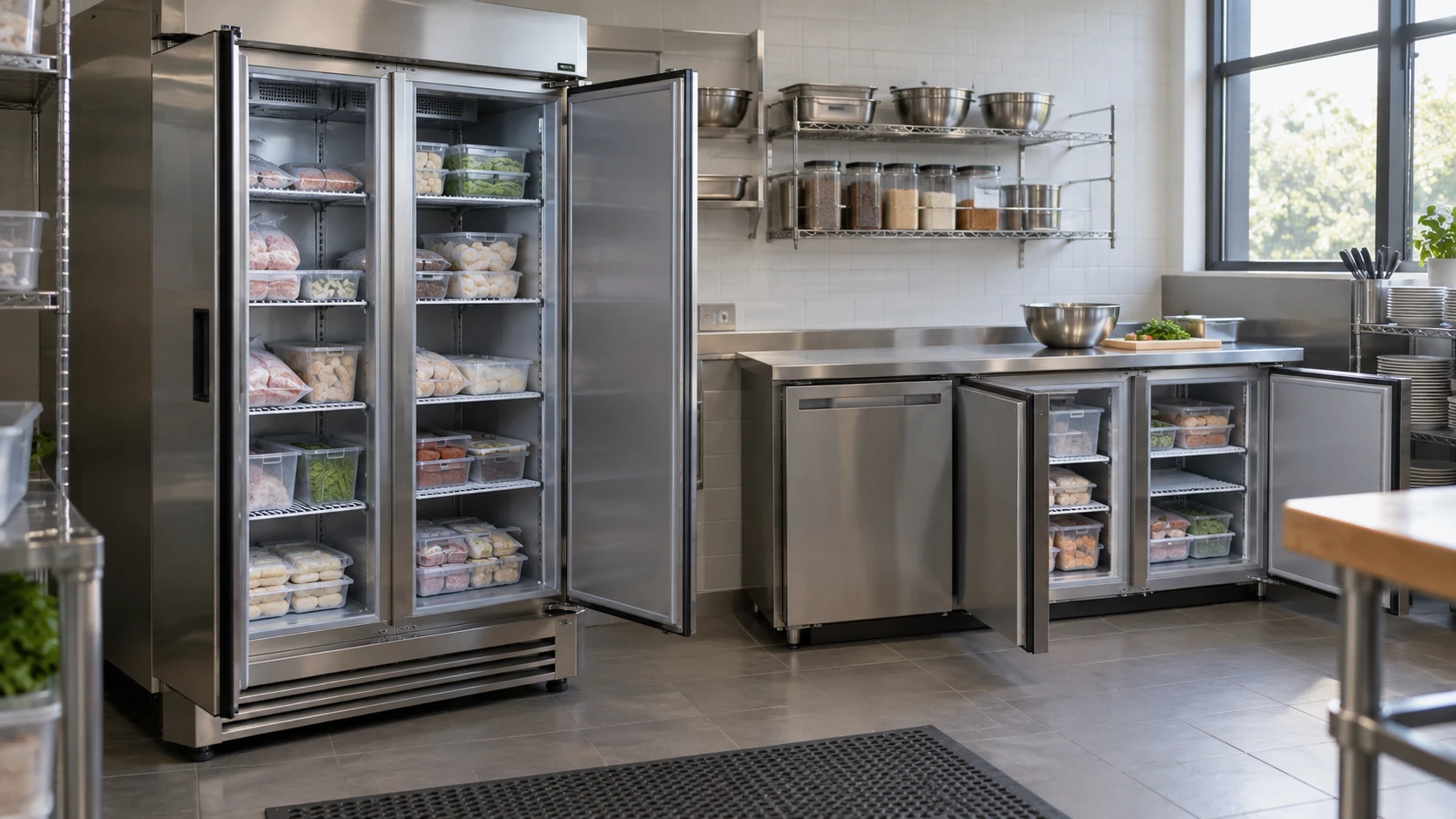
The Coolski 49-cu-ft commercial reach-in freezer and Elite Kitchen Supply's undercounter model use space in very different ways. Coolski describes a 54-inch-wide upright cabinet with two doors and eight adjustable shelves. Elite describes a roughly 72-inch-wide, three-door cabinet with 18.96 cubic feet of stated capacity. One concentrates stock vertically; the other spreads it beneath a work surface. The useful choice depends on where staff need frozen items and how those items arrive.
These details come from a September 30 catalog capture. Both exact product pages and the related guide were reachable when checked on October 3. Their descriptions are claims in Republeq's catalog rather than installation or temperature tests. Before ordering either large appliance, obtain the current model's dimension drawing, electrical requirements, ventilation clearances, warranty, and delivery terms. Correcting a fit problem after freight delivery can be difficult.
Put access into the floor plan — planning staff access to frozen inventory
Start with a busy period, not an empty room. Does a cook take small portions from frozen storage throughout service, or does someone bring stock from a back room once or twice a shift? An undercounter unit may keep frequently used ingredients close to the prep line. An upright may hold a larger reserve without taking the same length of wall. Neither layout is automatically faster. The walking route and how often a door is opened decide more than the category name.
The related guide on planning staff access to frozen inventory compares other freezers, including a display format. Its product specifications do not apply to Coolski or Elite. The relevant question is who retrieves the stock and from where. List the items that must be close to a station and the ones that can remain in reserve storage. That division may show whether one cabinet can do the job or whether the workflow calls for two locations.
Draw the kitchen or stockroom to scale. Include prep surfaces, doors, carts, handwashing points, and the route from receiving to storage. Show each freezer door fully open while a person stands in front of it. Elite's three doors may offer convenient sections along a line, but an open door can still block a narrow aisle. Coolski's two-door upright occupies less width in its saved title, yet it may require more vertical clearance and room to move cases in front of it.
Measure the delivery path as carefully as the final position. Check the loading entrance, corridor corners, door frames, elevator, and any floor threshold. Check Republeq's product page for packaged dimensions and shipping weight; a crated cabinet can be larger than the appliance itself. Confirm whether doors or casters may be removed for delivery according to the maker's instructions. Do not assume a unit that fits the final rectangle can reach it intact.
Compare the storage you can use — Elite Kitchen Supply 19-cu-ft undercounter freezer
Coolski advertises 49 cubic feet and eight adjustable shelves. Adjustable positions could help fit cartons of different heights, but the saved description does not give shelf dimensions or load limits. Ask for the interior drawing and the exact number of shelves included with the selected offer. Measure the cases, bins, or trays you plan to store. A cabinet's volume is not a promise that every inch can be filled without blocking circulation or making stock hard to retrieve.
Elite's detailed listing states 18.96 cubic feet, rounded to 19 in its title, across three doors. It describes one removable, adjustable wire shelf in each section. A long low cabinet might place small, frequently used containers close to a prep surface, but its individual compartments may be too narrow for a shipping carton. Get each door opening and compartment measurement. A single total-capacity number hides the shape of the usable space.
Decide whether staff will store goods in full cases, labeled bins, or portion containers. Check the width and height of the largest item before comparing the two nominal capacities. A carton may pass through an upright door but not an undercounter opening, even when the smaller cabinet has enough total volume on paper. Conversely, a deep upright can become hard to search if small items are stacked behind larger ones. Plan a label and stock-rotation method that keeps doors from staying open while people hunt for inventory.
Think about lifting as well as volume. A tall reach-in can place some goods near eye or waist height, depending on shelf arrangement. An undercounter unit puts every section lower. That may be awkward for heavy, frequently handled items, even if the cabinet is next to the prep station. Check the actual shelf heights and who will use them. The better position for a case of frozen food may differ from the better position for a small container used repeatedly during service.
Verify temperature behavior at the site — Elite Kitchen Supply 19-cu-ft undercounter freezer
Both saved descriptions list an operating range from minus 8°F to 0°F and automatic defrost. Coolski names a digital controller; Elite names a digital display and forced-air refrigeration. Those details do not establish the temperature of every item in a loaded cabinet during repeated door openings. Obtain each maker's loading guidance, ambient-temperature limits, and installation clearances. Then plan how the business will measure and record temperatures after installation.
A display reports what its sensor sees, which may differ from a container near a frequently opened door. New warm stock, crowded shelves, a hot room, and long loading periods can affect recovery. If your operation has a required storage temperature or monitoring procedure, confirm it with the responsible authority and check the selected model against that requirement. A marketplace listing alone is not a compliance determination.
Coolski says its two solid doors self-close and have a stay-open position for loading. Ask how that position is engaged and released. It could be helpful during a delivery, but staff need to know when the doors should return to normal operation. The short Elite description identifies three solid doors without making the same stay-open claim. Inspect gaskets, swing direction, and clearance for opening each door at the proposed location.
Automatic defrost does not remove the need for cleaning and maintenance. Ask where meltwater goes, how the condenser is reached, and what space service personnel need. Coolski describes a lower-mounted compressor and LED interior lighting. Elite describes rounded cabinet corners and stainless-steel surfaces. Those features may make some tasks easier, but neither listing supplies a complete cleaning schedule. Read the current manuals and confirm that staff can reach the parts that need attention without moving a fully loaded freezer through a cramped room.
Check dimensions, power, and service access — planning staff access to frozen inventory
Coolski's title gives a width of 54 inches but its saved description does not provide a full exterior dimension set or electrical specification. Get the exact height, depth, plug type, current draw, and ventilation requirements before reserving space or electrical work. An upright may need top clearance as well as room for both doors to open. Its stated width is only one of several measurements that must fit.
Elite provides more numbers in the saved record: approximately 72.5 inches wide, 31.5 inches deep, and 36.2 inches high, with 115-volt, 60-hertz operation, 1,050 watts of listed input power, and 8.0 amps of listed current. Treat these as pre-purchase reference figures and verify the exact unit's nameplate and manual with a qualified installer. A worktop built too tightly over an undercounter cabinet can obstruct ventilation or service even if the appliance slides into the opening.
Both descriptions mention locking casters. Coolski says there are four; Elite lists four five-inch locking casters. Confirm whether each stated cabinet height includes its casters and whether the floor can safely support the loaded unit. A movable freezer still needs a stable operating position and a clear cord path. Ask how the selected model should be leveled on an uneven floor. Do not assume the casters make it easy or safe to move a cabinet full of stock.
Both listings name R290 refrigerant. That is a service detail, not a reason to improvise installation or repair. Follow the maker's instructions and use qualified service personnel for the refrigeration system. Ask how warranty service is arranged at your location. A commercial freezer is not a small appliance that can simply be carried to a repair counter when it stops cooling.
Account for receiving and warranty terms — Elite Kitchen Supply 19-cu-ft undercounter freezer
At the September 30 capture, Coolski's minimum listed price was $2,374.98 and Elite's was $2,453.75; both were marked available. Those are historical catalog values. Compare today's exact-model price, freight, installation, electrical work, removal of an old cabinet, and any accessories. A slightly lower purchase price can disappear quickly if the unit needs a different circuit or a difficult delivery.
Elite's saved listing describes three years of parts coverage and six years on the compressor. It also says to keep the delivery pallet for a return or exchange. Read the current written warranty for labor coverage, exclusions, and claim procedure. Coolski's short description does not give comparable warranty detail, so request its terms rather than assuming they are weaker or stronger. Inspect the model, doors, shelves, and cabinet condition when the shipment arrives and document damage according to the product instructions.
The Elite Kitchen Supply 19-cu-ft undercounter freezer deserves a look when three accessible sections near a prep area matter more than one large reserve. Coolski may suit a stockroom that can use a taller, two-door cabinet and its much larger stated capacity. Before checkout, verify the delivery path, shelf and door dimensions, site power, ventilation, temperature-monitoring plan, and service access. Those checks will show which format works in the actual kitchen.