Home & Living
Christmas window cling welcome before visitors arrive: clear views
Choose a modest Christmas window cling arrangement that guests will notice while preserving normal window use.
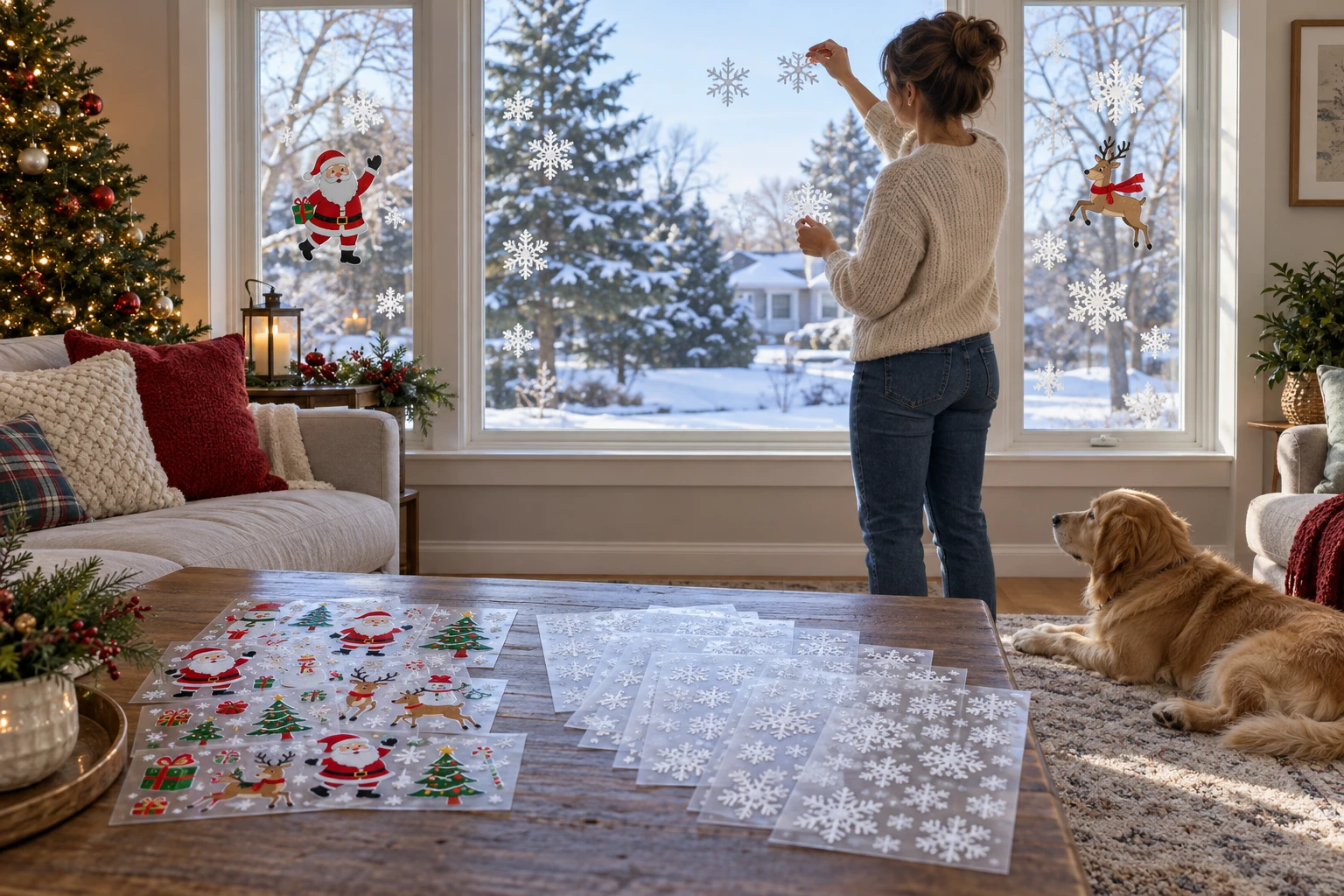
A Christmas window cling welcome before visitors arrive works best when the window still functions as a window. The decorations can make a room feel ready for guests, but they should not hide the view you use, interfere with opening hardware, or demand a complicated last-minute installation. Choose one visible pane and a modest arrangement before opening every sheet. This short seasonal setup is about preparing a clear, welcoming first impression, checking the actual glass and sight lines, and leaving an easy removal plan for later.
This is not a general window-art afternoon. The window-art room-view guide owns a leisurely personal display choice and a different set of products. It is also not an entry-door wreath plan; the Christmas wreath doorway guide owns that separate arrival surface. Here the task is a Christmas-week window: where visitors will see it, what should remain transparent, and how to finish the placement without turning the gathering into a decorating session.
Choose the window visitors will actually notice
Look at the room from the normal arrival path and from the places guests will sit. A pane that faces the front walk may be seen before the door opens; a living-room pane may be seen during conversation. You do not need to decorate every window. Choose one that has enough clean, reachable glass for a few pieces and still offers a useful view. Note any existing curtain, blind, latch, or handle that must continue to work. That limits the display in a practical way before you purchase or place anything.
Decide which parts of the glass should stay clear. A household may want to see the walk, keep a view of the garden, or preserve daylight. Hold an unused sheet against the glass without applying it and step back. If the design blocks the most useful sight line, shift it toward a side or upper margin. A small cluster can read as festive from across the room while keeping the center open. Do not assume that filling the whole pane creates a better welcome.
Check the actual surface and the product's instructions. Window clings and stickers may have different adhesive or static behavior even when the seller uses similar words. Do not add water, soap, tape, or scraping tools merely because a different decal set used them. Test a small unobtrusive piece as instructed on clean, suitable glass. Avoid applying anything to a surface the product does not support, and avoid a delicate coating without confirming compatibility. A clear pane is more valuable than a forced decoration.
Read the two actual sheet formats
The native listing for the eight-sheet Christmas window sticker set names snowflakes, Santa Claus, reindeer, and other holiday motifs. Its title calls the set double-sided and counts eight sheets. The seller describes quick application and removal without added glue. Those claims belong to that listing; the title's “3D” wording is not proof of a particular physical depth or viewing effect in every room. Use the actual package instructions and the visible motifs to decide which small group serves your window.
The separate 155-piece ten-sheet Christmas cling set advertises more pieces and sheets, with snowflake designs prominent in its title. Its seller description also mentions other holiday motifs and easy placement. A higher piece count does not mean every piece belongs on one pane. It may offer a choice of sizes or repeated motifs, but the exact usable arrangement depends on the pieces you receive and the glass you measured. Count only what you need for this window rather than making a crowded display to use the pack.
The two product descriptions use very similar broad language. Treat that language as seller copy, not as independent proof that both perform identically. The concrete differences you can use here are the stated sheet and piece counts and the described mix of motifs. Do not infer equal material, adhesive strength, reusability, or weather performance merely because their descriptions sound alike. If removal or repeated use matters, read the exact package directions and test the first piece on the surface you plan to decorate.
A mixed eight-sheet set may support a small scene with a character and a few snowflakes. A larger ten-sheet assortment may be useful when several panes need simple repeated accents. Those are planning possibilities, not a recommendation to cover all the glass. Decide how much visual space the window can give up before comparing pack sizes. If a smaller arrangement already looks complete, leave the remaining pieces on their backing for another permitted use instead of adding them to satisfy a count.
Make a simple placement map
Sketch the chosen pane as a rectangle and mark the handle, latch, screen edge, blind path, and main view. Draw one or two small clusters rather than every sticker. A low corner grouping can be visible from inside; an upper edge can frame the view if it stays within safe reach. Consider what a visitor sees from outside and what residents see from inside. Double-sided wording in a listing does not guarantee that every color or shape reads equally from both directions, so check the actual piece before placing the whole set.
Keep a clear margin around moving parts. A cling near a latch may catch when someone opens the window or become hard to remove later. Do not cover hardware or the edge that needs to be handled. Avoid placing pieces where curtains rub them repeatedly. A quick dry placement test can show whether a motif is too close to a blind or sash. If the window is part of a required exit route, its normal operation must stay straightforward; decoration is optional.
Plan from the guest's distance. A tiny sticker may disappear across a room, while many small pieces can make the pane look busy. Step back to the seat or doorway from which the display will be viewed. If a snowflake cluster frames a visible patch of winter sky, it may be enough. If a Santa or reindeer motif competes with a face or outside scene, move it. Do not judge the design only from inches away while pressing the stickers to the glass.
Think about room lighting. Daylight may make light-colored pieces look different from the way they appear after dark against a lit room. Look at the chosen pane at the time guests are likely to arrive if possible. Do not claim a particular set will be legible from the street without seeing it on your window. A paper mock-up or one removable test piece gives a better answer than a seller photo taken under unknown lighting.
Use the sketch to limit setup time. Choose a primary cluster, decide where the first piece goes, and set a stopping point before the household gets busy. Someone else can then help without having to guess the whole design. If the window is large, two separated small clusters may look calmer than one dense strip across the middle. The sketch is only a guide; the actual glass and sight line should still decide the final placement. Its value is keeping a seasonal task small enough to finish before visitors arrive.
Install with enough time to correct a mistake
Read the exact instructions, clean the glass in a way suitable for that surface, and let it reach the condition the product requires. Do not use harsh scraping or a solution that might harm a coated pane. Start with a small corner piece. If it does not attach or release as expected, stop and check the product directions instead of pressing every sheet harder. A few minutes of cautious testing can save the larger display from curling, trapped debris, or an avoidable cleanup just before guests arrive.
Apply the main pieces while you can still step back and reassess. Begin with the largest motif or the cluster's visual anchor, then add smaller accents with open space between them. Do not exhaust the sheet in a single pass. Pause after each small group and look from the normal viewing position. If the first grouping communicates the seasonal welcome, the display may be done. The remaining stickers are options, not a requirement.
Keep pets and children away from loose small pieces during application and storage. Follow the package's age and handling warnings if they are provided. Store unused sheets flat on their original backing so that a later adjustment does not depend on pieces stuck to a table or fabric. Avoid leaving packaging and peel-off backing where guests will walk. A tidy installation process supports the welcome as much as the final window does.
After placement, operate the curtain, blind, and window as they normally would be used, without forcing anything against the decorations. Step outside or view from the arrival path if that is safe and relevant. Make one simple correction if the display blocks a sight line or crowds a handle. Do not keep making decorative changes until the last minute. A clean, restrained window is easier for visitors to notice than a pane revised in a rush while they arrive.
Take one photograph from the usual seating area and one from the entry path if that helps you judge the result. Photographs can reveal a crowded edge or a motif that disappears against a tree outside. They also preserve the arrangement if you want to repeat a successful version next season. Do not treat the photo as the goal: the display still needs to work for people in the room, at real scale, as daylight changes and furniture is used.
Coordinate the window with the rest of the welcome
Look at the window in the context of the room. A nearby tree, string of lights, or wreath may already supply plenty of Christmas color. The window can then use fewer motifs. If the rest of the room is plain, a small character and snowflake arrangement might be the one seasonal detail. The linked doorway wreath guide handles the door itself; this window plan should not imply that decorations have to match perfectly. Repetition can be gentle rather than exact.
Leave space for ordinary hosting. Guests may need to pull a chair near the window, set down a coat, or watch outside for another arrival. Do not place decorations where someone must lean awkwardly around furniture to see or open the pane. The display is part of a usable room, not a stage set that prevents normal actions. If the window is behind a crowded table, move the table or choose another pane before assuming the stickers will be appreciated.
Give a helper one bounded job if the setup is shared: cleaning the suitable glass, sorting pieces by size, or checking the view from the doorway. That keeps the task pleasant and reduces the chance that two people press pieces into the same corner. If no one is available to help, the small primary cluster can be finished alone. A holiday welcome should fit the available time and hands; it does not require a complete scene on every pane.
Ask whether the chosen motifs make sense for this gathering. A family might favor snowflakes, a single Santa, or an all-white pattern; there is no universal Christmas arrangement. Use the actual pieces in the pack to make a modest choice. The article does not tell you which tradition to represent. It helps you preserve visibility and ease of use while making the seasonal signal clear to the people who will share the room.
Leave a removal plan for after the holiday
Keep the product backing and instructions with the unused sheets, and note where they are stored. After the gathering or season, remove the pieces as directed for the exact product and glass. Do not assume a waterproof or reusable seller claim means every piece can be pulled sharply or stored indefinitely without care. If a piece resists, stop and consult the instructions for that material. Protect the pane and its coating ahead of any hope of reusing a sticker.
Inspect the glass after removal and clean it using a method appropriate for the surface. If some pieces remain usable under their actual instructions, keep them flat and separated on suitable backing. If they are damaged or no longer hold, do not claim a guaranteed second season. A simple note about which motifs worked on the pane can make next year's choice easier without turning this holiday welcome into a storage project.
A Christmas window cling welcome before visitors arrive is complete when one chosen pane looks festive and still supports the household's normal view, light, and operation. The eight-sheet mixed set and 155-piece ten-sheet set offer different quantities, but neither package count determines how much glass to cover. Choose a small arrangement from the actual pieces, check it from guest distance, leave hardware clear, and keep removal instructions. The result should be ready before the doorbell rings.