Holiday Decorations
Plan Christmas tree collar stand concealment beyond fit
Plan Christmas tree collar stand concealment separately from fit. Examine pictured gaps, joins and the open top without assuming a complete screen for your stand.
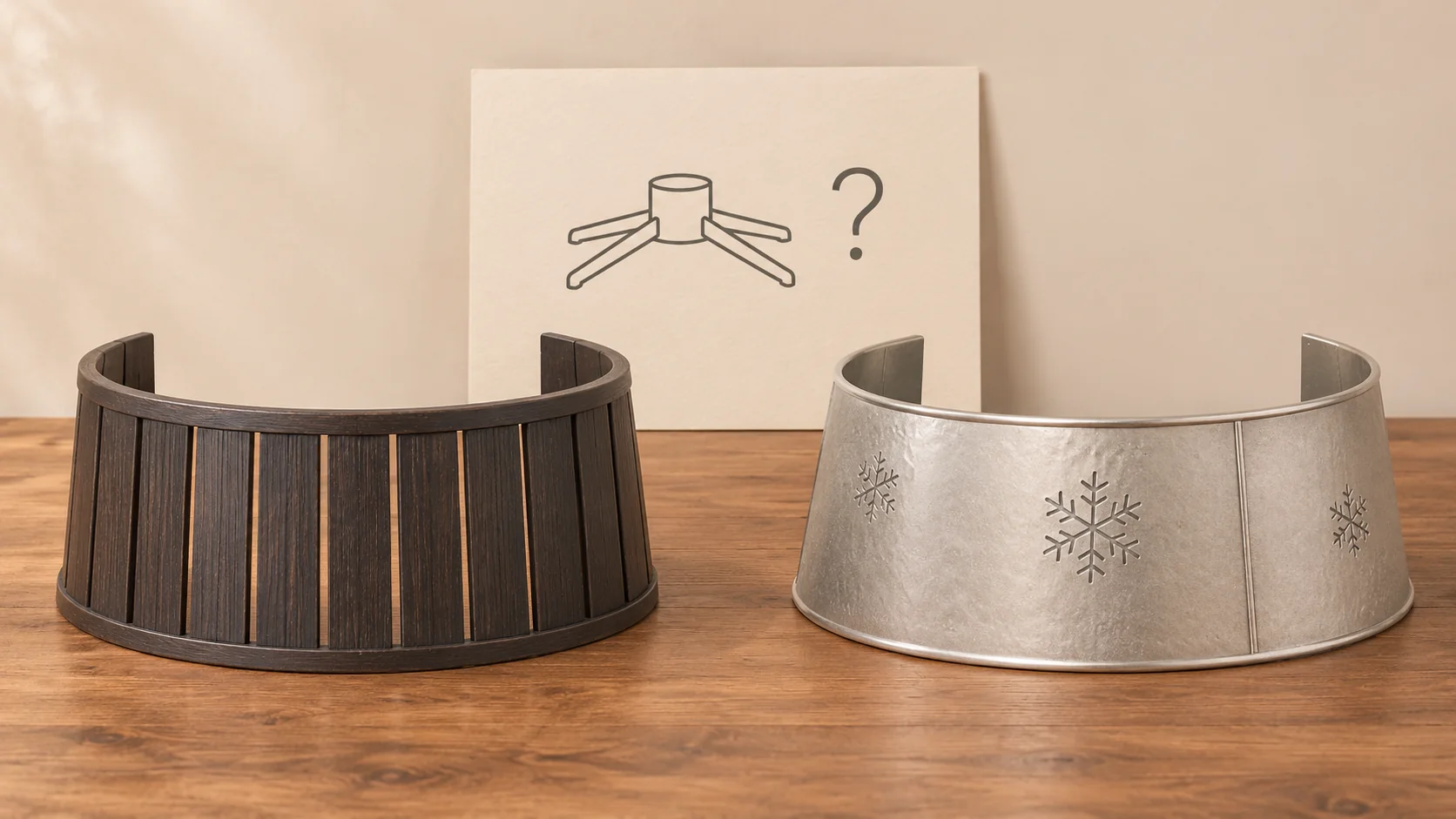
A collar can fit around a Christmas tree stand and still leave you with an appearance you did not intend. Christmas tree collar stand concealment is a separate decorating requirement to establish. Do you want the hardware visually hidden, or are glimpses of the base acceptable? The answer matters when an offer shows slats, panel joins and an open top. A staged tree photograph does not establish what you will see around your own stand.
This guide concerns that visual requirement. It does not measure an opening, approve a fit or supply assembly instructions. It also provides no test of opacity, reflection or concealment for either product. Start with the appearance you want, then examine what the actual source pictures show and what they leave unanswered. A collar's stated outer dimensions cannot answer every question about the view through or above its walls.
Decide what a slatted surround should contribute
A slatted surround presents a wall made from repeated narrow elements. For this purchase, identify whether you like that construction in its own right or expect it to behave like an uninterrupted visual screen. Those intentions can lead to different questions. Enjoying the lines does not require a promise that every part of the stand disappears, while complete concealment calls for more evidence than the word collar alone.
The Best Choice Products black wood-slatted collar offer identifies a slatted design. Its complete gallery shows a tapered ring, separated vertical slats, inner supporting rails and sectional joins. Other images show color and size choices. These are source observations and retail claims, not authentication of the delivered material or proof of stand concealment. The selected black offer should not be mistaken for a bundle of the pictured colors.
Decide what would make a glimpse of the base acceptable to you. Perhaps you enjoy seeing the display as a collection of separate objects, or perhaps visible hardware is the detail you specifically want to remove from the scene. Neither preference needs to become a universal decorating rule. Explain your own intention before judging whether the available evidence answers it.
Read a paneled surround with its joins intact
A paneled surround raises its own appearance questions. A broad wall area can coexist with sectional boundaries and an open top. Do not turn a photograph of one face into a statement about every view around the ring. The purpose of examining joins is to understand the offered construction, without treating a decorative seam as a fault or declaring that a particular arrangement will hide it.
The Beyamis silver tree-collar offer describes a bright steel ring. Its complete gallery shows joined panels, a dimpled-looking surface, horizontal bands and snowflake motifs. It is not a plain, seamless band. Those pictures do not authenticate the maker or material grade, establish an actual fit, or prove a complete screen around your stand. Staged trees and presents are not supplied items established by this comparison.
Retain the visible joins when imagining the appearance you are buying. If an uninterrupted-looking front matters, ask what the exact assembled item shows from the intended position. This article supplies no instruction to rotate, reassemble or reposition a collar around an installed tree. A preference about the finished view remains a question for the actual product and suitable arrangement, rather than a reason to disturb a sound stand.
Include the open top in the appearance question
The native pictures of both offers show an open top. A surrounding wall is therefore not a closed lid over the entire base. That observation does not establish how much hardware would remain visible with your tree and stand. It does mean that a claim about the outer wall should stay separate from a claim about the whole view. Neither account documents a concealment result for your room.
Describe the part of the appearance that concerns you. Perhaps you dislike seeing a stand foot near the floor, or perhaps the central hardware visible from above is the detail you want hidden. You do not need to convert that preference into an optical measurement. Naming the detail makes the question more specific than saying that the base should look finished.
Do not assume that solving one visual concern settles another. A wall that suits the intended side view may leave your question about the open top unanswered. Equally, a lower branch in a retailer's staged image can obscure something that would be exposed beneath your own tree. The comparison has no measured branch arrangement or installed stand with which to settle those differences.
Keep an acceptable glimpse different from an unmet requirement
Imagine a fictional household in which Avery likes the repeated lines of an existing decorative surround. Avery is content with some base details remaining visible. Another household member, Lee, had expected the entire stand to disappear. They have different desired results, even if neither objects to the collar's general color or shape. Choosing a new item before discussing that difference could repeat the same disappointment.
Avery can explain that the construction is part of the desired look, rather than promising that a gap will become invisible. Lee can explain which hardware detail feels distracting. Neither needs to claim a defect merely because their expectations differ. The useful next decision is whether they accept that visible detail or need further product evidence for another choice.
This example records no actual household, supplied product or installation result. It is a way to distinguish a preferred appearance from an assumed feature. A buyer who consciously accepts glimpses of the base has made a different choice from one who still needs complete concealment established. Leaving that distinction explicit is more useful than describing both intentions as the same request for a neat tree.
Give each person room to name one detail they would notice during an ordinary evening in the room. Keep the discussion attached to that detail rather than asking whether the whole display looks good. Agreement about a favorite color may leave the hardware question unresolved. A specific preference can remain useful even when it leads the household to keep what it already owns.
Separate this choice from the gift handoff
The guide to staging gifts around a tree skirt or collar concerns people's approach, package groups and the opening sequence. Those tasks remain separate from the collar-wall question here. A pile of gifts that temporarily covers the base does not establish that the selected collar supplies the concealment you wanted on its own.
Decide whether you want the collar's appearance to satisfy you when the surrounding floor is clear of packages. That is a preference about the seasonal decoration itself, without a new gift layout or cleanup method. If presents are the only reason an unwanted detail is hidden, say so in the discussion. You can then decide whether that temporary arrangement meets your actual intention.
Keep the tree's support and required access with their appropriate instructions. This guide does not propose adding an improvised liner, filling gaps, covering a stand opening or using the collar as a brace. It concerns the evidence for a decorative appearance, not a modification intended to produce it. An unanswered visual requirement should remain unanswered until a suitable choice can be established.
Keep the room view different from a photograph
The existing Christmas tree photo-planning guide starts by deciding whether the base belongs in the intended image. Here, the question concerns the display you live beside, even when no picture is being taken. A cropped photograph can omit a detail without establishing that the installed decoration conceals it.
When looking at an offer, notice the role of the picture you are using. A close product view may show the wall and joins more clearly than a decorated room scene. A staged room may show how the seller presents the item while leaving part of its construction out of sight. Use each image for the information it actually supplies, without assigning a test result to either.
Ask for clarification tied to the exact selected item if the required view remains unclear. Keep the question about visible construction distinct from a request for stand-fit or assembly guidance. This article has obtained no supplier reply and has not fitted either collar. A response concerning a different size, finish or arrangement would need its own consideration before it could answer your original question.
Retain the appearance requirement when ordering
Once an appropriate item and arrangement are established, retain the exact reference with the appearance you intended. If the selection changes, review the new item's own construction. Do not carry a conclusion about one pictured wall across to another merely because both are called collars. The source galleries include variants and marketing diagrams, which do not establish every delivered detail of the order you might place.
If you consider a collar through republeq.com and prefer crypto such as USDT, keep the exact selected offer and the intended appearance beside the order while you establish current purchase instructions. Paying for an item cannot supply concealment evidence left unresolved by its product account. Identify what you intend to buy and obtain the actual order and payment details before authorizing a transaction. This passage confirms no currently available payment method, asset, network or destination for either product. Follow only the instructions applicable to the current basket and order. If someone helps place the purchase, explain whether seeing parts of the stand is acceptable or whether that requirement still needs an answer. A general request for a tree collar may leave the helper unaware of the preference that determined your choice. If another item is proposed, examine its own evidence before authorizing a substitution. Keep the order reference and any payment identifier with the purchase correspondence. Instructions from an earlier order do not establish what a new selection requires. If the basket, size or finish changes, obtain current instructions for that order instead of carrying old details forward. When a payment or order attempt has an uncertain result, reconcile that exact attempt before authorizing another one. An unclear confirmation remains an order question until the destination establishes what happened. Once the purchase is confirmed, retain the product and appearance evidence separately from the transaction record. A receipt establishes an order event; it does not certify the delivered collar's fit, construction or concealment result. Resolve any difference in delivered identity before relying on information obtained for the earlier selection.
Return to the visible result you wanted. An offered slatted surround and a paneled surround give you different construction details to examine, with neither account proving complete stand concealment in your home. Decide which visible details you accept, keep the remaining appearance questions specific, and leave fit, support and assembly with their own applicable evidence.
Conceptual comparison of generic collar wall forms; no fitted tree stand, visibility test or complete concealment result is shown.