Holiday Decorations
Christmas stocking stand compatibility: match loops, length and hooks
Measure real stockings and stand hooks before choosing a freestanding holiday display; resolve loop, length and spacing mismatches first.
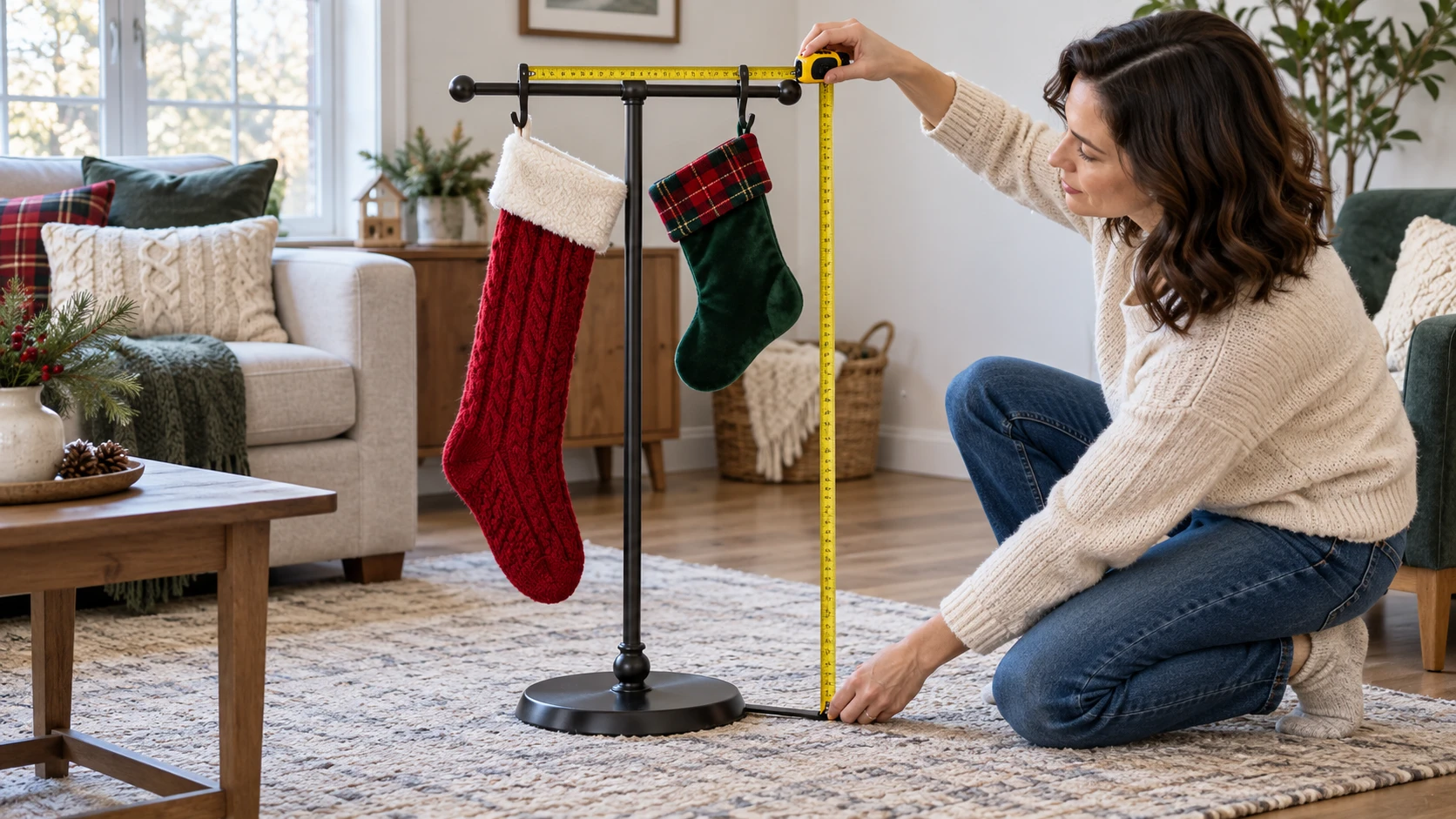
A stocking holder can list enough hooks for the whole household yet still leave a long stocking on the floor or crowd the next one. Christmas stocking stand compatibility begins with the actual stocking loops, hanging length, hook spacing, and intended load, not the hook count in a product title. This guide helps you compare the stockings you own with a freestanding stand before decorating. It covers physical fit and usable arrangement; a separate budget decision can follow once you know which stands work in the room.
Lay out the stockings before choosing a stand
Place each empty stocking flat and measure from the top of its hanging loop to the lowest point. Include any cuff, tassel, or decoration that hangs below the toe. Record the widest part of each stocking when it is lying naturally, not folded tightly. A set of different sizes needs more than a single average measurement. The longest piece controls vertical clearance; the widest pieces affect whether adjacent hooks can be used together.
Inspect every hanging loop. A narrow ribbon, sewn fabric loop, or metal ring may sit differently on a broad curved hook. Look for loose stitching or fraying before you hang anything. Do not use a damaged loop to test the stand's capacity. If the loop slips off an open hook under light movement, ask whether the maker offers an appropriate retainer or choose a compatible hook style. Do not tie a makeshift knot around a sharp tip.
Separate display from gift loading. Empty stockings may hang comfortably with several inches between them, while filled ones can bulge, lean, and pull each other together. Note what your family normally places inside, but do not estimate a safe weight from appearance. The stand's exact load directions control whether filled stockings are allowed and how weight should be distributed. If that information is missing, keep the display decorative until the maker clarifies it.
Keep the measurements in a small list beside the intended room location. You can group stockings by length or loop type, but do not hide an outlier in a group average. A handmade stocking with a thick cuff can need more hook depth than a thin store-bought one, even when their hanging lengths match. If several people add stockings on the holiday morning, leave a genuinely usable space for each rather than filling every visible hook during the first dry layout.
Measure the usable hanging space
For a straight rail, measure the distance between usable hooks and the clearance from hook to floor or base. For a central pole with radial hooks, measure the arc of room each stocking needs and whether the toe can swing into the pole or the next hook. A hook may be present yet unusable for a wide stocking. Set a simple paper or fabric template in the planned position to see whether several cuffs will overlap.
The live Renovators Supply stocking holder stand listing describes a black wrought-iron floor stand with six hooks. Its first gallery shows multiple stockings arranged around a central pole. That image establishes the display form, not usable space for every household's stockings or a safe load for uneven gifts. Check its current dimensions and instructions against your longest and widest pieces before treating six hooks as six usable places.
The live ZHIBO adjustable stocking stand listing describes movable hook sets, an adjustable height, and a base weight bag to fill as directed. Its gallery shows stockings at different hook levels around a central pole. The ability to move hooks may help separate different lengths, but only within the model's assembly and stability directions. Do not assume every adjustment position carries the same allowed load or that twelve wide stockings can hang without contact.
When comparing two forms, draw the hook locations on paper at roughly their listed scale. Place rectangles representing your stocking widths below each position. Mark the floor or base outline and the height of furniture nearby. This rough diagram exposes collisions before assembly. It does not replace the exact measurements, because product images may be staged or scaled. Ask the seller for missing hook spacing or assembled dimensions instead of inferring them from a photo.
Check the planned location in normal use
Measure the floor footprint of the exact stand, including legs, feet, or a required base weight. Leave room for people to pass without brushing the stockings. Place the diagram near the actual tree, sofa, or entry where it would stand during the busiest holiday day. A long stocking that clears the base on an empty floor can still contact a nearby chair, gift pile, or table edge. Check both the empty and normally furnished arrangement.
Watch how the stand would be approached. Children may reach for a stocking, and pets may brush fabric hanging near the floor. Ordinary decorative holders are not toys or climbing supports. Keep them out of traffic and follow the maker's stability guidance. Do not place an extended hook where it can catch a sleeve or bag. If the only possible location creates that conflict, the stand is not compatible with the room even if every loop fits its hook.
The tabletop ornament display stand guide covers another holiday display's base footprint and hanging clearance. Its tabletop rules do not determine a stocking holder's safe load, but the room-planning method is useful when both are present. Set both displays in the intended arrangement before assuming the floor stand can sit under or beside a decorated side table.
If the holder has height adjustment, measure the lowest and highest relevant positions that the instructions permit. Choose a setting that clears the longest stocking without putting the top into a shelf, lamp, or low ceiling feature. Do not raise a pole beyond its marked range simply to gain toe clearance. For a fixed-height stand, a shorter stocking may hang high while a long one touches the base; that is a fit issue to resolve before adding gifts.
Confirm the support path
Inspect where the loop bears on the hook and where the hook joins the rail or pole. A stocking pulling away from the center can create a different demand than a flat decorative sock. Follow the exact stand instructions for hook placement, base assembly, counterweights, and loading order. A listing's general capacity claim is not a substitute for instructions for the assembled product. If a hook is loose, missing, or bent, request the correct part rather than hanging a stocking on it.
Distribute stockings as the maker directs. Avoid putting every filled piece on one side of a freestanding pole while the opposite side remains empty. A counterbalancing idea mentioned in marketing copy is not a license to exceed a stated overall or per-hook limit. If instructions do not explain how to load a mixed set, ask for guidance. Test only within documented limits and keep people clear while evaluating the arrangement.
For the ZHIBO-style base, the listing describes a fillable weight bag. Use only the specified fill method and attachment instructions for the exact unit. The bag is part of the designed support system, not an optional styling detail if required by the maker. A heavy object placed beside the base is not equivalent. For the wrought-iron stand, check that its legs are fully assembled on a suitable level surface; do not assume apparent metal weight makes an uneven setup safe.
Resolve fit mismatches before purchase
If a loop will not sit securely on a hook, check whether the stocking maker offers an appropriate hanging accessory or whether a different stand hook is needed. Do not cut the loop, bend the hook, or attach a heavy clamp to an unknown stand. Such changes can damage a keepsake and alter the product's support path. A compatible accessory should be specified for both the stocking and the stand, especially if gifts will be placed inside.
If adjacent stockings overlap, see whether the exact stand allows moving hooks or using fewer positions. Do not force fabric behind another hook where it can catch on a sharp end. A larger advertised hook count may not fix spacing if the stand's circumference or rail length remains small. Use your measured template to decide how many positions are genuinely usable. It is acceptable to display fewer stockings on one stand and use another safe location for the remainder.
Pay attention to decorations attached to a cuff: bells, wooden names, pins, and small ornaments can change the usable spacing and may catch on a neighboring stocking. Keep detachable parts secure and away from small children or pets. If the stand's hooks are close, a plain fabric loop may work while a bulky decorative topper does not. Treat that as a compatibility finding, not a reason to squeeze the fragile decoration between metal parts.
If the toe rests on the floor, check permitted height adjustments or choose a stand with adequate measured drop. A stocking dragged across the floor can collect dirt and may be pulled accidentally. Do not shorten a family keepsake or prop the stand on loose boxes just to gain clearance. The stand should remain on its designed base and approved surface. If a tall model solves the drop but cannot fit the room or store safely, it may still be a poor match.
If the base cannot fit its location, revisit the display type. The Christmas stocking stand total-use-cost guide owns the follow-on budget comparison, including setup, storage, and repeated seasonal use. This fit guide stops first at whether the actual loops, fabric lengths, hooks, and support arrangement work. There is little value in a lower price for a stand that cannot carry the intended display safely.
Do a dry layout and keep a record
Before loading gifts, assemble the stand exactly as instructed on a level surface. Hang empty stockings in the planned order. Check cuff overlap, toe clearance, hook engagement, and whether the holder remains in its intended posture. Remove and reposition pieces only in ways the maker permits. If a hook rotates or pole joint moves unexpectedly, unload the stand and inspect the assembly. Do not continue testing with filled stockings to see whether added weight settles it.
Photograph the accepted empty arrangement and note the hook positions. This saves time next season and helps reveal a change if a part is missing. Keep model details and instructions with the stand. When the holiday ends, remove the stockings before adjusting or disassembling the holder. Inspect loops for wear; a loop that worked this year may need repair before the next display. Store the stand and its required base parts as the maker directs.
Christmas stocking stand compatibility is established when the actual stockings hang from secure loops on approved hooks, clear one another and the floor, fit the room, and remain within the exact stand's assembly and loading directions. A hook count is only the beginning of that check. Measure the pieces you own, verify the product's support instructions, and choose another arrangement when a physical or safety mismatch remains unresolved.