Holiday Decorations
Christmas ornament set parts explained: finishes and hanging points
Learn how ornament bodies, surface finishes and attachments differ across a mixed holiday set.
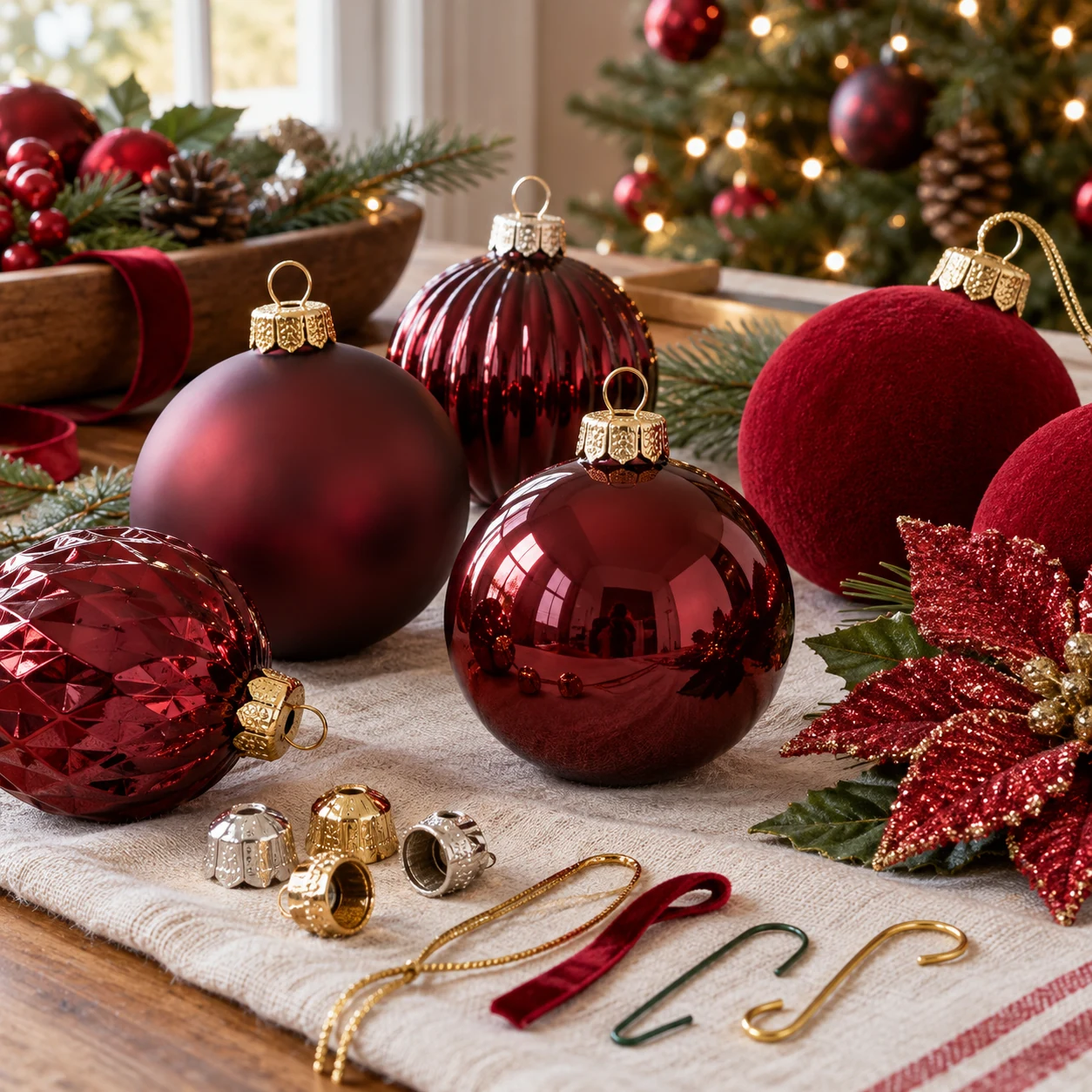
A Christmas ornament set is more than a count of matching pieces. The materials, finishes and attachment methods determine where the pieces can go and how they should be handled. A plastic ball with a hanging loop, a flocked ornament with a string and a wired floral accent may arrive in one seasonal collection but serve different physical roles. This explainer helps you read a set listing and inspect the actual pieces before placing them. It is about what the parts are and how they attach, not about choosing a color palette or building a storage system.
Start by reading the set as parts
Read the contents line before looking at the total count. A number may combine hanging ornaments with other accents. Ask how many pieces are balls, how many are shapes or florals, and whether every piece comes ready to hang. A set with several kinds of objects can be useful, but the pieces should not be treated as identical units. The actual distribution matters when you plan branch space and attachment points.
Inspect one piece of each type when the package arrives. Look at its body, surface finish, top cap or stem, and supplied string or wire. A listing photograph may show a decorative arrangement, while the delivered parts may need separate assembly or careful opening. Do not hang a piece by its decorative body if the maker provides a specific attachment point. Keep small loose hardware together so a missing loop does not leave an otherwise usable ornament stranded.
Measure the decoration you intend to use, including protruding bows, petals or stems. A branch with space for a small ball may not have room for a wide floral accent. The apparent size of a product photograph does not establish clearance in your tree, wreath or tabletop display. Use the maker's listed dimensions as a first screen, then compare the real pieces with the available space. A set can be physically varied even when its colors coordinate.
What two current listings show
The current SKYSONIC burgundy ornament listing describes 52 plastic pieces in several shapes, including candy, pinecone, heart and snowflake forms, with matte and glossy finishes. It says each includes a metal buckle and hanging rope. Those details identify a hanging role for the listed pieces. The seller's durability language should not be taken as proof that a particular ornament cannot crack, scratch or lose its finish in your home.
The current Bybiment velvet ornament listing describes 18 flocked velvet balls and six glittered artificial poinsettias. The listing says the balls have hanging strings, while the floral accents use flexible wire supports and can be arranged on branches or other displays. That is a mixed set: the balls and flowers are not interchangeable in attachment or storage. Inspect the exact delivered wires, strings and surfaces before placing them.
These examples show why a total set count is insufficient. The first listing describes many plastic hanging shapes; the second combines soft-finish balls with wide floral accents. Neither listing proves that every piece will fit the same branch, wreath frame or storage cell. The useful question is what each part asks of the display. Count and categorize the pieces you will actually use rather than assuming one generic ornament rule covers them all.
Check whether a listed count includes small accessories or only decorative bodies. The two current examples identify their main piece types, but another assortment may describe hooks or ties separately. Do not infer that a box marked with a large number provides that many ready-to-hang ornaments. Read the contents line and inspect the package on arrival. This prevents a decorating plan from depending on parts that were never included or on a hanging method that requires an additional compatible accessory.
Understand bodies and finishes
The body is the main shaped part of an ornament. Plastic bodies can be formed into multiple designs and may be lighter than some other materials, but actual weight and strength depend on the item. Do not infer unbreakable performance from the word plastic. Inspect seams, edges and any attached decoration. A rough edge can catch a ribbon or scratch nearby finishes. A decorative piece is suitable only when its own body and attachment remain sound.
A matte finish scatters light differently from a glossy one, so the same color can read as more subdued or reflective depending on the surface. This is a visual characteristic, not evidence of different structural strength. Gloss may show fingerprints or scratches differently; a flocked or velvet surface may collect lint or need gentler handling. Follow the maker's care advice for the actual finish. Do not use one cleaning method across every piece in a mixed set.
Glitter and flocking are surface treatments that can change how a decoration feels and how it should be packed. Loose particles may transfer during handling. Keep the original care instructions and test any cleaning method in an appropriate way rather than soaking or scrubbing a finish. A floral accent with flexible wire also has a shape that can be bent during storage. Treat its surface and structure as separate things to protect.
Color matching belongs to the styling decision, but it helps to know that material can change the apparent shade. A burgundy glossy ball may look brighter under a tree light than a burgundy matte shape, even within one set. A red flocked ball may read differently from a glittered red floral piece. These differences are normal reasons to inspect the actual collection. Do not promise a perfect uniform color from a listing thumbnail.
Understand caps, loops, strings and wires
A top cap or buckle connects a hanging ornament's body to its loop or rope. It is a small part, but it carries the load when the ornament hangs. Check that it is attached to the body and that the string or loop passes through the intended point. A decorative cap can look intact while its connection is loose. Set a questionable piece aside rather than placing it high on a tree and hoping the attachment holds.
A supplied string may be long enough for one branch shape and awkward for another. Shortening or replacing it can change the way it hangs; follow the product instructions and use an appropriate attachment if needed. Do not knot a string around a fragile branch so tightly that removal damages the tree or the ornament. If the piece has a metal loop, choose a hook or branch placement that keeps the ornament from slipping during normal movement.
Remember that attachment parts can be more delicate than the ornament body. A plastic ball may survive a bump while its cap becomes loose, and a velvet finish may remain attractive while the string frays. Inspect the whole assembly before placing it over a busy walkway or where a falling piece could be stepped on. A sound body with a poor connection is not ready for display. Put it aside for an appropriate maker-directed correction or another safe use.
A wired floral accent often behaves differently. Its wire may be intended to grip or nest into greenery, not to hang freely like a ball. Confirm the maker's intended method for the exact item. Keep wire ends away from people, pets and delicate surfaces. Do not suspend a wide poinsettia by a single petal or assume the flexible stem is a rated hook. Arrange the support where it can hold the accent without snagging lights or other ornaments.
Inspect each attachment after it is placed. A branch can bend under several ornaments, changing how the lower pieces sit. A heavy cluster near a branch tip may pull items together. Spread compatible pieces according to the tree or display maker's guidance, and keep a clear view of each loop and wire. The question is whether the finished arrangement stays secure in ordinary use, not whether every supplied piece can be placed somewhere.
Keep adjacent decisions distinct
The ornament-set color planning guide owns the visual decision about repeating color and using accents. This article supplies the physical vocabulary for that work: mixed shapes, finish types and attachment roles. Knowing that a collection has matte and glossy pieces helps you plan, but it does not dictate a palette. A separate styling choice can still use only some of the pieces that the set provides.
The ornament selection guide addresses which existing decorations deserve another year on display. Use that decision before adding a new set to a crowded collection. Here the goal is to understand the parts of a set you are considering or already own. A set with many pieces is not automatically useful when the household's tree and storage have room for only a few.
Storage is also a separate decision. A flocked surface, protruding floral stem and smooth plastic ball may need different protection. Keep the original packaging if it provides appropriate separation, and assess condition at takedown. Do not assume a generic compartment will fit a wide floral accent. The physical classification you make while unpacking can guide later storage, but this explainer does not replace the exact storage guide for your collection.
A short inspection routine
When a set arrives, compare the contents with its current listing: count the major piece types, check sizes and inspect each attachment style. Lay pieces on a clean surface in groups before hanging them. Keep detached caps, hooks or strings away from children and pets. If a piece is damaged or differs materially from the listed type, resolve that issue with the seller rather than improvising a risky hanging point.
Place one example of each type on the intended display and observe how it sits. Does the ball's loop stay on the branch? Does the floral accent have enough space without bending adjacent branches? Does the finish catch on rough greenery or wire? Then add other pieces gradually. This is a fit observation, not a test to the point of failure. Remove a piece that cannot be supported as intended.
At takedown, inspect the body and attachment again. A cap that has loosened, a torn string, or a wire that has lost its useful shape changes whether the piece can be used next year. Keep a brief note with the set rather than assuming every ornament will be ready next season. Understanding a Christmas ornament set means seeing the different physical jobs its pieces perform, then using each only where its actual body, finish and attachment make sense.