Crypto Commerce
ChicHomey 18-grid food dehydrator vs Tieasy 12-Tray Food Dehydrators
Compare ChicHomey 18-grid food dehydrator by usable tray area, temperature range, timer length, cleaning access, and cabinet fit.
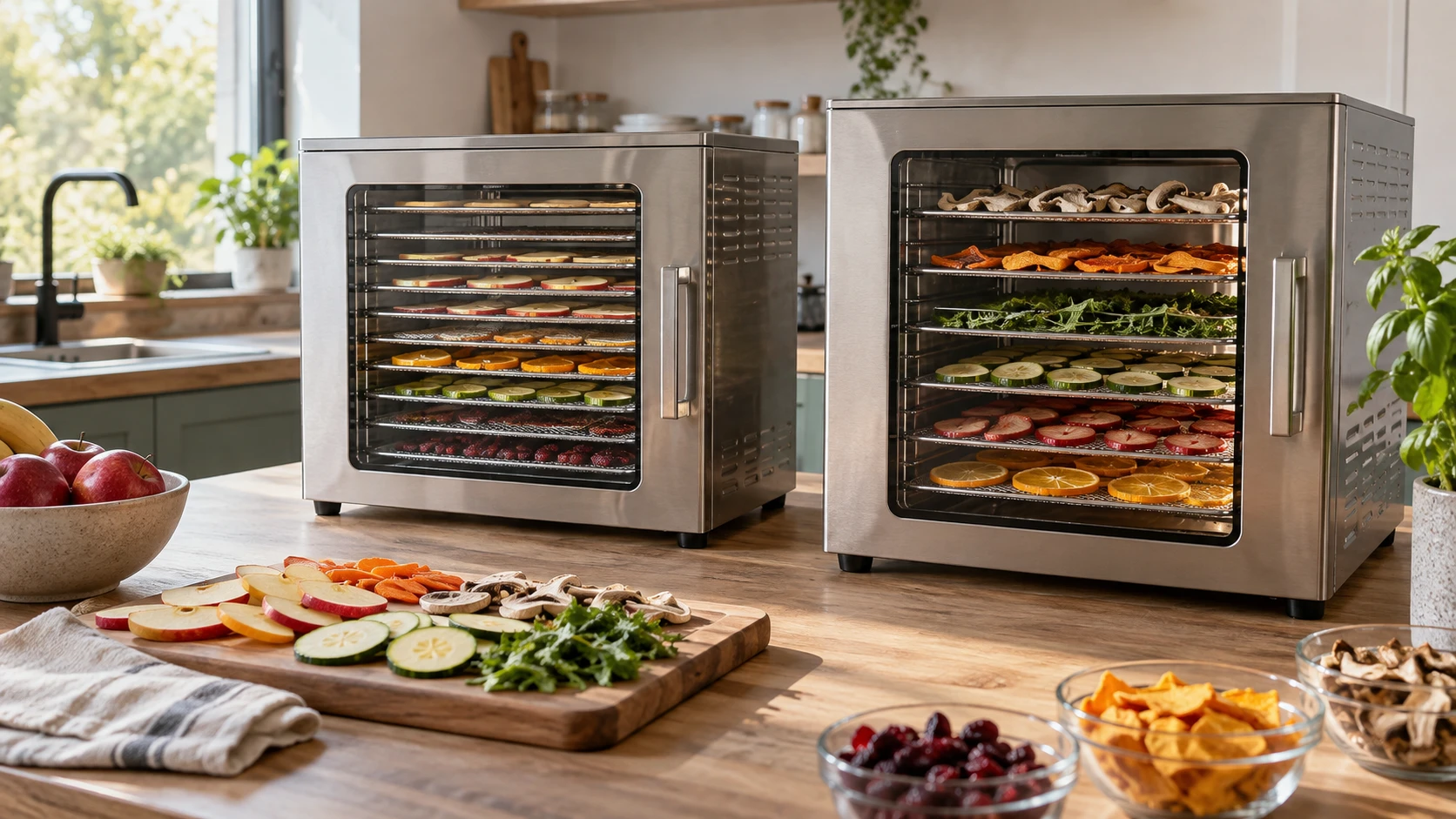
An 18-grid dehydrator and a 12-tray dehydrator do not necessarily give you more or less usable drying room in proportion to their tray counts. ChicHomey lists 18 grids with narrow spacing and a 24-hour maximum timer. Tieasy lists 12 trays, a longer timer and a lower maximum temperature. Which one fits your kitchen depends on the food you dry, how thickly you slice it and whether you can reach and clean every tray. The saved descriptions give useful starting specifications, but neither reports a side-by-side drying test.
Both machines are described as food dehydrators with stainless steel construction, windows and interior lighting. Their temperature ranges overlap, yet their controls, tray details and electrical information differ. Before buying, sketch a typical batch and check the current manuals for tray dimensions, airflow instructions and the space required around the machine. A rack count alone is a poor way to plan a batch of uneven fruit slices or bulky herbs.
Count usable area, not just shelves — dehydrator tray rotation requirements
The ChicHomey 18-grid food dehydrator lists 18 grids, each rated for about 2.2 pounds, and says adjacent grids are spaced 0.98 inches apart. That tells you more than the tray count alone, but the saved description does not provide each grid's width or depth. A loaded slice must fit below the tray above without touching it, and air needs room to circulate. Check the dimensions of a grid and its usable perimeter, especially if you dry long strips or large fruit rings.
Tieasy calls its model a 12-tray dehydrator and lists a 12.6-square-foot capacity. The excerpt does not show the tray dimensions or explain whether that area is total nominal shelf area or usable drying surface. Confirm the number against the current tray diagram. If you usually work with one small harvest at a time, a few trays may be easier to load, rotate and clean than a nearly full cabinet. If you process a larger batch, compare actual tray surface rather than assuming that 18 always exceeds 12.
ChicHomey's saved text says each grid is supported by a reinforced layer. The 2.2-pound figure is a listed grid rating, not a reason to pile wet produce until the pieces overlap. Weigh a representative loaded tray if you expect to dry heavy foods. Find out whether the grids flex when lifted with a full batch and whether the handles or edges remain easy to grasp. The Tieasy excerpt does not give a per-tray load rating, so ask for one before using the total area as a weight target.
The related guide on dehydrator tray rotation requirements raises a practical question for either cabinet: does the maker expect trays to be swapped or turned during a run? ChicHomey says a fan distributes heat from a heating tube, while Tieasy describes 360-degree airflow. Neither short listing provides a loaded uniformity test or a tray-rotation schedule. Check the manuals for the recommended arrangement and then try a small batch in several positions. Labeling trays at the start makes it easier to see whether the top, middle and bottom finish together.
Temperature controls have different limits — Tieasy 12-tray food dehydrator
ChicHomey's stated range is 86 to 194°F. Its description groups suggested settings for flower tea, fruits and vegetables, meat and seafood, and what it calls dissolved beans. The last phrase is unclear, and those category ranges are not a food-safety procedure. Use the current manual and an authoritative recipe for the particular food you are preparing. Confirm how the control increments temperature and whether it displays a setpoint, the air temperature or both; the short excerpt does not explain the display.
The Tieasy 12-tray food dehydrator lists 95 to 167°F in five-degree steps. That lower ceiling may matter if a process requires temperatures above 167°F, while the five-degree setting increments could make repeat batches easier to record. Neither listing supplies calibrated temperature measurements across a fully loaded cabinet. If a recipe depends on a narrow temperature band, verify the exact model's instructions and measure a test batch rather than treating a dial setting as proof of food temperature.
The overlap from 95 to 167°F covers many drying tasks on paper. It does not tell you how quickly each cabinet reaches its setpoint, how much the temperature moves during a cycle, or how much the door opening changes conditions. Keep notes on slice thickness, load size, setpoint and elapsed time. Those details will help you repeat a result, and they are more useful than a single advertised maximum when the food and room conditions change.
Timer length changes how you plan a batch — Tieasy 12-tray food dehydrator
ChicHomey lists a timer from zero to 24 hours and says the unit stops when the selected time is reached. Tieasy lists 30 minutes to 72 hours in half-hour steps. If a long drying run is normal for your food, Tieasy's stated upper limit may reduce the need to reset the timer. Check whether the machine resumes after a power interruption and whether it alerts you when a cycle ends; neither saved excerpt settles those behaviors.
A long timer does not mean food should sit unattended for its entire duration. Check the recipe's instructions for rotation, inspection and storage after drying. If you start a batch before bed, plan when someone can inspect it and whether the machine's location has enough ventilation. The ChicHomey timer's zero setting also needs clarification: the saved phrase does not say whether zero is off, continuous operation or an immediate stop. Confirm the control behavior before relying on it for a long batch.
Tieasy is rated at 1,300 watts, 120 volts and 60 hertz in the saved catalog. ChicHomey's excerpt does not state its electrical rating. A wattage label describes rated power, not a direct prediction of a batch's electricity cost. Total energy use depends on how the heater cycles and how long the food takes to dry. Check the outlet and circuit requirements for the exact machine and avoid planning a countertop spot from the tray dimensions alone; you also need room for heat and airflow around the housing.
Door, light and cleanup affect daily use — Tieasy 12-tray food dehydrator
ChicHomey names viewing windows, built-in LED lights and detachable grids. Its description says to wipe grids and smooth surfaces after use. It does not say the grids are dishwasher safe. Tieasy also names an interior LED and transparent window, along with a magnetic door closure. A window is useful for a quick look at progress, but confirm whether it stays clear during a run and whether the light can be switched on without opening the door. Opening a cabinet repeatedly can interrupt drying, especially when the room is cool.
Tieasy's package dimensions are listed as 20 by 19.2 by 17 inches, with an item weight of 30.8 pounds. Package dimensions are not necessarily the operating footprint. ChicHomey's saved excerpt does not provide comparable outer dimensions or weight. Measure the available counter, the distance to upper cabinets and the clearance needed to remove a full tray. Also check where the cord exits and how far the door swings. A large machine may fit on the counter yet be difficult to load if you cannot pull a tray straight out.
ChicHomey describes a housing made with 304 and 201 stainless steels; Tieasy says stainless steel construction without naming grades in the excerpt. The material descriptions do not establish which grids, panels or fasteners use which metal. For cleaning, follow each maker's specific instructions for the trays, door seal and interior surfaces. Ask whether crumbs can be reached beneath the lowest grid and whether sticky fruit residue requires a soak. A tray that is quick to load but tedious to clean may slow the next batch.
Tieasy lists noise below 48 dB, but the excerpt does not give a test distance or operating condition. ChicHomey names a dual ball bearing motor without a sound rating. If the dehydrator will run in an open kitchen or overnight near a bedroom, look for a demonstration of the fan at operating temperature. Compare the sound of a full cycle rather than treating the presence of a motor type as evidence that one machine is quieter.
The saved Tieasy listing calls the product black while also mentioning silver as a color. Check the exact variant and current photos before ordering. ChicHomey is listed as silver. Color is a secondary choice beside footprint, tray dimensions and cleaning access, but the order confirmation should still match the finish you expect. The Tieasy listing includes a recipe book; verify that it belongs to the current package if you intend to use it as a starting point.
At the saved catalog capture, both were marked available. Confirm current pricing, warranty, shipping and return terms before comparing total cost. Ask about replacement trays and service for the fan or heater, since a damaged grid or failed control can shorten the usefulness of a large cabinet. Neither short description supplies a complete parts list or a measured drying-cost comparison.
ChicHomey deserves closer inspection if you need many shallow, removable grids and temperatures up to its stated 194°F ceiling. Tieasy is worth checking if a long timer, a stated 12.6-square-foot area and its 120-volt electrical specification fit your plan. The choice becomes clearer after you measure the foods, verify tray dimensions and run one representative batch following the model's instructions.