Skills & Planning
Chess set missing pieces: check storage before replacing anything
A piece that seems absent after putting a chess set away may be in a drawer, nested stack or carrying tube. This guide traces the storage layout, records what is actually present and stops before an unsupported defect diagnosis.
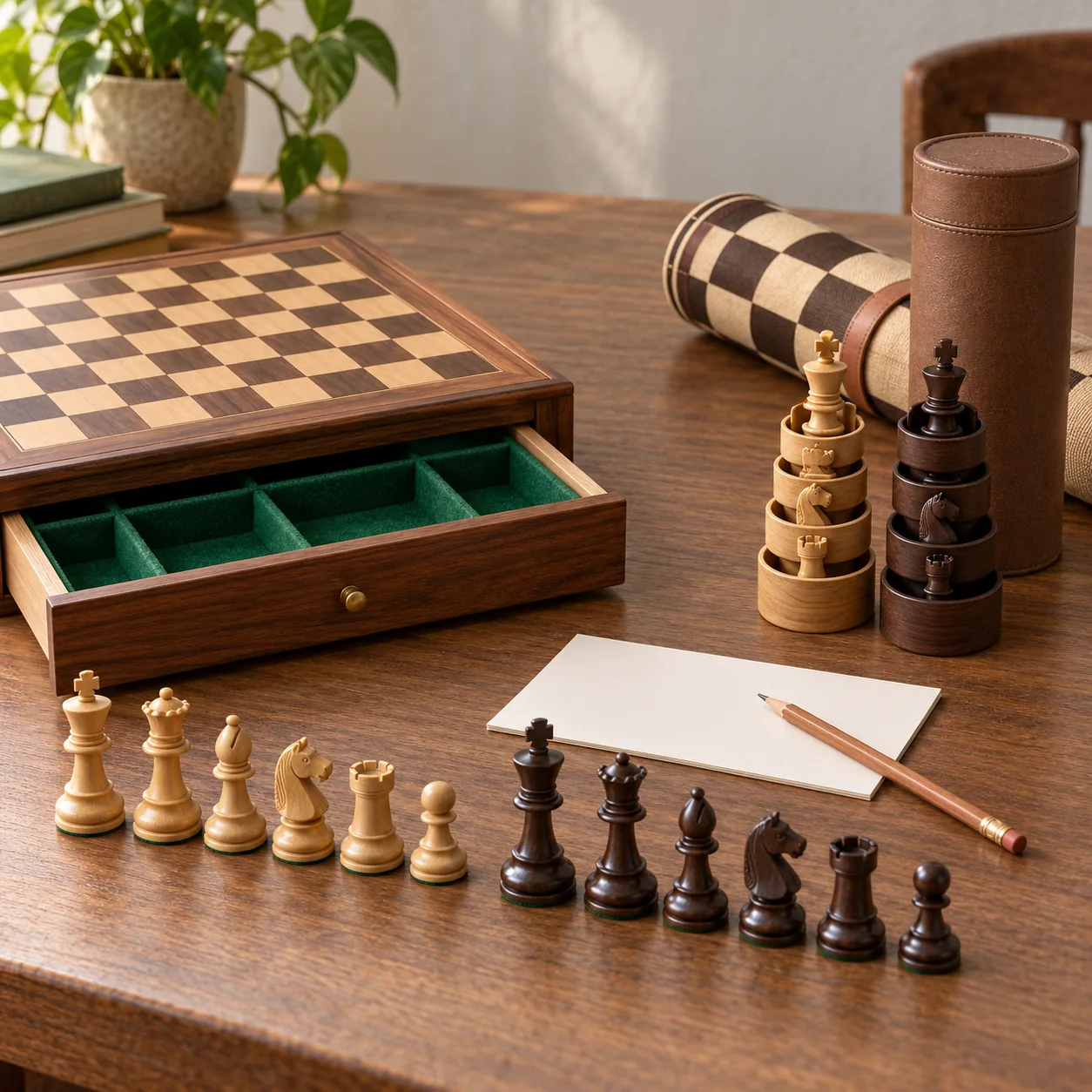
A chess piece looks missing when the board comes out of storage and one shape is absent from the row you expected to see. That is a good reason to stop setting up. It is not yet evidence that the piece was lost, left out of the package, or needs replacing. Put the pieces you have on a clear surface, leave the storage parts open, and check one location at a time.
The first useful question is which set is in front of you. A board with a sliding drawer gives you a different search route from a travel set whose pieces fit inside one another. The product pages for the Sagebrook Home 20911 chess set and the DesignNest DH0356 Crownes travel chess set show those two layouts. Use the layout of your own set, rather than borrowing a check from a different board.
Begin with the last place the set was complete
If you remember the set being complete before it was put away, start at that moment. Was a game still on the board? Were captured pieces beside it? Did someone carry the board, move a storage tray, or roll up the playing surface? Write down only what you remember, even if that amounts to “I saw both sides before lunch.” A guess such as “the missing bishop must be in the drawer” is useful as a place to look, but it is not an inventory result.
Keep the present pieces together while you search. A white piece on the table can be mistaken for one already counted if it is moved repeatedly. Make two small groups or use a sheet of paper with a line down the middle. Place each piece in its group once. If the set has a particular packing order, leave the order intact until you have noted it. Pulling every piece out at once can erase the clue that tells you which compartment or stack still needs checking.
Look around the board before opening any storage part. A piece can sit behind the board edge, under a folded sheet, or next to a chair without being inside the case. This is a search step, not a claim about the product. Check the surface where the set was last used, then the surface where it was stored, and mark each place as checked. If you cannot identify those places, write “unknown” rather than filling the gap with a story.
Trace a drawer-style set from the board inward
The Sagebrook listing describes a wooden tabletop board with a drawer for storing the pieces. Its native images show the board and an open green-lined drawer. That is enough to make the drawer a sensible next stop. It does not prove where a particular delivered set’s pieces were packed or how many recesses were occupied when yours arrived.
First look at the board face and around its frame. Then pull the drawer out over a clear table, so a loose piece has somewhere visible to land. Look into each recess or open area without assuming that one empty spot corresponds to the piece you seek. If the drawer can be viewed from more than one angle, turn it slowly and check the corners. Keep the drawer and board together until the count is finished; separating them mid-search makes it harder to say which part has been examined.
A drawer photograph may be arranged for display. The native gallery for this set includes playing scenes and close views of the storage area. Those images explain the physical layout, but they are not a record of the exact inventory in your unit. If you are checking an unopened purchase, compare what you actually received with the exact offer and any included packing list. If you are checking a set that has been used for months, compare with a prior photo or a count you made yourself. The two situations do not support the same conclusion.
Trace nested pieces without losing their order
The DesignNest listing describes a travel set with pieces that nest into stacks, storage cylinders, and a roll-up board. Its gallery shows the stacks being opened and the board rolled for storage. Begin with the case and tubes, then inspect each stack from the outside inward. Set the pieces down in the order you remove them. The nesting order matters here because a smaller piece can be inside a larger one that already looks complete from the outside.
Check the board or roll before deciding the stacks have told the whole story. A small item left on the playing surface can be caught in the fold or stay beside the case. Open the board flat and look along its edges. Do not force a stack apart if it resists; stop and consult the maker’s instructions for your exact version. The product images show different finishes, and one gallery note limits a magnetic-base feature to a premium set. Neither the pictures nor the listing establishes how strongly the pieces in your selected unit will hold during transport.
The Crownes gallery says each side’s pieces nest into a single stack. That is a useful way to organize a search, not permission to infer that a particular unit shipped complete. If one stack feels shorter, record that observation and identify what you have actually removed before naming a missing role. A short stack may point to a location worth rechecking; it does not tell you when or where an item went astray.
Make an inventory you can check again
Once the board, nearby surface, and storage parts have been examined, lay the pieces out where you can see every one. Use the exact set’s packing list if it came with one. If there is no list, use a prior photo or a written count from a time you know the set was complete. Do not quietly substitute the inventory of another model. A travel set with nested forms and a tabletop drawer set can have different packaging and extra parts, even though both are chess sets.
Make a short record: the model on the listing or package, the color or side being counted, the pieces present, the storage locations checked, and anything still uncertain. “One light rook not found after checking the board and drawer” is more useful than “set incomplete.” If you later find it beside the case, the record tells you what changed. If you need to ask the seller about a newly delivered order, the same record gives them a specific question. It does not assert a product defect before that has been established.
Keep a separate note for items that may belong to the storage system rather than the playing set. A tube, lid, board strap, or tray is not a rook merely because it was in the same box. Conversely, a piece in a carrying tube may be easy to overlook if you count only what was visible on the board. The aim is a count you could repeat tomorrow, with the same items in the same groups.
When two pieces look alike at a glance, set them side by side rather than naming one from memory. Note the visible shape and the side it belongs to, then compare it with the other pieces from that same set. Do not use a photograph of a different chess set as the deciding reference. The Sagebrook gallery shows traditional carved forms; the Crownes gallery shows a more abstract set. A shape that is obvious in one gallery can be less familiar in the other. If you still cannot identify a piece, label it “unidentified” in your count. That is an honest finding, and it keeps you from reporting a shortage that is really a naming problem.
If another person joins the search, hand them the written list before they move anything. Ask them to check one named area, such as the shelf where the drawer set was stored, and add the result to the same list. Two people searching the same table without a shared record can count a piece twice or both assume the other checked a tube. If the check is interrupted, leave the grouped pieces and the list together. When you return, restart from the last recorded location instead of reconstructing the search from memory. This small bit of bookkeeping matters more than a perfect photograph: it shows what was actually inspected and what remains open.
Decide what the check actually shows
There are three useful outcomes. You may find the piece in a place you had not checked. You may finish the search with a specific piece still unaccounted for. Or you may lack a reliable baseline for saying whether anything is absent. Record the result you reached. “Not found here” is narrower than “lost”; “not confirmed from the materials I have” is narrower than “arrived missing.” Those distinctions matter when the next step could be a replacement purchase.
If the piece is still unaccounted for, pause before buying a loose substitute. Check the exact model and any packaging record first. A replacement that looks similar in a photograph may differ in size, finish, base, or fit within the storage layout. The two native listings support the layouts described here; they do not certify compatibility with third-party pieces. If you contact a seller, describe the exact model and the result of your count, then ask what options exist. Avoid presenting a guessed cause as a fact.
If the set was recently delivered, keep the packaging and note when you opened it. If the set has been used, check with the people who last put it away. These are practical ways to find a missing location or a useful record; they are not warranty promises. Nothing in the two product pages establishes a seller’s response, a replacement policy, or whether your particular unit is defective.
Keep this task separate from playing and writing
A missing-piece check is about physical inventory and storage. It does not require a game score, a judgment about a move, or a plan for what to play next. If your real task is to separate what happened in a game from a line you only considered, use the chess analysis notes guide. If you are writing a fictional scene with chess figures, the chess piece microfiction guide owns that decision. Neither changes the count of pieces in the case in front of you.
After the check, put the pieces back in a repeatable order. For a drawer, note which side or section you used. For nested stacks, note which stack contains which side and whether the board and tubes returned to the same case. A quick photo of the packed set may help the next time a piece seems absent. It will be your own before-state, tied to your own set, rather than a product image used as a substitute for one.