Cameras & Video Gear
Camera tripod column positions: Ulanzi TT09 vs K&F T254A8
Compare camera tripod column positions on Ulanzi TT09 and K&F T254A8, including stated heights, heads, quick-release inventory and leg controls.
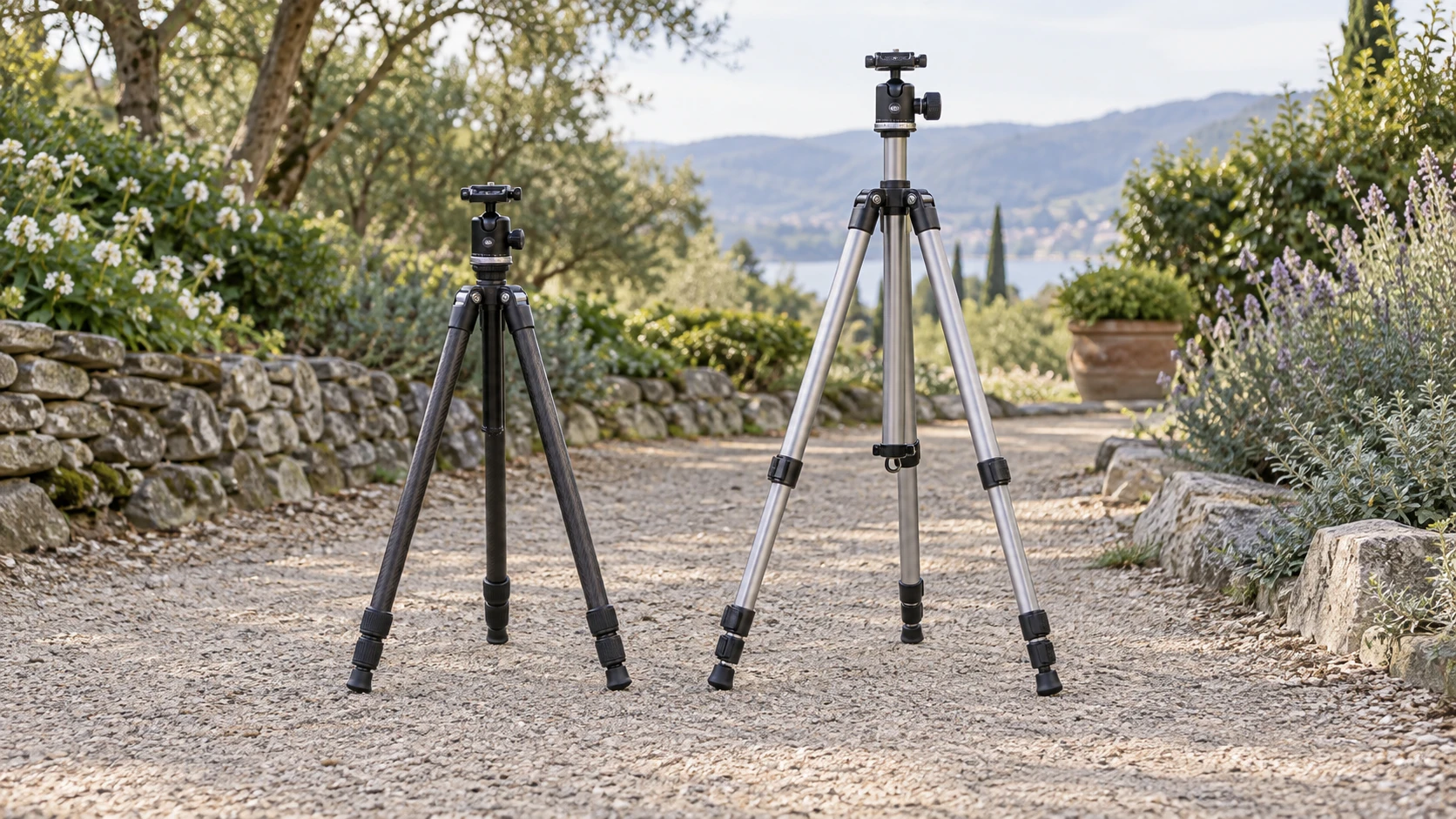
Choosing a camera support starts with where the lens needs to sit and which parts make that position possible. The Ulanzi TT09 and K&F Concept T254A8+BH-28L describe different answers. Compare camera tripod column positions alongside the described head, legs and attachment inventory. Ulanzi emphasizes a travel frame, leveling bowl and quick-release head. K&F describes a transverse column with a broad tilt range and two extended-column sections. Their maximum height and load labels need to stay attached to the configurations actually described.
The Ulanzi TT09 VideoGo travel tripod lists a carbon-fiber frame, 55.91-inch maximum height and an 11-pound load capacity. Its description names an Arca-Swiss F38 CLAW quick-release ball head with 360-degree panoramic rotation, a leveling bowl and fast-lock legs. A detachable column supports the advertised low-angle or inverted-shot options, and two quarter-inch threaded accessory mounts are listed. At the checked $293.63 offer, those are reasons to investigate it for changing shooting positions while carrying a travel support; they are not a timed deployment or stability test.
The K&F Concept T254A8+BH-28L tripod offer is also described as the 94-inch SA254T1 overhead tripod. Its aluminum tubing is 25 mm, its stated weight is 2 kg, and its legs have four sections with spiral locking knobs. The description gives 67.7 inches without the center column and 93.9 inches with its two sections extended. It includes a KF-28 metal ball head, with a 28 mm size and a stated 10 kg support figure. The checked $162.49 offer is worth investigating when its documented extended and transverse column options suit a stationary framing plan.
Conceptual editorial illustration of camera tripod column positions with two generic complete camera tripods; it does not depict exact retail models, approved camera attachments or a tested load configuration.
Read tripod height and load labels by position
K&F's two height figures are useful because their conditions are explicit. The 67.7-inch figure belongs to the setup described without the center column, while 93.9 inches belongs to the account with two column sections extended. Keep those conditions with the numbers when comparing tripod height and load labels. The shorter figure is not an independently specified minimum height. The description also does not give the height of every intermediate column position or a complete folded-size record.
Ulanzi gives a 55.91-inch maximum but does not attach an equivalent column-extension breakdown to it. That prevents a position-for-position height comparison with K&F's figures. A buyer planning a particular lens position should identify the configuration behind the applicable number, including the head and attachment used. The K&F account is more explicit about the column's contribution to its highest stated arrangement. It does not establish that the maximum-height arrangement is the best configuration for every shot.
The 94-inch wording in the K&F description sits beside its more specific 93.9-inch height statement. Preserve the listed identities too: T254A8+BH-28L is the offered model name, SA254T1 appears in the description, and KF-28 identifies the described included head. Those labels should travel together in a product inquiry. The source does not reconcile every naming convention, so do not silently rename the head or use one label to borrow specifications from a different K&F package.
Keep head and tripod load claims separate
Ulanzi states an 11-pound capacity for its travel tripod. K&F states up to 22.04 pounds, with 10 kg also given, for its tripod and up to 10 kg for the included head. The head and complete support are separate items in that description, even when a figure is repeated. Adding their capacities together would not produce a meaningful supported load. These are listed limits without a shared test of the two offers under an identical camera arrangement.
Start a purchase record with the actual camera and the equipment intended to remain attached to it. A camera body, lens and any supported accessory all belong in that record. Neither listing gives a capacity table for every extended, angled or inverted configuration. A headline load figure therefore cannot settle a particular overhead arrangement by itself. Obtain the configuration-specific information needed for that arrangement, keeping the source's overall tripod and head statements distinct.
Separate the ball head from the transverse column
K&F names two different rotations. Its transverse center column tilts from 0 to 180 degrees and rotates horizontally through 360 degrees. Its KF-28 ball head also rotates through 360 degrees. Those statements describe different components. A buyer interested in changing the position of the camera relative to the legs has a reason to investigate the column account, while a buyer interested in the head's orientation needs the head account. One rotation statement should not be substituted for the other.
Ulanzi describes 360-degree panoramic rotation at its quick-release ball head and support for horizontal and vertical shooting. It separately describes a detachable center column for low-angle or inverted shots. Ulanzi provides no transverse-column tilt range to compare with K&F's. Keep the exact configuration requirement in the purchase question instead of assuming every detachable column offers the same movement.
The two detachable-column descriptions also assign different uses to that feature. K&F says its column can detach for use as a monopod or walking stick. Ulanzi connects its detachable column with low-angle or inverted shots. These are advertised feature accounts. They do not provide a removal, reassembly or use sequence for either model. If any of those configurations decides the purchase, obtain its exact applicable instructions rather than constructing a method from a similar-looking tripod.
Leveling and leg locks describe different controls
Ulanzi names a built-in leveling bowl and says it simplifies alignment for straight horizons and balanced compositions. That identifies another component to examine alongside the head. It supplies no measured leveling tolerance, and the description does not give a comparable bowl feature for K&F. A purchaser who changes locations often can ask how the bowl and head are arranged in the delivered TT09. Do not infer the actual adjustment sequence or a measured improvement from the component name alone.
The Ulanzi description also calls its leg system rapid fast-lock and describes leverage locking across uneven terrain and surfaces. Its claim of deployment in seconds is not a measured setup comparison with K&F. K&F explicitly names four leg sections and spiral locking knobs, with a maximum diameter of 25 mm. The two accounts describe different lock and section information. Neither supplies the force, time or behavior of those locks under a matched camera and surface condition.
Choose which controls you need to understand before ordering. In these descriptions, leg locks, a leveling bowl, a transverse column and a ball head are separate pieces of the position account. Ulanzi also mentions an integrated multi-function screwdriver handle for adjustments in the field. Its description gives no complete bit or tool inventory, so that detail should not become a promise that every camera attachment can be adjusted without another tool.
Tripod quick-release inventory needs exact parts
The Ulanzi offer combines Arca-Swiss, F38 and CLAW wording in its quick-release head description. Keep that wording intact while checking the tripod quick-release inventory. It does not supply a complete approved plate list or establish that every item sold under those system names fits this head. For K&F, the described included part is a KF-28 ball head. The text does not enumerate its supplied camera plate or every compatible release interface. Those are exact-package questions for both offers.
Ulanzi's two quarter-inch threaded mounts are described as accessory points for lights or secondary gear. They should stay separate from the main camera attachment account. The description does not give every thread detail or a separate permitted load for each accessory point. A buyer who wants an additional light needs its actual attachment requirements and the supported arrangement, not simply a matching fraction in a product title. No accessory plate or adapter is approved by this comparison.
The actual GoPro MAX and Insta360 X4 field-kit guide shows why mount identity and accessory inventory belong together. Its GoPro offer names a quarter-inch-twenty mounting point, while the camera bundles leave parts of their accessory kits unspecified. Use that actual kit comparison to identify which mount pieces must be confirmed. Its GoPro thread description does not supply Ulanzi's unspecified thread pitch or prove that either tripod accepts the camera, plate or adapter being considered.
Match the support to stationary framing
The actual Canon PowerShot V1 and DJI Pocket 3 bundle guide compares a flexible tripod in Canon's package with DJI's built-in stabilization for handheld work. It also considers seated interviews and overhead demonstrations as different shooting plans. That distinction helps identify why a buyer is investigating a support. The bundled Canon tripod and DJI stabilization provide no load, movement or camera-fit evidence for the Ulanzi or K&F offers here.
Describe the stationary shot before comparing the feature lists. A seated subject, an object on a table and a higher camera viewpoint call for different position requirements. K&F's documented transverse column, tilt range and extended-height account can be investigated against those requirements. Ulanzi's head orientation, leveling bowl and detachable-column description provide another set of features to investigate. These are starting points for obtaining applicable configuration information, not an overhead setup recipe or assurance that a particular shot is supported.
Carrying claims need a weight and packed-size record
Ulanzi calls its carbon-fiber frame lightweight and compact, but the checked description provides no numerical weight. K&F gives a 2 kg weight for its aluminum tripod. That does not permit a numerical carrying-weight ranking. The material names alone cannot resolve it, and the K&F wording does not specify every included component in the weight measurement. If carrying the support is central to the purchase, request the actual configuration and weight record rather than treating the adjective lightweight as a scale reading.
Maximum shooting height also differs from the size carried between locations. Neither description supplies a complete folded-length or packed-dimension account in the text being compared. The four K&F leg sections and two described column sections are useful structural details, but they cannot be used to calculate a packed length without more information. Match the confirmed carried size to the intended bag or transport space. Keep any additional head, plate or accessory in that same packing record.
Compare the documented position options before the price
The checked offers differ by $131.14 before the order's final charges. Ulanzi's higher listed amount accompanies its named quick-release head, leveling bowl, fast-lock account and carbon-fiber travel frame. K&F's lower listed amount accompanies its transverse column, explicit height conditions, four-section legs and described KF-28 head. The price difference is not evidence of a stiffness, reliability or smoother-pan advantage. Compare the features needed for the actual position and attachment first, then compare the completed package.
Investigate Ulanzi when its travel-oriented inventory and named head and leveling components suit the support you want to carry. Investigate K&F when its explicitly described transverse and extended-column arrangements are central to the planned stationary view. Keep the offered model and head identifiers, configuration-specific height, stated load and required attachment information together. Retain those details when choosing camera tripod column positions; they identify the documented offer and which configuration questions remain open.
Crypto payment belongs to the exact support order
USDT may be a payment choice to investigate when buying a tripod through republeq.com, but the selected offer should be settled first. Keep the tripod identifier and described head with the order, including any unresolved plate or accessory question. A crypto transaction does not confirm a mounting interface or fill a missing package list. When checkout offers USDT, follow the asset, address and network details displayed for that purchase. A wallet balance alone does not establish that its transfer network matches the receiving instructions. Review those details before sending and retain the transaction information with the order confirmation. Read the exchange policy, because cryptocurrency payment changes the available remedy if the purchase is unsuitable. The checked Republeq policy makes crypto sales nonrefundable. Exchanges can be requested within thirty days, subject to product availability and the eligibility conditions. The goods must remain unused and unwashed in their original condition. Preserve the packaging together with accessories, manuals and tags, and keep proof of payment. Contact support for authorization and shipping instructions before sending an item back. For a defective item, shipping damage or an incorrect shipment, the policy asks for contact within seven days after delivery. Replacement or exchange is at the company's discretion; the policy does not promise a cash refund for a crypto purchase. Check the received tripod and identified package against the confirmation without treating a generic photograph as its contents record. If the head identifier differs or a stated item is unaccounted for, describe that exact discrepancy in the support request. Keep product and transaction evidence together so the discussion concerns the actual order. Resolve the planned camera attachment separately through applicable product documentation. Payment confirmation establishes that a transfer occurred; it does not certify a load configuration, a plate fit or a delivered accessory's operating instructions.