Gift Wrap & Party Supplies
How to calculate candle gift bags for a batch of favors
Calculate whole-case quantities for a planned candle-favor batch with a stated spare allowance, without assuming the listed bags fit a particular boxed candle.
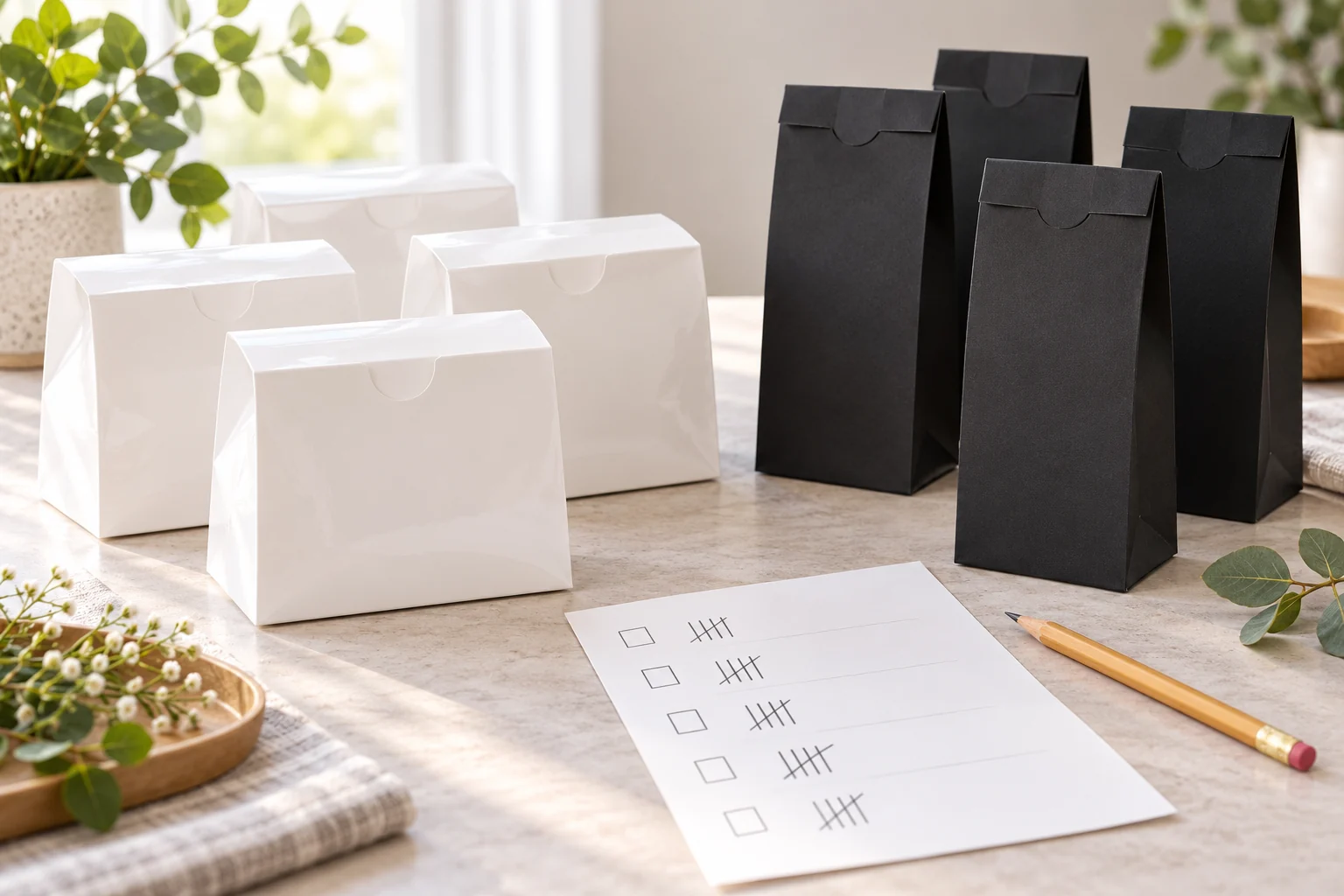
For a whole event, order candle gift bags against a count you can explain. Start with the number of favors you expect to hand out, add a spare allowance you chose deliberately, and compare the result with the seller's case quantity. Settle the boxed candle’s fit before doing case arithmetic; a product photo cannot establish clearance.
This guide uses two current gift-bag offers to show the calculation. One is listed as a case of 36 and the other as a case of 48. Their dimensions and shapes differ. The example does not treat those bags as interchangeable for a particular candle or promise that a listed dimension is usable interior space. The math only answers how many whole cases would supply a stated number of bags once you know which bag fits.
Write down the actual handoff count
Count the recipients or places where a gift will be handed over. Do not start with the number of seats if some people share a gift, and do not start with the number of invitations if not every guest will receive one. Mark each planned handoff on a short list so you can audit the count later. If the event has several groups, keep their counts separate until you have checked whether every group will receive the same bag.
Then choose a spare allowance. It might cover a bag torn during packing, a late addition, or a favor you want to set aside. The allowance is your planning decision, not a percentage supplied by either product page. Write its number beside the handoff count. If you cannot explain why you added it, consider whether you need it at all. That keeps an ordinary contingency from silently becoming an inflated order.
For a worked example, suppose you plan 40 candle favors and decide to hold four bags as spares. Your bag requirement is 40 + 4 = 44. That is a hypothetical event count, not a claim that either seller offers a 44-piece package. Keep the 44 on the page while you inspect the actual case quantities; changing the requirement to make a package look convenient hides the difference between need and supply.
If the guest list is still changing, mark the count as provisional and record the date you checked it. You can prepare the arithmetic now, but delay the final order decision until the number is firm enough for your event. An estimate is useful for planning, while an unmarked estimate can be mistaken for a confirmed handoff count. When a person is added or removed, change the handoff count first, keep or revise the spare allowance deliberately, and then redo the case calculation. That sequence makes it clear whether the order changed because the event changed or because you chose a different margin.
Read the case quantity on the exact offer
The Large Alexa White Gift Bag is presented as a case of 36. Its native description gives dimensions of 7 by 6 by 2 inches and calls it a one-piece fold-and-tuck construction. The gallery shows a white bag-shaped gift package with a ribbon. That is a useful candidate if its actual package and closure suit your boxed item; this guide does not infer interior clearance from the listed outside dimensions.
The Small Black Deluxe Candle Gift Bag is presented as a case of 48. Its description lists dimensions of 3.3 by 3.5 by 7.5 inches and a matte black color option. The gallery shows a taller, narrower dark gift package. The different shape matters when choosing a bag, but the arithmetic that follows uses only the stated case quantity. Check the current selected offer at checkout, since listings can change.
Read “case of 36” or “case of 48” as a count of the offered bags, then check the seller's current product page for any variant, minimum order, or package detail that affects what will arrive. The captured descriptions establish the quantities used here. They do not establish stock, shipping time, price, protective strength, or a guaranteed number of usable bags after handling. Keep those questions separate from the simple count.
Divide and round up whole cases
For one bag style, divide your requirement by the number of bags in a case. If the result is not a whole number, round up to the next whole case; you cannot order a fraction of a sealed case under this calculation. For the 44-bag example, 44 divided by 36 is more than one, so one case of 36 is short by eight bags. Two such cases would supply 72 bags.
Using the other offer's case quantity, 44 divided by 48 is less than one. One case of 48 would meet the 44-bag requirement and leave four bags beyond the chosen spares. Those statements compare quantities only. They do not say that the smaller black bag is the better purchase for your candle or that it costs less. If the boxed item does not fit that model, its favorable case count has no practical value.
Write the arithmetic as a small line for each acceptable bag style: required bags, case size, whole cases, supplied bags, and bags left after the requirement. For the 36-count offer, the line reads 44, 36, 2, 72, 28. For the 48-count offer, it reads 44, 48, 1, 48, 4. The last number is surplus beyond the 44-bag plan, which already includes four spares.
If your result is exactly divisible by a case size, no rounding is needed. If you need 36 bags and have accepted the 36-count model, one case supplies the number. If you need 37, one case is short and a second case is required by this whole-case method. Use the same rule for any current case count, but do not reuse these example numbers if the seller changes the offer or you change the number of favors.
Keep fit and count as separate checks
Before you treat the case result as an order, check the dimensions and the actual candle packaging. The two native bags have different proportions: one is wider and shallower, while the other is narrower and taller by their listed figures. A candle in a jar, box, or protective sleeve may need different clearance. The product pages do not provide a measured internal opening, so do not certify fit from these three numbers alone.
The gift bag fit guide handles the separate question of opening clearance, body shape and incomplete listing dimensions for a boxed gift. Use that check if the item catches at the opening or cannot sit where you expected. Once you have a bag that actually suits the item, return to the case count. This tutorial does not repeat its fit diagnosis or promise that one of the two current examples will work.
Also decide whether every favor uses the same bag. If the favors differ in size, make a separate requirement for each bag style and run the division twice. Do not add the case counts together until you have written down which recipients belong to which style. A common error is counting all recipients in one total, choosing two different bags, then using that full total for both orders. A simple style-by-style tally prevents that double count.
The Christmas gift bag size guide sorts different gift shapes among handled bags and drawstring pouches. Its packing-station decision is useful when the gifts are varied and the bag type itself is unsettled. Here the narrower task is to count cases for a chosen candle bag. Keep the selection of bag type and the arithmetic in separate columns so one does not stand in for the other.
Check a mixed order without losing track
You might use both styles for different groups. Suppose 20 favors are intended for one bag and 20 for another, and you assign two spares to each group. Each group's requirement is 22. One 36-count case can supply the first group; one 48-count case can supply the second. This is a different plan from ordering 44 of each bag. It depends on two distinct groups and on each bag passing its own fit check.
Label the two lines by product identity, not simply “large” and “small.” Seller pages can change names or show several variants. Write the exact model or product URL beside the count and save the selected option if the storefront offers one. A product image can help you recognize the style, but it should not replace the current product title, case count, or dimensions when you place the order.
If a group changes after you calculated, update that group's required number and redo only its line. For example, adding three recipients to the 20-person group with two spares changes its requirement from 22 to 25. It may still fit within one case of 36, but you must verify that against the chosen current case quantity. Keeping the arithmetic visible makes the change easy to check without relying on memory.
Reconcile the count when the bags arrive
Before a packing day, compare the received order with the product identity and case count you recorded. Count the cases, and if practical count the bags or verify the seller's packing information. Put any damaged or unusable bags aside and update the available count. A stated case quantity is a planning input; the number ready for handoff is what you actually have after receipt and inspection.
Use the same two numbers you began with: planned handoffs and chosen spares. If the available count has fallen below their sum, resolve that shortage before assuming you can complete every favor. You may reduce an optional spare allowance, order more of the verified bag, or change the event plan. The arithmetic shows the shortfall. Choose the response that suits your event.
Keep a note of the selected bag, its current case quantity, the number of cases ordered, and the number received. That note helps another person continue the work if they take over favor preparation. It also prevents an accidental second order based on an older count. If you later use leftover bags for another event, start a new requirement and subtract only the bags you actually have, not the surplus that the earlier calculation predicted.
A quick check before placing the order
Confirm the bag style and real fit first. Write the handoff count, add a stated spare number, divide by the exact current case size, and round up to whole cases. Check the resulting supplied count against the requirement. For the hypothetical 44-bag requirement, the 36-count offer requires two cases and the 48-count offer requires one, provided the chosen bag is otherwise suitable. Verify the seller's present listing and receipt before relying on either result.