Musical Instruments & Listening
Repair a cabasa session timetable with a copied duration
An original fictional forty-minute schedule demonstrates a copied duration, rebuilt boundaries and a separate late-start branch.
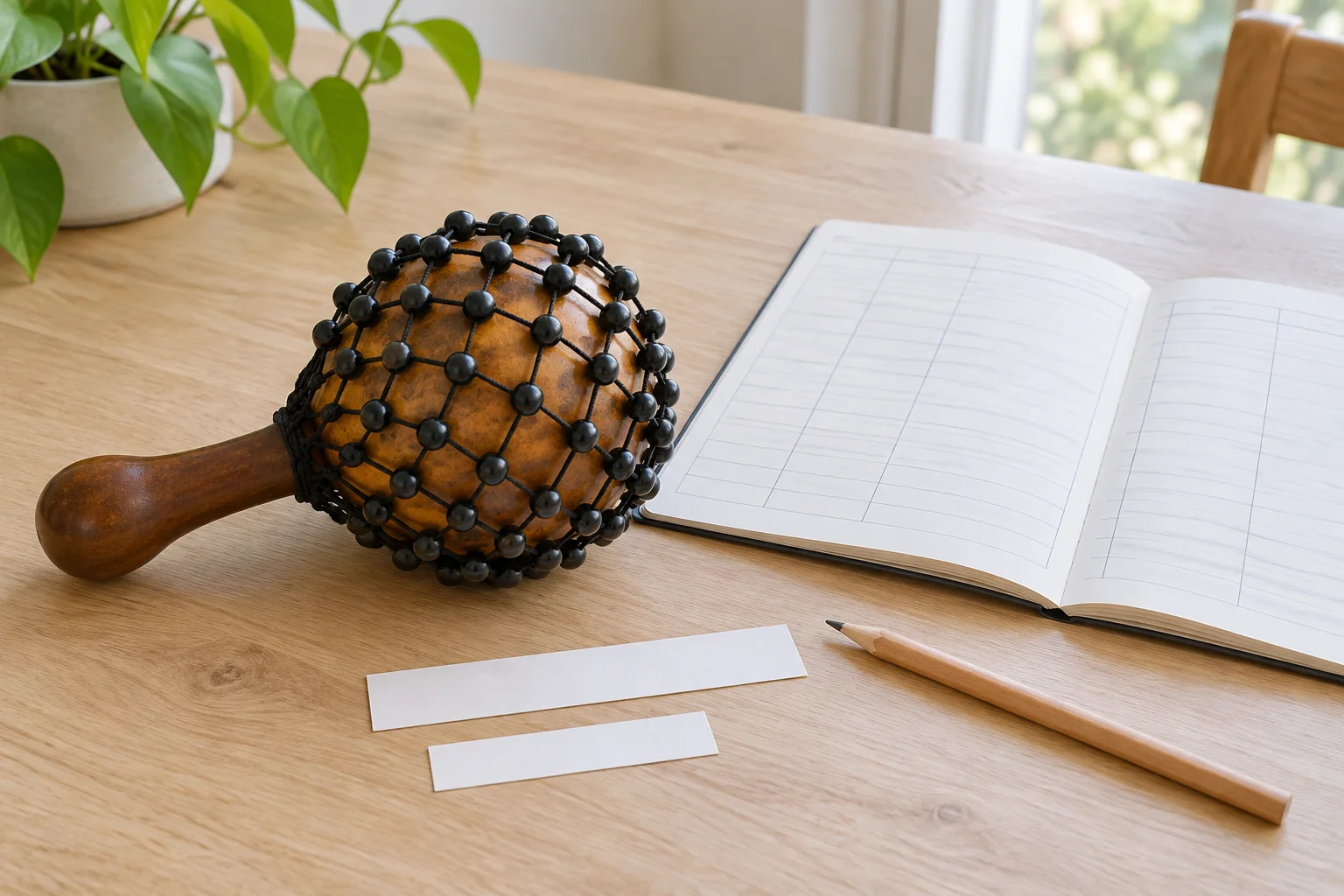
A cabasa session timetable can contain an error even when every activity name looks familiar. This original paper exercise begins with a fictional forty-minute session and a copied duration that makes its draft five minutes too long. The task is to compare the draft with its stated brief, repair the mismatched interval, and check the resulting finish. It is a timetable-editing example, with invented numbers supplied below. It gives no playing sequence, recommended practice duration or instructions for repairing an instrument.
Imagine a coordinator named Mira preparing a sheet for a discussion about an instrument. Mira's brief assigns five minutes to the welcome, twelve to discussion A, five to a break, twelve to discussion B and six to closing. The session starts at minute zero and must finish at minute forty. All five intervals follow one another without overlap in this invented model. The two discussion labels identify schedule blocks only. Nothing in the exercise prescribes what participants do with equipment during either block.
Find the copied interval before changing the plan
Mira's draft instead gives discussion B seventeen minutes. Its listed durations are therefore five, twelve, five, seventeen and six. Adding them gives forty-five minutes: five plus twelve is seventeen, plus five is twenty-two, plus seventeen is thirty-nine, plus six is forty-five. The copied interval is the fourth duration. The draft has no extra activity name to make that difference obvious. Reading only the list of block names would leave the disagreement between the draft and the brief unexamined.
Put the brief and draft beside each other. Welcome matches at five, discussion A matches at twelve, and break matches at five. Discussion B differs: the brief says twelve while the draft says seventeen. Closing matches at six. This comparison identifies one specific mismatch under the supplied premises. It does not establish that seventeen minutes would be a bad duration in a real gathering. In this example, it is wrong because it differs from Mira's expressly stated brief, whose other requirements remain in force.
Preserve the first draft while preparing a corrected copy
Keep the forty-five-minute draft as the version being checked. On a separate copy, replace only discussion B's seventeen with the brief's twelve. The corrected durations are five, twelve, five, twelve and six. Their sum is forty. Naming the changed row matters: shortening the welcome by five would also reduce the numerical total to forty, but it would leave the discussion B mismatch and create a new welcome mismatch. A matching total alone would not demonstrate that this particular brief had been followed.
For an explicit comparison, suppose a second editor offers five, twelve, zero, seventeen and six. That list also sums to forty. However, its break is zero instead of five and its discussion B is still seventeen instead of twelve. Under Mira's given brief it contains two mismatched rows. Keep the question precise when assessing this alternative. “Does it total forty?” and “Does each duration match the supplied brief?” are two checks with different answers for this proposed replacement. Neither question needs an acoustic or equipment claim.
Rebuild the boundaries from the corrected durations
Starting at zero, welcome ends at five. Discussion A then runs from five to seventeen. Break runs from seventeen to twenty-two. Discussion B runs from twenty-two to thirty-four, and closing runs from thirty-four to forty. Each end becomes the next start because the model explicitly says the blocks are consecutive. The intervals describe elapsed minutes from an invented starting point, rather than actual clock times or a measured rehearsal. You can verify every boundary by adding its block's assigned duration to its recorded start.
Now compare the faulty boundaries. With seventeen minutes assigned to discussion B, that block runs from twenty-two to thirty-nine and closing runs from thirty-nine to forty-five. The first three boundaries stay the same because the earlier durations did not change. Copying thirty-nine into the corrected closing row would preserve a number from the faulty version after its cause had been removed. Rebuild the affected later boundary from thirty-four rather than keeping it merely because it was already printed on the draft sheet.
Keep remaining minutes attached to a particular boundary
The remaining minutes at minute twenty-two are forty minus twenty-two, which is eighteen. In the corrected plan, discussion B takes twelve of those minutes and closing takes six. Twelve plus six equals eighteen. In the faulty plan, seventeen plus six requires twenty-three minutes after that same boundary. It exceeds the eighteen available by five. Stating the boundary beside the remainder prevents the eighteen from drifting into another part of the sheet where a different amount of the session has already elapsed.
At minute thirty-four in the corrected plan, six minutes remain. At minute seventeen, twenty-three remain. These are different answers to questions asked at different boundaries, not competing totals for the same moment. If Mira writes “six remaining” alongside the start of discussion B at twenty-two, the annotation disagrees with the corrected schedule even though six appears legitimately elsewhere. Compare each annotation with its own boundary. This is another copying check within our invented sheet, rather than a claim about how quickly a group will complete a real discussion.
Separate a late start from the original copying error
Consider a new branch in which the session begins three minutes after the original zero point but still must end at the original minute forty. The available interval is now thirty-seven minutes. Keeping all five corrected durations would end at original minute forty-three. The earlier copying repair is still valid: discussion B remains twelve under its brief. The new shortage comes from the changed start, so silently restoring seventeen or repeating the old correction would not answer this different set of stated conditions.
For this branch, add one new permission to the imagined brief: closing may be shortened from six minutes to three, and the other four durations remain fixed. The revised sum is five plus twelve plus five plus twelve plus three, or thirty-seven. Beginning at original minute three, the successive ends are eight, twenty, twenty-five, thirty-seven and forty. This is a deliberately supplied permission in a fictional scenario. It is not permission to shorten a real break, training requirement or activity that has its own actual constraints.
Check what the new permission actually changes
The late-start branch changes closing only, from six to three. It also changes every absolute start and end because the beginning moved to original minute three. Discussion A still lasts twelve even though its end is now twenty rather than seventeen. Keep duration and boundary in separate columns if you choose to draw the sheet. The column names are a presentation choice for this exercise; the arithmetic comes from the explicitly stated start, durations, consecutive arrangement and final deadline, regardless of the stationery used.
If the new permission is absent, retain the three-minute shortage as unresolved under those fixed requirements. A neat-looking sheet cannot establish authority to remove time from a block. In Mira's fictional example, write that the unchanged forty-minute duration total exceeds the newly available thirty-seven minutes. That statement identifies the conflict without pretending to settle it. Another stipulated branch could move the deadline instead, but its forty-three-minute endpoint would belong to that new branch and would not satisfy the original deadline of forty.
Keep actual instrument references outside the arithmetic
The LP LP480 Traditional Cabasa listing identifies that instrument, and its photograph shows a handled rounded body surrounded by a bead net. The MEINL Fiberglass Cabasa listing names its separate item; five photographs show a handled rounded form with an attached bead net and end cord. These are complete instrument references, without separately supplied stationery or a demonstrated sound result. Neither listing supplies Mira's invented durations. The calculation needs only the brief and the deliberately faulty draft printed in this exercise.
The handbell story guide proposes a shared invented scene with optional contributions and listening. Its social choices establish no duration for either discussion block here. The familiar sheet music afternoon guide discusses choosing a known piece and a stopping point, alongside actual stand requirements. Our fixed numeric brief is an invented checking exercise, rather than a recommended way to time that afternoon. Read those activities in their own contexts instead of treating the forty-minute example as a rule that their participants must follow.
Keep a possible purchase with its own questions
If preparing a real session leads you to investigate an instrument order, put the exact item reference in a separate purchasing note. Mira's corrected arithmetic establishes no specification, availability or package content for either offer. Someone interested in asking republeq.com about crypto such as USDT can include that preference in the enquiry. Ask which payment methods are actually offered for the proposed order and examine the instructions associated with the chosen method before deciding whether to proceed. This article confirms no particular token or network and provides no transfer instructions. Keep unanswered product questions visible alongside the payment enquiry, so a response about one does not silently settle the other. Check the delivery information and return terms applicable to the item being considered, and retain any written clarification that affects your decision. The deadline on a fictional schedule creates no arrival commitment for an actual purchase. If another person will place the order, share the original listing reference and the seller's actual replies with them. A shortened recollection can leave out the unresolved question they need to see. You can also leave the buying discussion open while continuing the paper exercise; no instrument is needed to add its durations. If an order is later confirmed, keep its acknowledgement and associated correspondence together. They concern a proposed or completed transaction, while the three schedule versions concern invented premises. Neither a correct sum nor a preferred payment method establishes what an order contains, when it will arrive, which method will be accepted or how an instrument should be used.
Leave the corrected version beside its stated brief
Mira can now retain three clearly identified sheets: the original forty-five-minute draft, the corrected forty-minute plan, and the separate late-start branch with its added closing permission. The first repair replaces one copied duration and rebuilds its affected boundaries. The later branch responds to different premises. Keep those premises with their respective answers. If someone checks the sheets again, they can compare each interval, total and boundary with the conditions that actually produced it, without guessing which version a number came from.
For a final copying comparison, imagine that Mira receives only a sheet ending at forty, with no listed durations. That endpoint does not reveal which of the two forty-minute duration lists was used. It could be the corrected list, or the alternative that removed the break and retained seventeen for discussion B. Ask for the rows when checking this fictional requirement. Conversely, a list of matching durations does not establish that copied boundary labels are right; the earlier thirty-nine label could still remain in the margin. Retaining both kinds of information lets another reader check both questions. The example's correction is complete only when its row durations and its rebuilt boundaries agree with the chosen version's own supplied conditions, rather than with an unrelated sheet that happens to display the same final number.