Crypto Commerce
Ca'Lefort CLF-WD428-23US wine cooler or Lanbo LW133DD for a large collection
Compare Ca'Lefort CLF-WD428-23US wine cooler by bottle layout, shelves, temperature zones, dimensions, door access, lighting, delivery, and warranty claims.
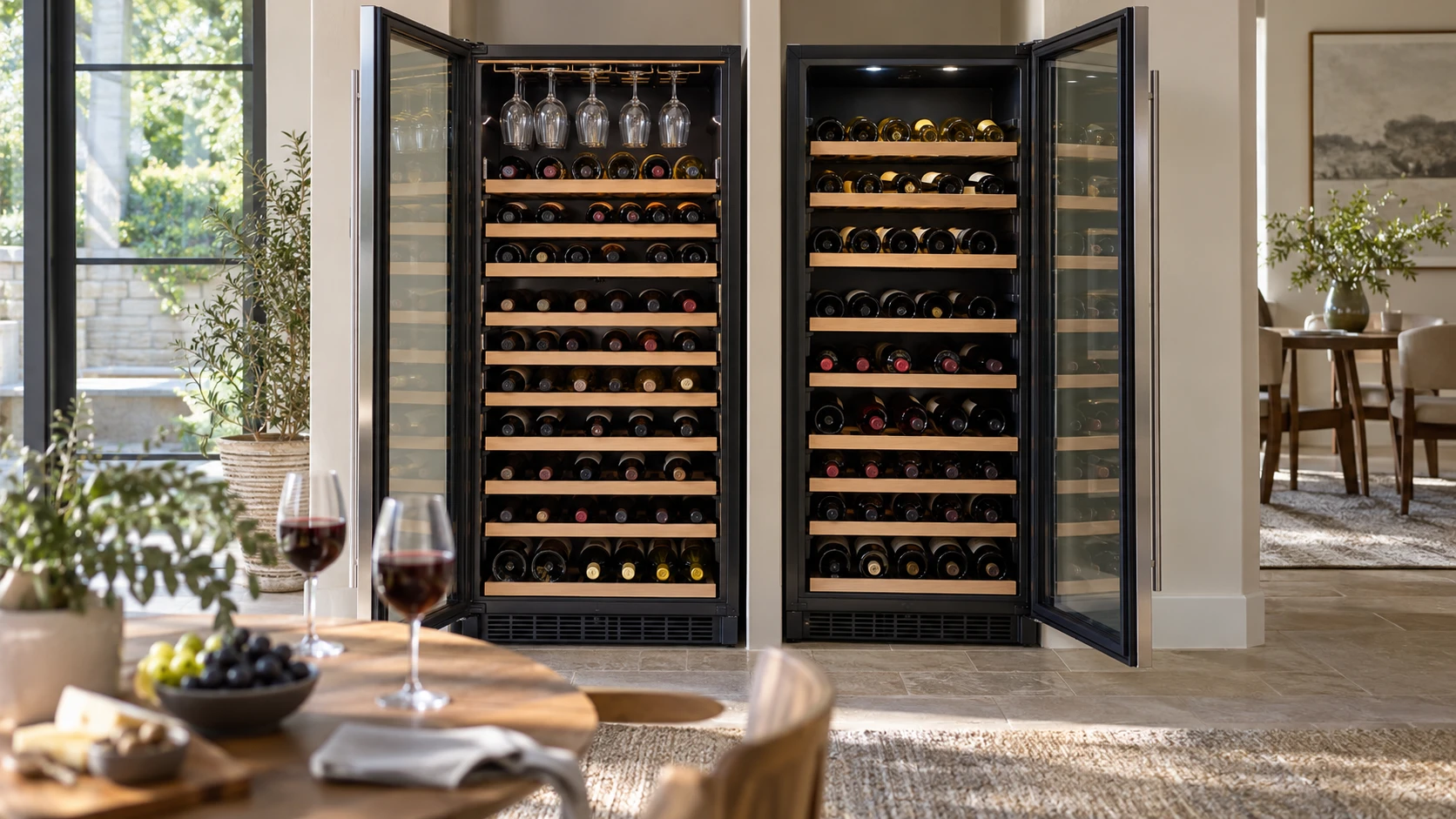
The Ca'Lefort CLF-WD428-23US wine cooler is listed for up to 155 standard bottles on thirteen pull-out wooden shelves and a hanging glass basket. A published guide on wine refrigerator bottle-fit checks covers other cabinets but raises the right question here: how many bottles can be loaded and reached in the actual collection? The Lanbo LW133DD wine cooler is listed for 130 bottles on eleven sliding beech-wood shelves. Both are described as 24-inch-wide, dual-zone cabinets for built-in or freestanding placement.
At this scale, a headline difference of twenty-five bottles may be smaller than it first looks. Ca'Lefort's count assumes standard bottles, and Lanbo tells buyers to remove one or two shelves for larger ones. A collector with broad sparkling bottles or unusual formats needs a shelf plan before treating either maximum as usable space. Delivery and installation also matter more for a tall, heavy cooler. Check the path from the entrance to the final location before choosing by bottle count alone.
Sketch the collection across the shelves — Lanbo LW133DD wine cooler
Ca'Lefort describes thirteen pull-out solid-wood shelves, including one display shelf, plus a glass hanging basket. Its saved row says the shelf spacing is 92 millimeters and mentions bottles from 750 milliliters to three liters. It does not explain exactly how many of the largest bottles fit in that arrangement. Ask for the loading diagram for this model and find out what the display shelf and basket are intended to hold. A special shelf can make selected bottles easier to show, but it may not pack the same way as the standard shelves.
Lanbo lists eleven sliding beech-wood shelves and says one or two may have to come out for large bottles. Its 130-bottle claim therefore needs recalculation for a collection with wide or tall formats. Ask how many standard positions each shelf provides and what remains after one is removed. Check whether the bottle at the rear can be taken out while the front row is still loaded. Sliding access helps only when the door opens wide enough for the shelf to move freely.
Make a list of the current collection by bottle shape and intended use. Separate the bottles opened frequently from those that will remain for months. Place the widest bottle on each proposed shelf first, then fill the remaining spaces with standard bottles on the diagram. Check the clearance above shoulders and around labels. Leave some positions free for future purchases. The working capacity is the count that can be stored and retrieved without making every selection a rearrangement.
The shelves also affect inventory. Ca'Lefort's display position may suit a small group of bottles that need to be seen quickly. Lanbo's eleven tiers may be simpler to label, though fewer tiers do not establish easier access without a loaded demonstration. If the cabinet sits in a busy room, a written shelf map can reduce door-open time. That habit becomes useful long before a collection reaches either model's stated maximum.
Assign bottles to two temperature zones — Lanbo LW133DD wine cooler
Ca'Lefort's row describes independent evaporators controlling two zones and gives ranges of 5 to 18 degrees Celsius and 40 to 65 degrees Fahrenheit. It states temperature precision of plus or minus two degrees Celsius. Confirm the range available in each specific compartment and how the control panel displays it. A broad overall range does not tell the buyer how many bottles fit in the cooler or warmer section. Draw zone boundaries on the shelf plan before deciding where each wine will go.
Lanbo says its two zones are independently controlled, each adjustable from 41 to 64 degrees Fahrenheit. Its digital controls can display Celsius or Fahrenheit. That detail makes the stated range easier to interpret, but it does not show loaded temperature variation across the shelves. Check the manual for the position of the zone divider and whether a shelf can be moved between the sections. If one type of wine dominates the collection, make sure its zone has enough usable positions.
Both descriptions mention compressor cooling, fans or air circulation, and a charcoal filter. Ca'Lefort also lists automatic defrosting, an inverter compressor, and R600a refrigerant. The saved rows do not include matched tests of temperature stability, noise, humidity, or recovery after a door is held open. Use an independent thermometer after the delivered cabinet has settled and again after it is filled. Record a stable reading in each zone so a later change can be recognized.
Ca'Lefort's row mentions floating racks and compressor shock absorption intended to protect bottles. Lanbo's beech-wood shelves and cooling system are described without a comparable vibration measurement. Do not infer that one system disturbs sediment less from those descriptions alone. If the cooler will be in a quiet room, listen during a cooling cycle after installation and check for loose bottles or shelves. A small rattle can come from the contents even when the compressor operates normally.
Resolve the dimensions before ordering — Lanbo LW133DD wine cooler
Lanbo's saved row gives two depths for the same 23.4-inch-wide, 64-inch-high cabinet: one dimension line says 26.8 inches deep, while another says 28.4 inches. It also lists a weight of 200.6 pounds. The 1.6-inch depth discrepancy must be resolved with the current manufacturer drawing before a fitted opening is planned. Ask whether either measurement includes the handle, hinge, or rear projection. The carton may be larger still, so measure doorway turns and stairs as well as the final wall.
Ca'Lefort calls its cooler 24 inches wide and suitable for built-in or freestanding placement, but the saved excerpt does not provide a complete exterior height, depth, or weight set. Obtain the exact drawing and packaged dimensions. Thirteen shelves and a tall bottle count do not establish that the cabinet fits a planned niche. Include space to open the door, reach the outlet, and pull the cooler forward for maintenance. Check the current ventilation requirements for the chosen installation.
Ca'Lefort says a hidden hinge lets its one-piece stainless-steel door frame sit flush with cabinetry. Lanbo lists front ventilation and two separate tempered-glass doors with locks. Those features could change how each cabinet sits beside a wall or adjacent appliance. Make a full-size door-swing template after getting the drawings. Check the handle and open doors against nearby drawers and walkways. A flush face does not guarantee a sliding shelf can be used when a wall limits the door angle.
Delivery is a practical distinction. Ca'Lefort says its cooler ships in wooden pallet packaging, which may require an agreed unloading method and a route wide enough for the packed unit. Lanbo gives a product weight but no matched packaging description in the saved row. Confirm with Republeq who brings the cooler inside, handles the pallet or carton, and places the appliance. Confirm that the floor and stairs can support the move with the delivery service before scheduling it.
Inspect the cabinet on arrival. Check the glass, hinges, shelf runners, locks, lighting, and control panel before the delivery crew leaves if the service allows it. Keep the packaging until the condition and model identity are confirmed under the terms in Republeq's offer. After placement, follow the maker's setup instructions before switching it on and loading the collection. A tall cabinet can be difficult to move again once it is surrounded by furniture or trim.
Compare door, light, and service details — Lanbo LW133DD wine cooler
Ca'Lefort lists a fingerprint-resistant brushed stainless-steel frame, three lighting colors, and a Smart Mode that turns the light on when the door opens and off when it closes. It also names door-open and over-temperature alarms. Lanbo lists separate locked tempered-glass doors, LED lighting, a fan, and a charcoal filter. If the cabinet is in a shared room, decide whether separate locks are useful. Ask how each light and alarm is controlled in the delivered model.
A door-open alert may help in a household where many people use the cooler. It still cannot undo a period when the door was left ajar. Keep a thermometer in each zone and check it after an alarm or a power interruption. Ca'Lefort's saved row does not give a comparable independent test of its alert accuracy; Lanbo's excerpt does not list a similar alarm. Look at the current manuals for the exact behaviors and any notification settings before relying on either feature.
Ca'Lefort's listing says the unit is Energy Star certified and suitable for multiple U.S. climate zones. It also states a thirty-day return policy, one-year whole-unit warranty, three-year wearable-parts replacement, and five-year compressor warranty. The saved Lanbo row does not give matched energy or warranty terms. Verify the current documents for both SKUs, including parts, labor, and damage on delivery. Keep the model and serial number with the receipt so a later service request is specific.
Cleaning a large collection takes planning. Follow each manual for removing shelves and maintaining the charcoal filter. Keep the gasket clear of bottle necks and wipe spills before they reach lower shelves. Check the door seal after a large loading session and update the inventory when a shelf is moved. Those routines protect the usability of the layout chosen at installation.
Choose by working capacity and fit — wine refrigerator bottle-fit checks
Ca'Lefort offers the higher 155-bottle standard count, more shelves, a display position, and stated alarms and warranty terms. Lanbo offers 130 bottles, two independently controlled ranges stated for each zone, separate locked doors, and a listed weight. Its conflicting depth figures need a current drawing. Ca'Lefort's missing full exterior dimensions and the actual capacity with larger bottles also need resolution before either model is fitted into a room.
Ask for current shelf diagrams and installation manuals, then place the real bottle mix and zone assignments on each plan. Measure the door swing and the delivery path using confirmed dimensions. After installation, verify both zone temperatures under a normal load and keep the shelf inventory.