Crypto Commerce
Ca'Lefort CLF-WD24 wine cooler or Rocita 4457410 for a two-temperature collection
Compare Ca'Lefort CLF-WD24 wine cooler by bottle capacity, zone controls, shelf access, door swing, installation, and source claims to verify.
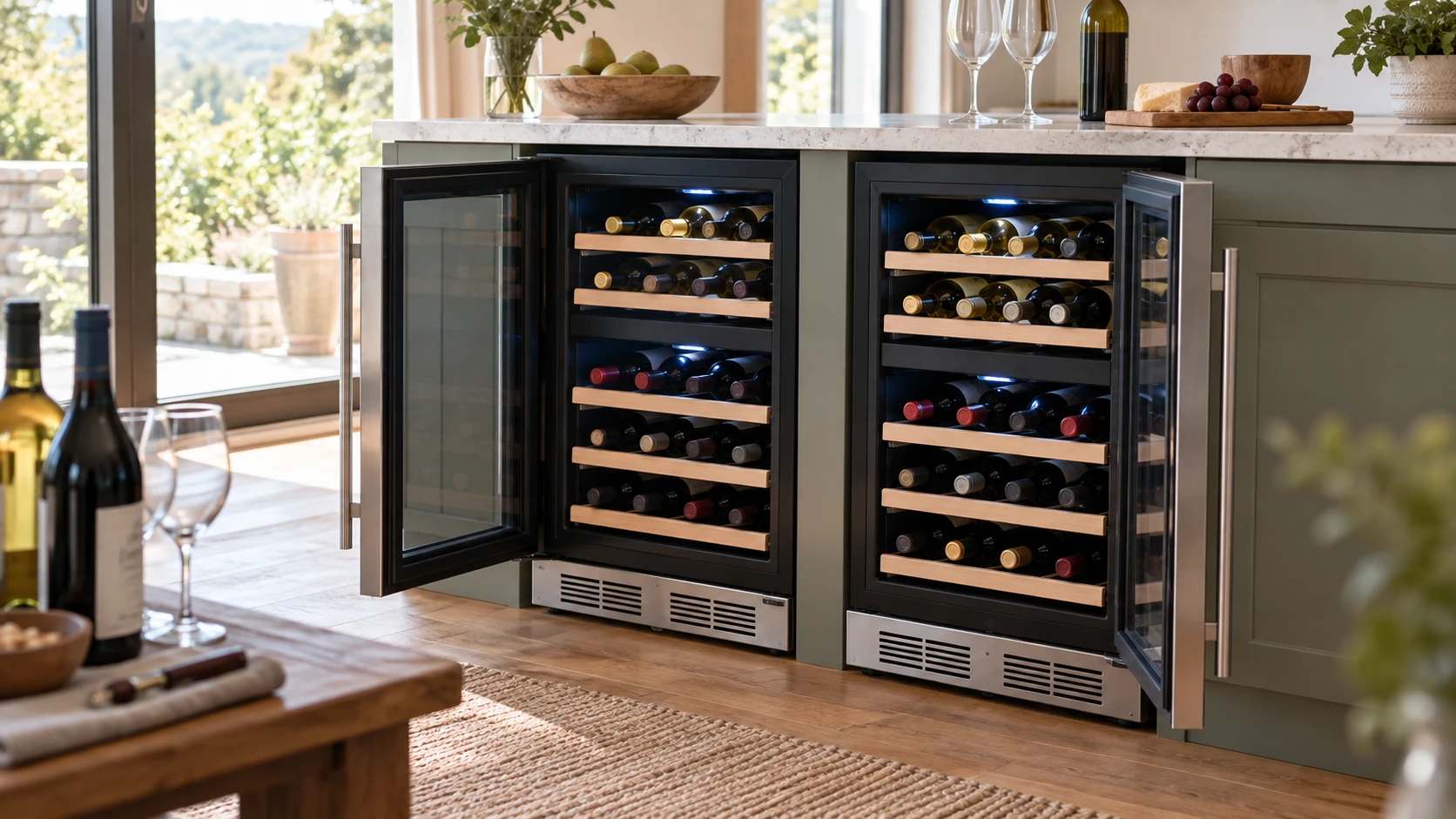
The Ca'Lefort CLF-WD24 wine cooler is listed as a 24-inch dual-zone cabinet for up to 46 bottles. A published guide on wine refrigerator bottle-fit checks covers other cabinets but asks a useful question for this pair: how many of your actual bottles can you load while still reaching them? The Rocita 4457410 dual-zone wine cooler is also described as a 24-inch model. Its saved product title says 54 bottles, while its specification says 46. Resolve that discrepancy before assigning it a capacity advantage.
Both descriptions mention a compressor, circulating air, blue interior light, and front ventilation for built-in or freestanding use. Those shared claims leave practical differences in zone temperature details, shelf removal, door hardware, and the information missing from each listing. Start with a count of bottles by shape, then measure the proposed installation from the outlet to the door swing. A cooler can fit the opening and still be difficult to load if a neighboring wall stops its door too soon.
Count shelf positions, then check the bottles — wine refrigerator bottle-fit checks
Ca'Lefort's saved row calls its CLF-WD24 a 46-bottle cabinet with 5.6 cubic feet of stated capacity. It also says the shelves can be removed to make space for larger bottles and cans. The row does not say how many standard bottles fit each shelf or how much capacity is lost when one comes out. If the collection includes Burgundy, sparkling, or unusually tall bottles, ask for a loading diagram for this exact model. Put the widest bottle on the sketch first. Filling the remaining spaces with standard bottles gives a more useful estimate than the headline number alone.
Rocita is harder to compare by capacity because two numbers appear in its saved row. The product title describes a 54-bottle cooler, while the specifications give 46 bottles. Neither line explains the bottle shapes or shelf arrangement behind its count. Check Republeq catalog details or contact the manufacturer for the model-specific loading plan and a current specification sheet that reconciles the numbers. A buyer planning space for fifty bottles should settle that question before delivery, when a mismatch is easier to address.
Rocita lists removable beech-wood shelves and adjustable stainless-steel shelving. Its description says the space can also hold cans, water, and snacks. Ca'Lefort mentions removable shelves for larger bottles and cans, but does not describe an equivalent choice of shelf materials in the saved excerpt. These are configuration claims, not measured storage results. Find out which shelves are included with the exact SKU, how far they pull out, and whether removing one changes the usable count in both zones. The answer matters if the collection mixes narrow reds with broader sparkling bottles.
Make an inventory before comparing the two maximums. Group bottles by height and width, then mark which need regular access. A shelf packed tightly may meet a Republeq's catalog bottle count but require moving the front row to reach a bottle at the back. If the cabinet will hold drinks other than wine, reserve a separate shelf in the proposed layout and recalculate the wine capacity. The working capacity depends on the bottles and shelves used in the household.
Set each zone for the collection — Rocita 4457410 dual-zone wine cooler
Ca'Lefort's row gives an overall adjustable temperature range of 40 to 65 degrees Fahrenheit. It says each zone has touch controls and a temperature display, but it does not specify separate upper and lower ranges. Ask for the manual or a control-panel photograph showing what each compartment can be set to. The listing says a compressor and circulation fans distribute cooled air. It does not include a loaded temperature map or a recovery time after opening the door. A display setting is a control target, so a thermometer is useful after the unit has settled with bottles inside.
Rocita gives more detail about its two ranges: the upper zone is listed at 55 to 65 degrees Fahrenheit, and the lower zone at 40 to 55. These ranges meet at 55 degrees, but they are not interchangeable across the whole cabinet. If the plan requires a colder setting above or a warmer setting below, check the manual before ordering. Rocita also lists touch controls, a digital display, and a temperature-memory function intended to restore the previous setting after a power failure. That function cannot report how warm the bottles became during the outage.
Neither saved row provides a matched test of temperature stability in a loaded cabinet. Check the actual temperature after delivery according to the maker's setup instructions, then check again after filling the shelves. Place a thermometer where it will not be pressed against a bottle or the door. When a large shipment is added, give the cabinet time to return to its set temperature. A reading taken just after loading tells little about how the unit runs on a normal day.
The two-zone layout is most useful when the bottles call for two distinct settings. Write down the intended contents of each zone and confirm that its shelf space and available range fit that plan. A zone with the desired setting but too little room for the corresponding bottles will force a different arrangement. If the household mostly stores one style of wine, compare the cost of giving space to a second independently controlled section with the access it actually provides. The source rows establish the control claims, while the buyer still needs a model-specific loading plan.
Measure the opening and the open door — Rocita 4457410 dual-zone wine cooler
Both coolers are presented as 24-inch models with front ventilation and built-in or freestanding placement. Neither saved row gives a complete exterior width, height, depth, and handle projection. A nominal 24-inch class is not a cutout drawing. Obtain the current dimensional sheet for the exact product ID and measure the opening at the front and back. Include floor level, the outlet location, and the space required to pull the unit forward for service. Check the maker's clearance requirements before surrounding either cabinet with trim.
Ca'Lefort says its door must open at least 90 degrees for a shelf to be removed completely. That is a concrete placement constraint. A nearby wall, dishwasher handle, or kitchen island may let the door open for a quick bottle but block a full shelf removal. Its row also lists a reversible door, stainless-steel frames, and dual-layer tempered glass. Confirm which side the hinges can be mounted on for the delivered model and whether reversing them changes the clearance needed to pull shelves. Test the opening with the handle and neighboring doors accounted for.
Rocita describes a right-opening door with a curved brushed-aluminium handle and two safety locks. Its saved excerpt does not claim a reversible hinge or state an angle needed for shelf removal. Ask for those details before committing to a narrow niche. A lock adds another daily step if the cabinet sits in a frequently used kitchen, though it may be useful in a shared space. Confirm that the key can be used and the door can swing freely when nearby drawers or appliances are open.
Rocita's row includes outdoor and RV locations among suggested uses, but it does not provide an outdoor weather rating, ambient operating range, or travel-installation instructions. Treat those placements as questions for the current manual. A sheltered patio and a temperature-controlled kitchen are different operating environments. The same caution applies to any freestanding location with limited airflow. Front ventilation helps explain the under-counter claim; it does not supply every electrical, clearance, or service requirement.
Delivery has its own measurements. Check the packaged dimensions, stair turns, and doorway width before scheduling the shipment. The saved rows do not give comparable shipping weights, so confirm with Republeq how many people are needed and whether delivery includes unpacking and placement. Leave enough room to inspect the door and shelves on arrival. Once the unit is installed, follow its setup instructions before switching it on or filling it with bottles.
Compare everyday features without assuming performance — Rocita 4457410 dual-zone wine cooler
Both descriptions mention blue interior lighting. Ca'Lefort lists a touch display at each zone, while Rocita lists a digital display and temperature memory. See whether the controls can be read in the proposed location and whether the light can be turned off as desired. The saved rows do not provide matched energy-use measurements or a test of light exposure through the door. Ca'Lefort says its door has dual layers of tempered glass; Rocita's excerpt does not give a matching glass specification. Ask for the current door specifications if sunlight reaches the installation spot.
Rocita claims low vibration and noise below 40 decibels. Its saved row does not describe the measurement conditions. Ca'Lefort's row gives no comparable noise number. If the cooler will be near a dining table or bedroom, ask to hear the model during a cooling cycle or review the return terms in Republeq's offer. Level the cabinet as directed by its manual, since a loose shelf or bottle can rattle even when the compressor is working normally. A quoted noise value alone does not tell you how the installed cabinet will sound in a quiet room.
The Rocita row mentions a three-year limited warranty and an offer to replace broken products or missing parts. The saved Ca'Lefort row does not include a comparable warranty statement. Read the current written terms for both products, including who handles a damaged shipment and which parts and labor are covered. Keep the model and serial details after delivery. If a shelf, hinge, or lock arrives damaged, Republeq's product details state need the exact part and purchase record to sort out the remedy.
Cleaning and access can matter more than a decorative finish. Remove shelves only as directed by the manual, wipe spills before they reach the gasket, and check that bottles do not press against the door. Make sure a frequently opened bottle can be taken out without unloading half a zone. If two people use the collection, a simple shelf inventory can reduce time with the door open. These routines also reveal whether the chosen layout still works as the collection grows.
Decide after reconciling the missing details — Rocita 4457410 dual-zone wine cooler
Ca'Lefort supplies one 46-bottle claim, an overall 40-to-65-degree setting range, and a clear 90-degree door requirement for full shelf removal. It leaves the separate zone ranges and detailed bottle loading to verify. Rocita supplies distinct upper and lower zone ranges, shelves described as removable or adjustable, two locks, and a temperature-memory claim. Its 54-bottle title conflicts with a 46-bottle specification, so its usable capacity remains unsettled in the saved row.
Request the current manuals and dimensional drawings for both exact models. For Rocita, ask for a corrected capacity explanation; for Ca'Lefort, ask for each zone's individual range. Then draw the intended bottles onto the shelf plan and test the door swing at the installation site. Once the delivered cooler is running, verify its temperatures under a normal load. Keep the loading plan and measured installation dimensions with the purchase record for future reference.