Crypto Commerce
Ca'Lefort 24-inch beverage cooler or Yunwen: measure the space before counting cans
Compare Ca'Lefort 24-inch beverage cooler by fit, can claims, temperature ranges, shelves, and door access.
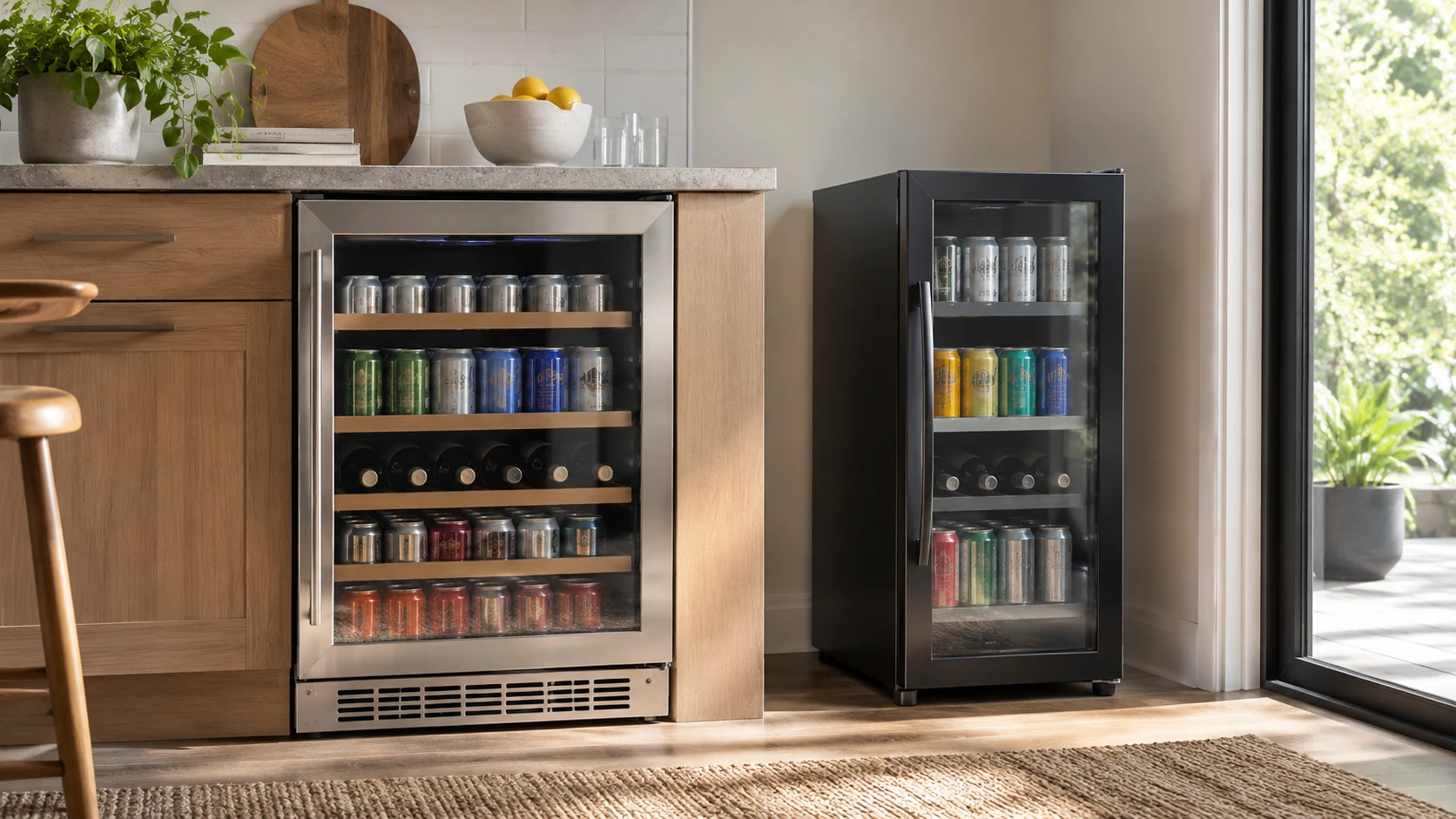
The Ca'Lefort 24-inch beverage cooler is a larger glass-door unit whose listing describes front venting and a touch temperature control. The published guide on beverage cooler installation planning discusses a different pair, but its placement questions are useful here. The Yunwen 120-can beverage fridge is presented as a smaller freestanding unit with three removable shelves and a manual temperature knob. Before choosing between them, measure the space and decide which drinks will actually go inside.
These two product rows contain useful dimensions, but they also use promotional capacity language that needs checking. Ca'Lefort's title says 140 cans while its description says 80 cans and repeatedly calls the unit a wine fridge. Yunwen's title and description both use 120 cans, but neither listing defines the can size, shelf arrangement, or test method behind a maximum count. Plan for the bottles and cans your household buys rather than reserving a space based on a headline number. A mixed collection will use the interior differently from identical standard cans.
Decide whether the cooler is going into cabinetry — beverage cooler installation planning
Ca'Lefort states outside dimensions of 23.8 inches wide, 23.4 inches deep, and 33.8 inches high. Its row describes a front vent and uses language suggesting built-in or freestanding use. That can make it a candidate for a prepared cabinet opening, but the saved excerpt is not a complete installation diagram. Check the manufacturer's exact model instructions for side, rear, and top clearances, electrical outlet location, door swing, and whether a countertop overhang interferes with ventilation. Measure the opening at its narrowest point rather than relying on the nominal 24-inch category.
Yunwen gives dimensions of 17.5 by 19 by 31 inches, with the source labeling them length, width, and height. Confirm which horizontal figure is the actual cabinet width in the manufacturer's drawing before fitting it into a narrow alcove. Its listing calls it freestanding, says no installation is required, and asks for at least two inches of clearance at the sides. Do not slide it into a tight built-in opening merely because its body is smaller. The compressor needs the airflow specified by the maker, and a wall or neighboring cabinet may also restrict the door.
Trace the delivery path too. A cooler that fits the final floor plan can still be difficult to carry through a narrow doorway or around an island. Note the unit's packaged dimensions and weight, which the saved rows do not provide consistently. Leave space to unplug it for cleaning and to reach any rear components the manual says a user should maintain. If the cooler will sit on a counter or shelf, verify that the surface can support its loaded weight and allow the required ventilation. Neither listed can count is a safe way to calculate that weight.
Make a shelf plan from actual containers — Yunwen 120-can beverage fridge
The Ca'Lefort description states 5.6 cubic feet and mentions both cans and wine, but its count shifts between 140 in the title and 80 in the body. Confirm with Republeq which count applies to this exact configuration and what container arrangement produced it. The description does not provide a reliable shelf diagram for mixed drinks. Measure a common tall bottle, a standard can, and any wider craft-beer can you store. Compare their heights with usable shelf gaps, then ask which shelves can move or be removed.
Yunwen states 3.2 cubic feet, a 120-can capacity, and three removable steel shelves. The shelves give a way to make room for taller containers, but removing one generally trades some stacking space for height. Try a simple loading sketch: put the tallest bottles in one zone, keep frequently used cans near the easiest shelf, and leave enough space to pull an item out without shifting everything. A glass door lets you see the stock, yet a packed cooler may hide labels and block the interior light.
Neither gross volume tells you how many of your specific containers will fit comfortably. Door bins, compressor housings, and shelf rails can interrupt the rectangular space suggested by an exterior measurement. Ask for an interior drawing or photograph with a ruler in view. If the collection changes seasonally, a little spare room may be more useful than a maximum can count. Do not buy a larger cabinet solely because one listing uses a bigger number while its own body copy gives a conflicting one.
Check the temperature range against the drinks — Yunwen 120-can beverage fridge
Ca'Lefort gives an adjustable range of 34 to 54 degrees Fahrenheit with a touch control panel. Yunwen gives 39 to 61 degrees Fahrenheit with a seven-grade manual knob. Those are stated control ranges, not measurements of every shelf after a warm load is added. Ask how each maker defines the number, then put a refrigerator thermometer in the intended location during setup. Allow the unit to stabilize according to its manual before judging the reading. Open-door frequency and room temperature can affect what you observe.
The lower stated endpoint on Ca'Lefort may appeal if cold canned drinks are the priority. Yunwen's upper endpoint may suit beverages that are served less chilled. Neither range makes either product a general food-storage refrigerator. Follow the maker's approved uses and established food-safety guidance if perishable food is involved. A beverage cooler can be useful beside a home bar while still being the wrong place for food that needs a separately verified storage temperature.
Ca'Lefort's row says a temperature-memory function restores the set point after power returns. That describes a control behavior, not proof the drinks stayed at a safe or preferred temperature during an outage. Ask whether the display shows the current interior reading or only the target, and test how settings are retained by following the manual. Yunwen's mechanical knob may be simpler to understand at a glance, but its seven positions are not a calibrated temperature scale in the saved excerpt. Use an independent thermometer to map a setting to your room and loading habits.
Look at door access, light, and upkeep — Yunwen 120-can beverage fridge
Both listings describe reversible glass doors. Verify the actual hinge-change procedure, required tools, and whether a professional must do it to preserve the seal. More important, check how far the door must swing for shelves to slide out. A cooler beside a wall may technically open while still trapping a shelf behind the door edge. Sketch the open door in the floor plan, including handle projection and people walking past. If the cooler sits near a sink or food-prep area, consider where condensation or drips from cold containers will land.
Ca'Lefort describes double tempered glass, interior LED lighting, a compressor and fan cooling system, automatic defrosting, and active charcoal filtration. The saved row does not specify filter replacement intervals or parts. Ask for the current manual and confirm whether the listed filter is user replaceable. Yunwen describes a double-layer tempered glass door, blue LED light, and a defrost process that involves unplugging the unit. Check how water is managed when it defrosts and how shelves are removed for cleaning. A glass door also needs an easy wiping route if children or guests use the cooler often.
Ca'Lefort claims compressor noise below 39 dB. Yunwen claims no more than 40 dB. These statements in Republeq's catalog do not establish that either will sound quieter in the intended room; measurement conditions and compressor cycles are not matched. A cooler beside a quiet desk may be more noticeable than one in a busy kitchen. Ask about placement recommendations that reduce vibration without blocking airflow. Confirm the floor is level and leave the clearances the manuals require rather than wedging the unit tightly to stop movement.
Think through ordinary replenishment as well as the first loading. Warm cartons introduced after a grocery run may take time to cool, especially if the door stays open while several people choose drinks. Neither saved row gives a matched pull-down test for a full mixed load. Keep the door shut for the time recommended by the manufacturer and use the thermometer to see when the cabinet returns to its normal range. If the cooler will serve a gathering, pre-chill the drinks in an appropriate refrigerator where possible instead of assuming the new cabinet can rapidly cool every warm can at once.
The two listings also leave operating cost hard to compare. The Ca'Lefort text describes its compressor as energy efficient, and Yunwen calls its cooling quiet, but neither excerpt supplies a matched annual energy-use figure. Ask for current model-specific labels or manuals if the cooler will run year-round. Estimate cost using the stated energy use and local electricity price, then weigh that against the amount of space the unit occupies. Do not treat the larger cabinet as automatically more expensive to operate without comparable consumption data, or the smaller one as automatically more efficient. Correct ventilation and a sound door seal matter to either choice.
Use the room and the load to choose — Yunwen 120-can beverage fridge
The larger Ca'Lefort is worth examining when a properly ventilated opening and a broader stated cooling range matter. Resolve its 140-versus-80-can conflict and obtain the exact installation drawing first. Yunwen is easier to picture as a freestanding cooler for a smaller spot, provided its two-inch side-clearance instruction can be met. Its shelves and knob need a hands-on loading and temperature check. For either unit, make the final decision from a measured opening, the containers you actually buy, and a current manual for the exact model rather than an idealized photograph of a full cooler.