Crypto Commerce
Breville BNV550GBL Vertuo Next — Two one-cup routines with different supplies
Compare Breville BNV550GBL Vertuo Next by cup size, supplies, power, cleanup, and an unresolved Makita voltage label.
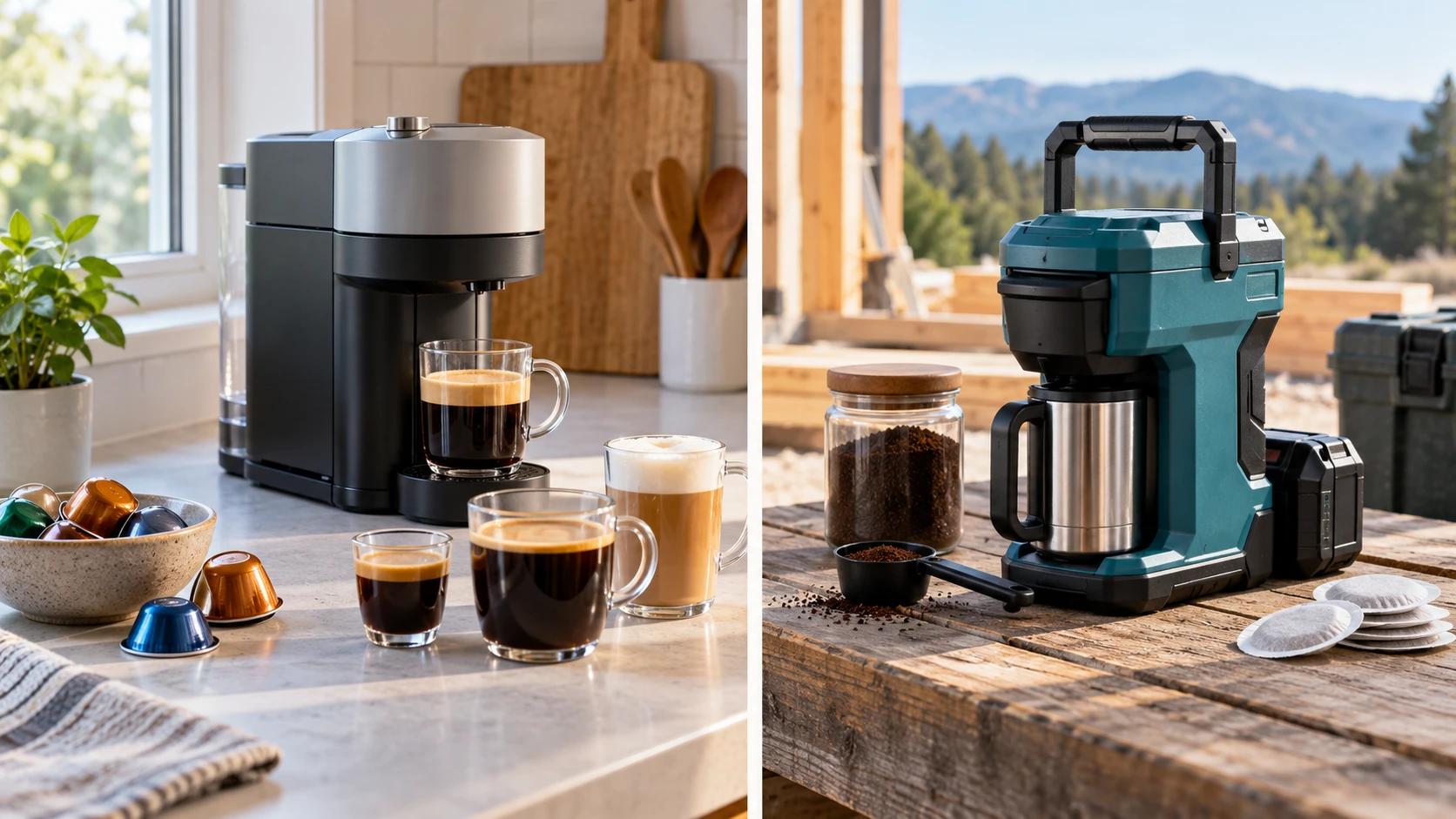
The Breville BNV550GBL Vertuo Next is a countertop capsule machine described with five cup sizes and a one-button brewing routine. Makita's cordless machine uses ground coffee or single-serve packs and lists brewing from an 18V LXT battery, which is not included. They are alternatives for someone who wants a small amount of coffee without making a full carafe, but they depend on different supplies and power arrangements. Decide where the machine will be used and what coffee you want to keep buying before comparing the buttons.
Breville's saved description names Nespresso Vertuo Line capsules, sold separately. It also says a capsule tasting pack is included. Those statements do not establish which flavors or quantities will be available in the package you receive, nor do they mean other capsule formats will fit. Makita's excerpt says its permanent drip filter accepts grounds directly and that it also uses single-serve packs. It does not identify every compatible pack. Check the current manuals and supply specifications for both exact models. The published guide on choosing coffee grounds or pods explores that decision for a different brewer; its product claims should not be transferred to Breville or Makita.
Ask how much coffee you actually drink at one sitting. Breville lists three coffee sizes of 5, 8, and 14 ounces, and two espresso sizes of 1.35 and 2.7 ounces. Makita's source describes a 5-ounce cup. A large travel mug may be easily filled by one Breville setting but would require repeated Makita cycles, if the manual permits them in your situation. Conversely, someone who wants only a small morning serving may not need the larger options. Measure your favorite cup and check its height against the current machine dimensions before assuming it fits under either spout.
The sizes also affect how many servings a group can make without refilling water or preparing more coffee. The saved Breville excerpt calls its tank removable but gives no capacity, while Makita's source gives cups per battery charge under one stated condition but no water-reservoir volume. If two or three people use the machine in succession, ask how much time and handling a full round of drinks takes. A fast single cup may still involve a tank refill, battery swap, or filter cleaning between people. Plan around the busiest morning, not a lone demonstration cup.
Settle the power question first — Makita cordless coffee maker
The Makita listing title includes both "18V LXT" and "12V," while the detailed performance claims describe an 18V LXT battery. The excerpt does not explain how 12V relates to this exact unit. Do not assume a 12V pack is compatible because the title includes that number. Confirm the complete model number, approved battery platform, and compatible charger from Makita's current documentation. The supplied product is described as "bare," and its battery is explicitly not included. If you do not already own the approved battery and charger, include them when calculating the real setup cost.
Makita says a 5.0Ah 18V LXT battery can brew up to three 5-ounce cups on one charge, and that one 5-ounce cup takes five minutes. These are listed conditions, not a guarantee for every battery age, water temperature, or operating environment. Ask whether other approved battery capacities change the practical number of cups and whether the machine shuts down before a brew is complete as battery charge falls. A portable brewer is useful only if the battery plan matches the number of people and the length of time away from charging.
Breville's source lists a 20-second brew time and an automatic shutoff. It does not say whether the timing includes heat-up, cup preparation, or capsule handling. Ask for the current operating sequence and check it under the cup size you would use. Breville is a countertop appliance that needs a suitable outlet and water. The saved excerpt does not provide electrical rating, cord length, or dimensions, so obtain those before assigning it a place in a crowded kitchen. Neither machine should be used through an improvised power arrangement contrary to its manual.
The absence of a wall outlet is the Makita's obvious advantage only when an approved charged battery is ready. That does not mean it is safe in every outdoor, vehicle, or dusty setting. The short description gives no weather rating, maximum ambient temperature, or spill protection. Use it only where Makita's instructions permit, on a stable surface with clean water. For Breville, give the water tank and capsule area enough access for filling and cleaning, rather than fitting the machine so tightly beneath a cabinet that normal maintenance becomes awkward.
Think about what each cup requires — coffee grounds or pods
Breville describes Centrifusion technology and one-button preparation for its listed cup sizes. The source does not explain how the machine identifies a capsule, whether every size is available for every blend, or how taste differs across sizes. Cup volume alone does not tell you how each capsule will brew or taste. Try the capsule type and volume you plan to buy regularly. The listing names an included milk accessory, but confirm the current package contents and learn its separate cleaning steps.
Makita's permanent drip filter removes the need for paper filters according to the listing. Grounds still have to be measured, added, and emptied after brewing. That gives you flexibility to use a coffee you already like, subject to the brewer's grind and dose instructions. A single-serve pack may make cleanup simpler, but only if a compatible format is available where you shop. The saved excerpt does not specify a grinder, included cup, or water reservoir capacity. Verify those details before assuming the portable machine is a complete kit.
The two brewing methods also affect what must be stored. Breville requires space for its capsules and for used capsules awaiting disposal or return through any applicable program. The listing does not establish a recycling arrangement in your location. Makita needs coffee grounds or compatible packs, plus storage for a charged battery and charger. If the brewer travels, plan how to keep water, coffee, and a clean cup together without leaving a wet filter in a bag. This kind of preparation is easy to overlook when comparing only machine size.
Cost comparisons need current prices rather than guesses. Record the price of the exact Breville machine and the capsules you would drink each week. For Makita, include any battery and charger you lack, plus grounds or approved packs. Then calculate cost per cup for a realistic month. The saved catalog descriptions give no current price or subscription policy for coffee supplies, so neither route can be called cheaper from the available evidence. Time spent charging, washing a filter, or buying capsules is also part of the routine, even if it does not appear on a receipt.
Supply availability matters as much as unit price. If the household shops locally, confirm that the exact Vertuo Line capsules or Makita-compatible packs can be bought conveniently, and ask whether the preferred coffee is offered in the size you drink. Grounds provide more freedom to choose a roaster, but they may require grinding equipment and a way to keep opened coffee fresh. The saved sources do not say whether either machine accepts reusable capsules or alternative filters. Treat accessory claims from third parties as separate compatibility questions rather than assumptions about the manufacturer-approved setup.
Check placement, cleaning, and ownership — Makita cordless coffee maker
Makita lists a compact height of 8 and 9/16 inches and cup clearance of 3 and 1/2 inches. Those figures help with a small shelf, but they do not provide total depth, width, or the space needed to add water and grounds. Confirm the exact dimensions with the approved battery attached. A cup taller than the stated clearance may not fit even though the brewer itself is compact. Breville's source gives no dimensions. Measure its footprint, tank removal direction, and opening space from the current manual or a physical display.
Breville's removable tank may make filling easier if it can be lifted clear of nearby cabinets. Ask for its capacity and cleaning instructions; neither appears in the saved excerpt. Makita's permanent filter needs washing after use, but its source gives no dishwasher-safe claim or maintenance schedule. Follow the manufacturers' descaling and cleaning directions for the exact models. Coffee oils and minerals can affect flavor and performance over time, and a quick brew button does not remove those tasks.
Think about who will use the machine. A shared kitchen with several drink preferences may benefit from Breville's range of listed cup sizes and the included milk accessory, provided everyone accepts the capsule system. A person who already owns Makita batteries and drinks one small cup away from an outlet may find the cordless route practical. Neither saved listing gives noise measurements, warranty terms, or repair support. Ask for those before making an expensive purchase or relying on the brewer as the only coffee source in a workplace.
The Makita cordless coffee maker has a clear 5-ounce, battery-powered use case in the description, with a permanent filter and the option of compatible single-serve packs. Its 12V title wording still requires model-specific clarification. Breville offers a broader set of capsule cup sizes at a countertop outlet, with an included milk accessory named in the source. Choose from the actual cups, power supply, and recurring coffee purchase you want to live with. Verify the exact package and manual before relying on either listing's shorter claims.