Home & Living
A borrowed discount code on Lena's purchase list
Lena removes an assumed personal-offer discount from her own purchase estimate after reading an invitation addressed to Nico.
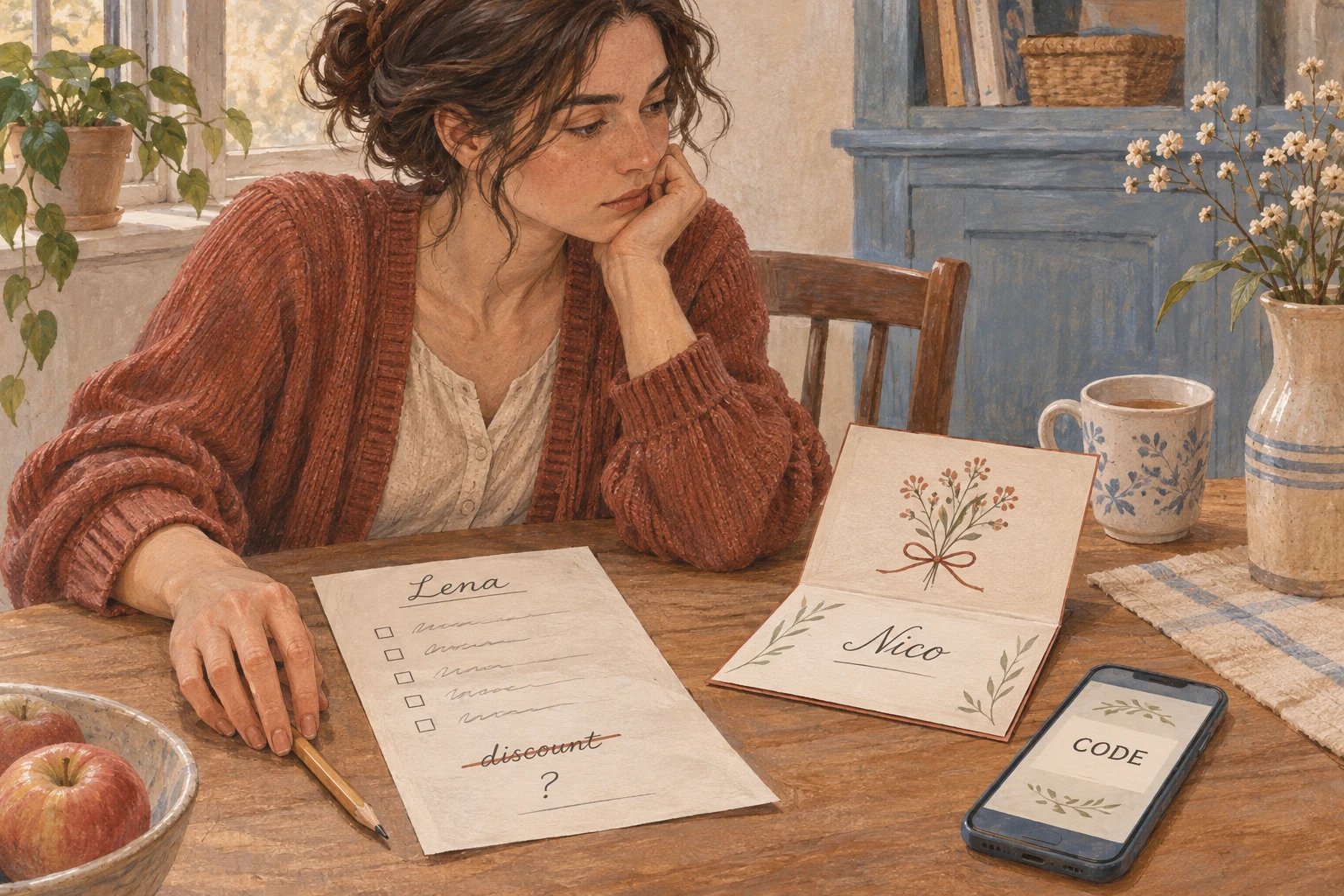
A borrowed discount code sits beside Lena's purchase estimate when Nico sends her the rest of his invitation. In this original fictional shopping story, she discovers that the message names him. Her planned saving loses its place in her own estimate.
The cropped message arrives during an unfinished evening
Lena has a shopping note open beside a half-finished letter. The note concerns an optional purchase she has been considering for a while. She has left the order unfinished. Tonight she wants to decide whether to keep considering it or put it aside until another evening. The letter belongs to a different task, and its unfinished sentence has begun to annoy her.
Her phone lights up. Nico has sent a picture of a promotional email with a code visible near its lower edge. His message says he might use it over the weekend. Lena asks whether he minds her looking at it. He says she can keep the picture. She moves the shopping note above the letter and copies the code into a blank line.
The picture begins halfway through the email. Lena can see the code and a short invitation to place an order. The top of the message, including its greeting, is outside the crop. She treats the reduction described in the picture as part of her own proposed purchase. In the estimate she has been keeping, she writes that the code will reduce what she expects to spend.
At this point the story has given her Nico's picture and his permission to keep it. It has given her no reply from the invented shop. Her estimate has moved ahead of the message she has read. Her assumption is visible in the note, where an expected reduction now sits beside a purchase that still belongs entirely to her.
Nico sends the whole invitation
Nico notices her reply a little later. She has thanked him for helping with her estimate, and he had meant only to show her something he was considering himself. He forwards the complete email so she can see it. In this authored scene, the full invitation opens with his name. A sentence beneath the greeting says the offer is addressed personally to Nico.
Lena lowers the phone until the top edge rests against the table. She reads the greeting again. Nico's name is at the beginning, above the part he originally sent. The next sentence addresses the invitation personally to him. She slides the phone closer to her shopping note, where she can see the reduction she has already written beside her own proposed purchase.
She puts the cropped picture beside the full message. The lower part matches what she saw earlier. The upper part adds the greeting she had missed and the sentence naming Nico. She had copied from a fragment of a message addressed to someone else. She reads the complete email once more, then goes back to the line she added to her note.
Nico sends another message asking whether she wants to see the items he is considering. Lena says she will look later. She wants to finish the small correction in front of her before the conversation moves on. His willingness to forward a message has already happened. The invented shop has still said nothing to her about her proposed order.
The personal offer recipient has a name
Lena starts a reply saying that Nico can give her the code if he has decided against using it. She stops before sending. That sentence would settle the question between the two of them, although the unanswered part of her estimate concerns the shop's invitation. She deletes the draft and asks whether he has received any other message explaining who the invitation covers.
He says this is the only email he has. He has not placed his order, and he has not asked about hers. Lena leaves their exchange there. In this version of the scene, neither character invents an answer for the absent shop. Nico can decide what to do with his own invitation while she keeps the question about her own purchase open.
The personal offer recipient in the full authored message is Nico. Lena's name appears only in their private conversation and in her own shopping note. Her earlier estimate came from a specific part of their exchange. She used the forwarded crop before reading its missing opening.
The phone dims while she looks at the note. She touches the screen to bring the message back and rereads the sentence below the greeting. Then she returns to Nico's conversation and checks his earlier replies. He has sent the picture, agreed she can keep it and forwarded the full email. His latest message leaves him considering his own order over the weekend.
Lena changes the purchase estimate
Lena crosses out the line assigning the reduction to her own purchase. She leaves the rest of the note where it was. The proposed order remains a possibility, and the letter underneath remains unfinished. She adds a short question in the margin asking whether the shop has an offer for her. The question has no answer written beside it.
She then reads the estimate without the assumed reduction. Earlier in the evening she had treated the forwarded code as a reason to complete the purchase. Now the note contains the purchase she was already considering, along with a question she has yet to resolve. She closes the order page while she thinks about whether she wants to return to it later.
The crossed-out line makes the page untidy. She considers copying the whole estimate onto a fresh sheet, then leaves it as it is. The old line explains why her earlier message sounded pleased. Her question in the margin records what she still wants to ask. She can read both versions on the same sheet without trying to remember what she had assumed before the complete email arrived.
Nico asks whether the code worked. Lena tells him she has left her order unfinished. She explains that his full message addressed him, so she removed the reduction from her own note. He says he will tell her what he decides about his purchase. She thanks him for sending the whole email, then moves the shopping note away from her letter.
Finish the conversation without inventing a reply
Nico sends a photograph of his kitchen table, where he has left his own list under a bowl. He jokes that neither of them seems ready to order anything tonight. Lena smiles at the picture. She starts to type that the offer has confused her, then changes the sentence. She tells him she had copied it into her estimate before reading the greeting. That describes what she did without asking him to explain the shop's intentions.
His next message says he had cropped the image because he thought the bottom was the interesting part. He had not noticed what disappeared from the top. Lena scrolls back to the first picture and sees the edge he means. The conversation can settle that small detail between them. She has the complete message now, and the remaining question in her margin can wait until she chooses to ask it.
She sends him a photograph of the half-written letter, keeping the shopping note outside the frame. He recognizes the address at the top and asks whether she has finally found time to answer it. Lena says she has started. Their conversation moves to the letter while the proposed order remains closed. She has made the correction she wanted to make tonight.
Read the same evening from the note on the table
The first version of Lena's note contains an expected reduction. The final version contains a question beside the proposed purchase. Between those two versions, the full invitation arrives and names Nico. The crossed-out line records the change. The shop remains outside their conversation, and the order page stays closed at the end of the selected scene.
Looking back through their conversation, Lena sees the thank-you she sent before the full email. It is the only message where she treats the reduction as settled for her own purchase. Her later reply tells Nico she has left the order unfinished. She keeps both messages in the thread. Nico has already seen the earlier one, and the later exchange explains why she changed her note.
The corner of the shopping note catches beneath her letter as she moves it. She straightens the two pages and notices that she has written more messages to Nico than words in the letter tonight. She reads the letter's opening aloud, quietly enough that only she hears it. The sentence still trails off at the point where her phone first lit up. She picks up the pencil and finishes it.
Keep the actual sleeve references within their evidence
The 10SE03 outer-sleeve account names Square Deal Recordings & Supplies. Its native description claims 500 sleeves, while a gallery label shows 100 and 10SE03. Their pack-level relationship remains unresolved. The pictured albums are staging. Delivered quantity, measured fit and preservation performance are unverified.
The ivory inner-sleeve account names the same brand. Its gallery depicts a 1,000 case, 40 packs of 25 and a retail pack label. The printed code is Ø7IWIV, while the native model field is empty. Delivered count, measured dimensions and archival properties remain unverified. Neither account supplies the fictional invitation.
Leave neighboring budget stories with their own decisions
The shared-box budget story follows the question of who will keep a proposed shared box while an existing caddy is temporarily lent. Its ownership decision belongs to that separate story.
The unspent bookshop allowance story follows an outing where a character leaves part of a self-set spending ceiling unused. Lena instead removes an assumed personal-offer reduction from her own unfinished estimate.
Keep a separate order tied to its actual details
A separate purchase on republeq.com begins with the actual offer and the order being considered. If a checkout presents cryptocurrency as an available payment choice, read that transaction's current information before choosing USDT or another displayed asset. The fictional manuscript above supplies no payment instructions and establishes no transaction. An expression of interest in a product can remain open while its actual details are being checked. Keep the selected offer reference and any questions with the order information so that a later answer can be understood in context. If someone else is helping with the purchase, tell them which decisions have actually been made before they act on your behalf. A remembered preference for one payment method cannot confirm that it appears in the checkout you are using. Read any presented conditions carefully and obtain clarification through the responsible service when an essential detail is unclear. This article provides no receiving address, transfer network, wallet procedure or promise about processing time. It attaches no discount, faster delivery or special refund arrangement to the mention of USDT. Preserve the actual records of any action you do take, including the order reference and the communications relevant to it. An acknowledgement needs to be read for what it actually confirms. A payment record, an order acceptance and a delivered item concern separate events. If the status of a transaction is uncertain, retain that uncertainty while seeking an account of the event before considering another payment. You can leave the purchase undecided while a necessary answer remains outstanding. A current checkout and its actual terms govern any eventual transaction, while Lena, Nico and their shopping evening remain part of an invented story.
The note goes beneath the unfinished letter
Lena folds the shopping note once and puts it under the letter. The crossed-out reduction and unanswered question remain legible. On her phone, Nico's complete email is still open at its greeting. She closes it and returns to her letter, beginning the next sentence. Her purchase stays undecided, with the personal invitation left in Nico's name.